
Audio only
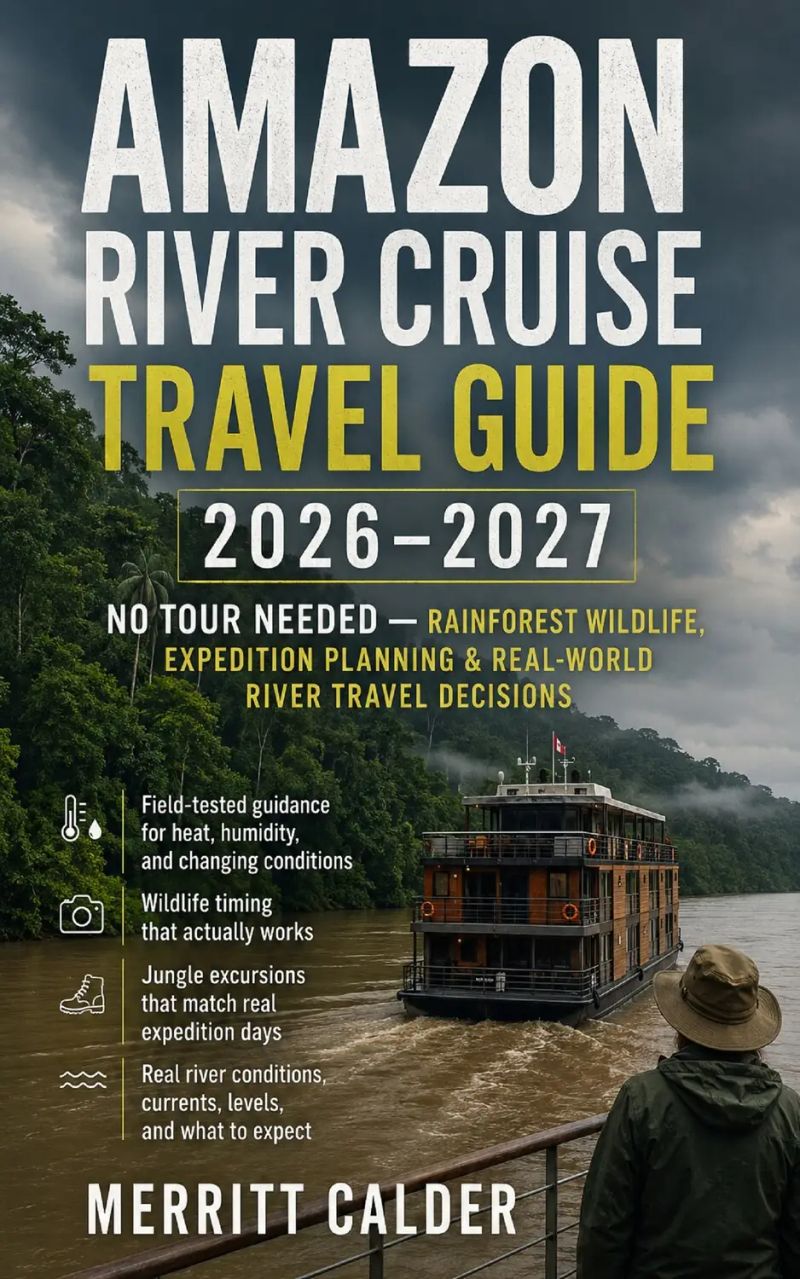
Amazon River Cruise Travel Guide 2026–2027
NO TOUR NEEDED — Rainforest Wildlife, Expedition Planning & Real-World River Travel DecisionsBy Merritt Calder


Length3h 46m
About this audiobook
You don’t really “arrive” in the Amazon—you adjust to it.
Most travelers step onto a river cruise expecting a structured sightseeing experience. What they often find instead is a slower, hotter, and more variable environment where timing, weather, and energy levels shape almost every decision.
The problem most travelers don’t see in advance
The Amazon is not difficult because it is inaccessible—it is difficult because it is unpredictable in small but constant ways.
Heat builds faster than expected. Excursions feel more physically demanding than they appear on paper. Wildlife sightings are inconsistent rather than scheduled. Rain can shift plans without warning. Even simple decisions—what to do in the afternoon, how long to stay on deck, whether to join a landing—carry more weight than expected.
At the same time, connectivity is limited, communication is intermittent, and planning must often be done without real-time confirmation. Many travelers realize only after arrival that their usual travel assumptions—fixed schedules, reliable signal, predictable comfort—do not fully apply here.
What this guide provides
This book is written as a field-based decision guide built around real river conditions, not abstract travel summaries. It focuses on how the Amazon actually behaves day-to-day and how travelers can make clearer decisions within it.
It helps you understand:
How excursions actually feel under heat, humidity, and physical fatigue
What wildlife experiences are realistic versus commonly overestimated
How river conditions, weather, and timing affect daily planning
How to manage energy across long, heat-intensive travel days
Rather than listing attractions, it explains how to choose between them under real constraints.
What you gain from using this guide
Clear expectations for what Amazon river cruising is like in practice, not in theory
A practical framework for deciding which excursions are worth your time and energy
Better understanding of pacing, rest, and heat management across multi-day travel
More confident decision-making in situations where schedules and conditions change
A grounded way to approach the journey
This is not a guide about doing everything. It is about understanding what matters most in a limited window of time, and what can be skipped without regret.
The goal is simple: to help you move through the Amazon with fewer surprises, clearer judgment, and a more realistic sense of how each day actually unfolds on the river.
Audiobook details
GenreTravel
Length3 hrs 46 mins
Narrated byListen with 1,000+ voices
FormateBook with Audio
Publish dateJul 14, 2026
LanguageEnglish
Table of contents
1Introduction
2The River That Refuses to Be a Route
3The Moment You Stop “Planning” and Start Adapting
4The First Wrong Assumption: Distance Means Time
5What the Air Feels Like Before You Understand the River
Show all chaptersShow less
6The First Correction: Wildlife Is Not Scheduled
7The River as a Daily Decision System
8Why Small Boats Matter More Than the Cruise Vessel
9The Hidden Constraint: Energy, Not Time
10What the River Takes Away Before It Gives Anything Back
11The Misread Signal of “Nothing Happening”
12If I Had Understood This Before Boarding
13The Real Beginning of the Amazon Experience
14The First Breath Outside the Airport Feels Like Contact, Not Air
15Where the Airport Road Becomes the City Without Warning
16The Misjudgment of the First 12 Hours
17The Port District: Where the River Presence Finally Becomes Visible
18The First Negotiation: Transport, Timing, and Small Uncertainty
19A Small Interaction That Reveals a Larger Pattern
20What the Heat Actually Does to Decision-Making
21The Moment Before Boarding: Stillness With Pressure
22The First Misunderstanding That Follows You Onto the Ship
23What I Would Do Differently Returning Through Manaus
24The Real Lesson of Manaus Arrival
25Where the River Stops Being a View and Becomes a Structure You Live Inside
26The First Correction: This Is Not a Cruise Ship Experience
27Cabin Entry: The First Honest Moment of the Journey
28The Onboarding Rhythm: Quiet Efficiency Instead of Ceremony
29First Cabin Reality: Space, Humidity, and Immediate Adaptation
30The Deck Transition: First Real Contact With the River System
31The First Movement: Departure Without Announcement
32The Early Onboard Pattern: Observation Without Structure
33The First Real Misunderstanding of River Cruising
34A Small Interaction That Reveals the System’s Logic
35What I Would Adjust If Boarding Again
36The Real Beginning of Onboard Life
37The Harbor Doesn’t End — It Simply Stops Behaving Like a City
38When the Water Stops Acting Like a Surface
39The First Hour of Movement: A Quiet Recalibration
40Time Starts to Lose Its Edges Before You Realize It
41Shoreline Behavior: Why Distance Becomes Deceptive
42The First Behavioral Shift on Deck
43The Moment the River Stops Feeling “Outside”
44A Small Exchange That Revealed a Larger Adjustment
45What I Would Have Done Differently in These First Hours
46When the River Becomes the Only Reference Point
47When “Inside” Stops Meaning Shelter and Becomes a Controlled Climate
48The First Misjudgment: Thinking Air Conditioning Solves the Problem
49Airflow as a Constant Negotiation
50Clothing Strategy Stops Being About Style Immediately
More from Merritt Calder

A Cook's TourAnthony Bourdain5h 50m4.2 (38.2K)$28 · $0.00

Little PrincesConor Grennan9h 38m4.3 (27.6K)$29 · $0.00

We are Soldiers StillHarold G. Moore, Joseph L. Galloway7h 46m4.4 (2.4K)$26 · $0.00

The Road to San DonatoRobert Cocuzzo7h 29m4.4 (397)$17 · $0.00

Around the World in 60 SecondsNuseir Yassin7h 48m4.4 (836)$26 · $0.00

The Midwest Survival GuideCharlie Berens6h 6m4.3 (4.9K)$24 · $0.00

The Home of the Blizzard (Annotated)Sir Douglas Mawson19h 2m4.3 (1.3K)$2 · $0.00
Local WondersTed Kooser6h 21m4.4 (978)$14 · $0.00

Over the Edge of the WorldLaurence Bergreen6h 14m4.3 (23.2K)$24 · $0.00

What Really Happened In WuhanSharri Markson16h 28m4.3 (4.8K)$40 · $0.00
American RambleNeil King10h 58m4.3 (2.8K)$29 · $0.00

Seven Pillars of Wisdom (Unabridged Edition)T. E. Lawrence27h 31m4.3 (32.4K)$5.70 · $0.00
In The Footsteps Of RamaVikrant Pande, Neelesh Kulkarni9h 45m4.3 (778)$16 · $0.00

Never Leave the Dogs BehindBrianna Madia5h 37m4.2 (7.8K)$24 · $0.00

Touch the Top of the WorldErik Weihenmayer11h 18m4.3 (2.9K)$20 · $0.00

Mud, Sweat, and TearsBear Grylls9h 25m4.2 (20K)$29 · $0.00
NorthboundNaomi Arnold7h 21m4.3 (669)$24 · $0.00

China RoadRob Gifford10h 35m4.2 (4.7K)$20 · $0.00

Love, AfricaJeffrey Gettleman11h 55m4.2 (3.1K)$29 · $0.00
Pasta, Pane, VinoMatt Goulding9h 9m4.3 (985)$29 · $0.00
You may also like
Hunting with the Bow & ArrowSaxton T. Pope7h 14m4.3 (750)$1 · $0.00
The Call of the Wild + White Fang + The Son of the WolfJack London17h 23m4.3 (3K)$2 · $0.00
NorthboundNaomi Arnold7h 21m4.3 (669)$24 · $0.00
Burning DaylightJack London13h 1m3.9 (4.3K)$5 · $0.00

The Explorer's GeneAlex Hutchinson9h 26m3.9 (1.1K)$8 · $0.00

The Prairie Traveller, a Hand-book for Overland ExpeditionsRandolph Barnes Marcy, Richard Francis Burton6h 16m4.1 (446)$1 · $0.00
Woodcraft and Camping (Annotated)George Washington Sears3h 30m4.6 (1.2K)$0.99 · $0.00
The Trapper's BibleLivingston, Eustace H18h 52m4.4 (1.2K)Free

SurviveLes Stroud8h 58m4.2 (2.5K)$29 · $0.00
How to Survive Your First Trip in the WildPaul Magnanti2h 51m4.3 (602)$15 · $0.00
WoodcraftNessmuk3h 29m4.2 (1.6K)$6 · $0.00
Robinson Crusoe (Annotated)Daniel Defoe22h 59m3.9 (2.4K)$1.99 · $0.00

SapiensYuval Noah Harari15h 18m4.3 (1.4M) · 1267$33 · $0.00

The Descent of Man, and Selection in Relation to SexCharles Darwin28h 1m4.1 (6.4K)$1 · $0.00

Pierre and His People: Tales of the Far North. CompleteGilbert Parker7h 40m$2 · $0.00

My Crowded SolitudeJack McLaren5h 55m3.4 (49)$2 · $0.00

Isle Royale National ParkOrion C. Valemont2h 22m$2.30 · $0.00

Nile River Cruise Egypt Travel Guide 2026–2027Merritt Calder3h 45m$1.20 · $0.00

Joshua Tree National ParkOrion C. Valemont2h 26m$2.30 · $0.00

Wild Sports in the Far West (Annotated)Friedrich Gerstäcker11h 19m$2 · $0.00