
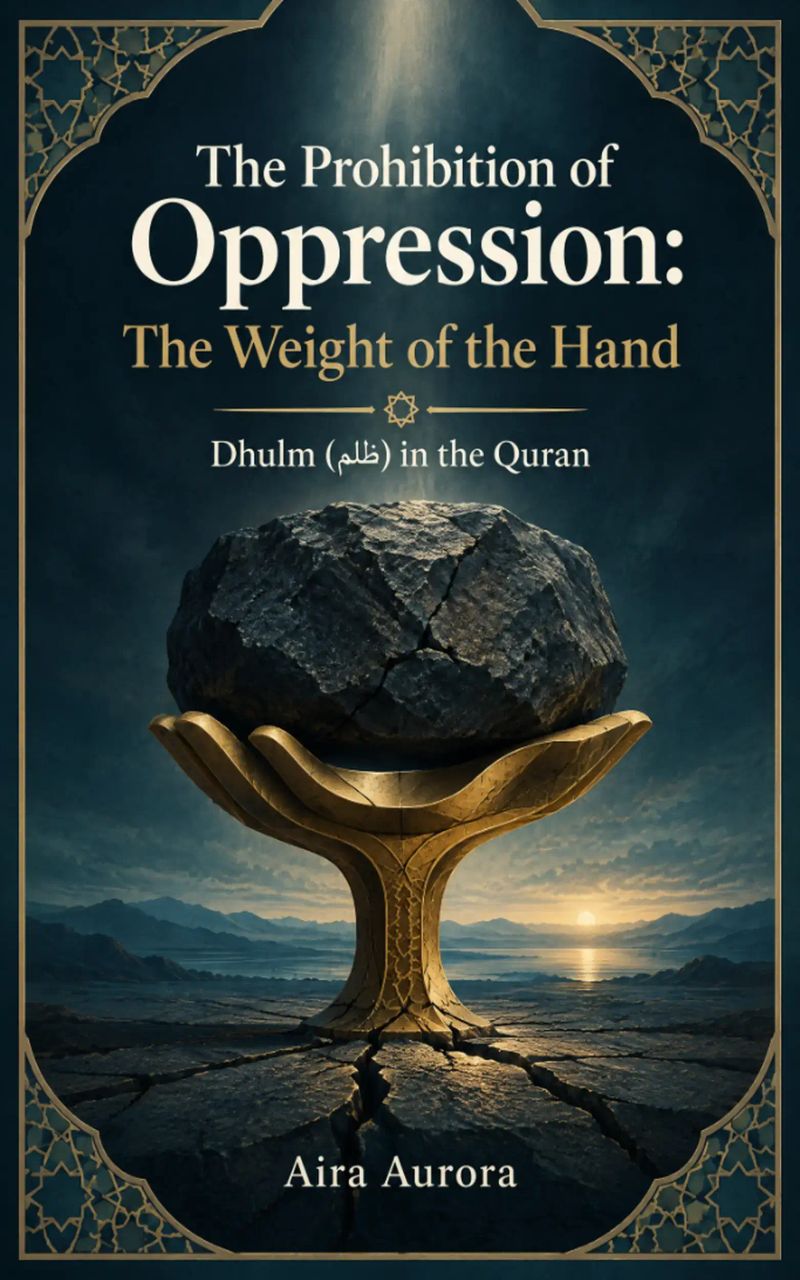
The Prohibition of Oppression: The Weight of the Hand
Dhulm (ظلم) in the QuranDe Aira Aurora


Duração1h 24m
Sobre este audiolivro
The Quran's prohibition of oppression is one of the most emphatic and wide-ranging commands in the entire text. The word *dhulm* — oppression, injustice, wrongdoing — appears in hundreds of verses, in dozens of forms, across every dimension of human life. The Quran prohibits the oppression of others, the oppression of the self, and the acceptance of oppression. It describes the consequence of oppression in the most severe terms: "And the Day the wrongdoer will bite on his hands, saying: O would that I had taken with the Messenger a way" (25:27). The image — the wrongdoer biting their own hands in regret — is the image of the person who, on the Day of Judgment, realizes the weight of what they did and the impossibility of undoing it.
Detalhes do audiolivro
GêneroSpirituality and Religion
Duração1 h 24 min
Narrado porOuça com mais de 1.000 vozes
FormatoeBook com áudio
Data de publicação17 de set. de 2026
IdiomaInglês
Sumário
1Title Page
2Introduction: The Darkness on the Day
3Chapter 1: The Prohibition — What Allah Forbids
4Chapter 2: The Foundation — Allah as the Just
5Chapter 3: The Nature of Oppression — The Misuse of Power
Mostrar todos os capítulosVer menos
6Chapter 4: The Oppressor and the Oppressed — The Two Sides
7Chapter 5: The Prophets and Justice — Models of Liberation
8Chapter 6: The Tyrants — The Models of Oppression
9Chapter 7: The Social Face of Oppression — The Systems of Injustice
10Chapter 8: The Prohibition — The Scope of the Forbidden
11Chapter 9: The Reward — The Justice of the Pure
12Chapter 10: The Avenger and the Pardoner — 42:39-43's Balance
13Chapter 11: The Wronged One's Voice — 4:148 and 3:186's Patience Doctrine
14Chapter 12: The Threatened Messenger — 14:13-14's Succession-Promise
15Disclaimer
16Frequently Asked Questions
17Glossary
18About the Author
19Series Info
Séries


Ruqyah: The Recited CureAira Aurora1h 21min$2.99

Money Lenders and Loan Sharks: The Predatory File in the BookAira Aurora1h 58min$2.99

Across Traditions: Quranic Prophets in Judaism and ChristianityAira Aurora1h 33min$2.99

The Unnamed Messengers: Prophets Beyond the Twenty-FiveAira Aurora1h 33min$2.99

Muhammad: The Final Messenger and the Seal of the ProphetsAira Aurora1h 31min$2.99

Al-Kawthar: The Abundance and the RiverAira Aurora1h 23min$2.99

Isa: The Messiah, the Miracles, and the Word from AllahAira Aurora1h 27min$2.99

Al-A'raf: The Heights Between Paradise and HellAira Aurora1h 22min$2.99

Yahya: The Forerunner and the Prophet of PurityAira Aurora1h 30min$2.99

Intercession: Shafa'ahAira Aurora1h 22min$2.99

Zakariya: The Father in Old Age and the Gift of YahyaAira Aurora1h 28min$2.99

The Scale and the Bridge: Al-Mizan wa As-SiratAira Aurora1h 16min$2.99

Yunus: The Reluctant Messenger and the WhaleAira Aurora1h 29min$2.99

Loans, Transfers, and Credit Cards: The Modern Debt-File in the BookAira Aurora1h 50min$2.99

The Judgment: Al-HisabAira Aurora1h 19min$2.99

Alyasa: The Inheritor of the Prophetic MissionAira Aurora1h 33min$2.99

The Six Pillars of Faith in the QuranAira Aurora1h 22min$2.99

Marital Intimacy: The Approach-File in the BookAira Aurora1h 41min$2.99

Prohibition of Gambling: The Maysir-File in the BookAira Aurora2h$2.99

Tabuk: The Last MarchAira Aurora1h 25min$2.99

Prayers from the Throne RoomBrian Simmons8h 55min4.9 (256)$10 · $0.00

31 Decrees of Blessing for Your LifePatricia King2h 38min4.8 (1.4K)$10 · $0.00

Running to the FireKen Isaacs9h 47min4.9 (252)$20 · $0.00

Loved BabySarah Philpott4h 51min4.8 (1.4K)$10 · $0.00

The QuranAllah23h 7min4.7 (136.1K)$1 · $0.00

The Secret of the RosaryLouis de Montfort6h 1min4.7 (16K)$2 · $0.00

The Holy Qur-an: Text, Translation and CommentaryAbdullah Yusuf Ali22h 16min4.7 (133K)$1 · $0.00

All of Grace (Annotated)Charles Spurgeon5h 1min4.7 (1.3K)$1.99 · $0.00

Steps to ChristEllen G. White3h 12min4.7 (13.8K)$2 · $0.00

The Doctrine and Selected CovenantsJoseph Smith13h 53min4.7 (10.4K)$1.99 · $0.00

BelovedFrancis Chan4h 59min4.7 (2K)$17 · $0.00

Sinners in the Hands of an Angry God & Other Sermons (Annotated)Jonathan Edwards7h 51min4.7 (1.5K)$2 · $0.00

Swayam Ki AwaazPrem Rawat8h 34min4.7 (1.1K)$26 · $0.00

Behind the BadgeAdam Davis10h 18min4.7 (2.7K)$10 · $0.00

The New Human Revolution, vol. 1Daisaku Ikeda7h 46min4.7 (669)$12 · $0.00

You Are Worth ItKyle Carpenter, Don Yaeger8h 53min4.7 (4.8K)$29 · $0.00

Praying GraceDavid A. Holland3h 2min4.7 (658)$10 · $0.00

Evidence Not SeenDarlene Deibler Rose11h 11min4.6 (11.9K)$29 · $0.00

The Christ KeyChad Bird, Chad Bird7h 33min4.7 (592)$17.40 · $0.00

He and IGabrielle Bossis10h 12min4.7 (554)$17 · $0.00
Você também pode gostar

The Smalcald ArticlesMartin Luther2h 33min4.4 (314)$2 · $0.00
The ApologyXenophon1h 44min4.2 (571)$2 · $0.00

The Ninety-five ThesesMartin Luther3h 10min4.1 (4.3K)$1 · $0.00

The War on MenOwen Strachan7h 22min4.4 (416)$17

A Treatise on Christian Liberty (Annotated)Martin Luther4h 19min4.3 (3.8K)$1.99 · $0.00

ApologyPlato1h 16min4.3 (125.2K)$10 · $0.00

Murder in the CathedralT. S. Eliot3h 4min4.0 (18.5K)$1 · $0.00
The Apology of SocratesPlato1h 37min4.3 (74.1K)$2 · $0.00

Commentary on the Epistle to the GalatiansMartin Luther8h 45min4.5 (2.9K)Grátis

Contending for Our AllJohn Piper4h 8min4.3 (1.7K)$20

The Kingdom of God is Within YouLeo Tolstoy13h 32min4.3 (8.2K)$16 · $0.00

EuthyphroPlato1h 1min4.1 (17.3K)$2.30

The ApologyPlato1h 7min4.3 (78.2K)$21 · $0.00

Bethink Yourselves!Leo Tolstoy1h 41min4.1 (349)$6 · $0.00

MARTIN LUTHER Premium Collection: Theological Works, Sermons & HymnsMartin Luther126h 42min4.6 (25)$1 · $0.00

The Ultimate Luther CollectionMartin Luther126h 57min4.6 (63)$1 · $0.00

The Life and Legacy of SocratesXenophon17h 3min4.0 (26)$1.99 · $0.00

The Reforming Treatises of Martin Luther (Annotated)Martin Luther12h 34min4.3 (18)$2 · $0.00

Prelude on the Babylonian Captivity of the ChurchMartin Luther4h 44min4.1 (242)$1 · $0.00

The Bible Against SlaveryTheodore Dwight Weld4h 5min4.3 (78)$1 · $0.00