
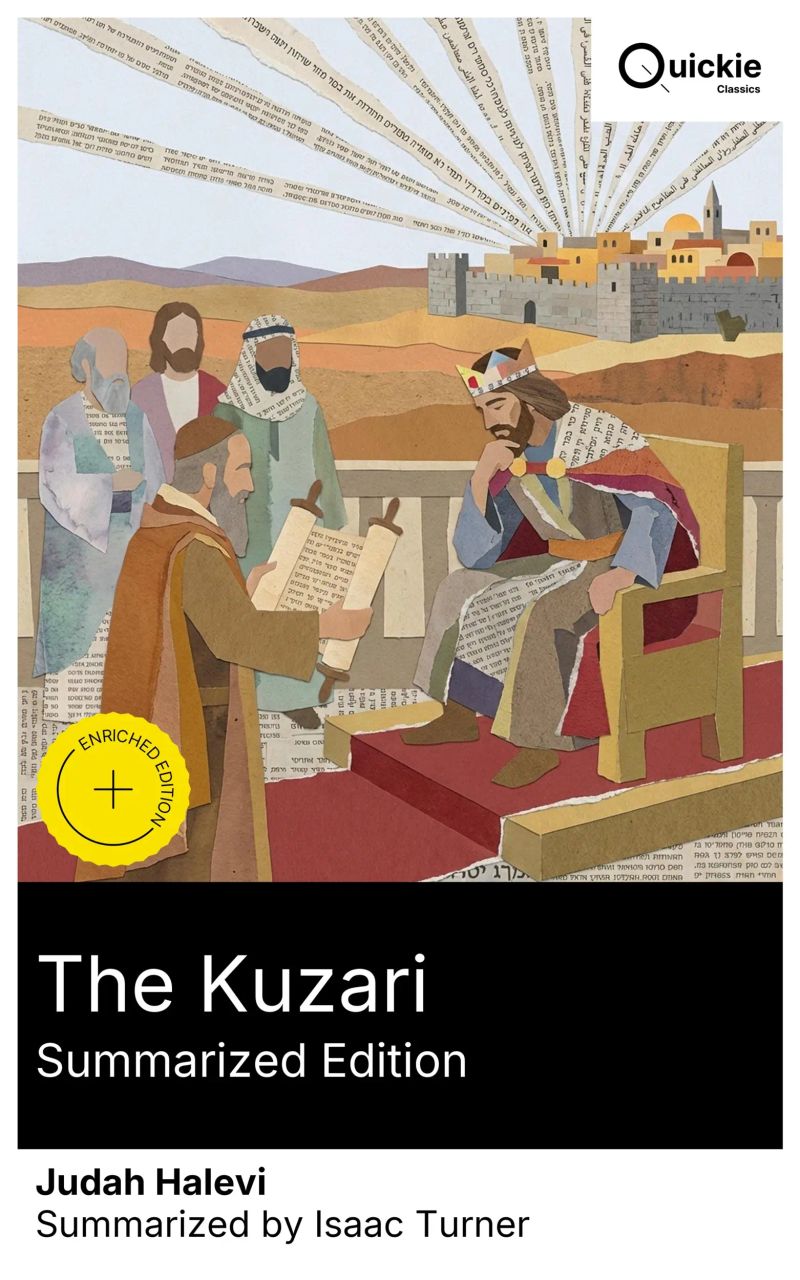
The Kuzari (Summarized Edition)
Enriched edition. A medieval Jewish dialogue where Sinai's revelation outruns reason, guiding the Khazar king and the embodied bond of people, land, and God.De Judah Halevi

Duração3h 22m
Sobre este audiolivro
The Kuzari is a philosophical dialogue in which the Khazar king questions a philosopher, a Christian, a Muslim, and finally a rabbi, seeking a faith to live, not merely contemplate. Halevi critiques Aristotelian and kalām reason, privileging Sinai's public revelation, embodied mitzvot, Hebrew, and the bond of people, land, and God. Written in Judeo‑Arabic and framed by the Khazar conversion legend, its supple, courtly prose carries liturgical cadences, situating the work within, yet against, the rationalist current of Andalusian letters. Judah Halevi (c. 1075–1141), famed Hebrew poet of al‑Andalus and a physician, inhabited a cosmopolitan court yet yearned for Zion, a longing he pursued in his late pilgrimage. His devotional poetics, exposure to Islamic and Christian polemics, and skepticism toward abstract system-building shaped this defense of Judaism as lived, historical encounter. Readers of philosophy of religion, Jewish thought, and interfaith studies will value its clarity and provocation; students will find it accessible in dialogic form; scholars will appreciate its polemical precision and historical depth; and seekers may discover a moving argument for sanctified practice grounded in communal memory.
Quickie Classics summarizes timeless works with precision, preserving the author's voice and keeping the prose clear, fast, and readable—distilled, never diluted. Enriched Edition extras: Introduction · Synopsis · Historical Context · Author Biography · Brief Analysis · 4 Reflection Q&As · Editorial Footnotes.
Detalhes do audiolivro
GêneroSpirituality and Religion
Duração3 h 22 min
Narrado porOuça com mais de 1.000 vozes
FormatoeBook com áudio
Data de publicação10 de jan. de 2026
IdiomaInglês
Sumário
1Introduction
6The Kuzari (pt. 1)
2Introduction
7The Kuzari (pt. 2)
3Synopsis
8Analysis
4Historical Context
9Reflection
5Author Biography
Mais de Judah Halevi

I Hear His Whisper 365 Daily Devotions (Gift Edition)Brian Simmons, Gretchen Rodriguez9h 23min4.8 (2K)$10 · $0.00

A Little God Time for Women Morning & Evening DevotionalBroadStreet Publishing Group LLC15h 15min4.9 (1.2K)$10 · $0.00

The Chosen Presents: A Blended Harmony of the GospelsSteve Laube, Amanda Jenkins, Dallas Jenkins7h 8min4.9 (823)$10 · $0.00

Prayers from the Throne RoomBrian Simmons8h 55min4.9 (256)$10 · $0.00

31 Decrees of Blessing for Your LifePatricia King2h 38min4.8 (1.4K)$10 · $0.00

Running to the FireKen Isaacs9h 47min4.9 (252)$20 · $0.00

Loved BabySarah Philpott4h 51min4.8 (1.4K)$10 · $0.00

The QuranAllah23h 7min4.7 (136.1K)$1 · $0.00

The Secret of the RosaryLouis de Montfort6h 1min4.7 (16K)$2 · $0.00

The Holy Qur-an: Text, Translation and CommentaryAbdullah Yusuf Ali22h 16min4.7 (133K)$1 · $0.00

All of Grace (Annotated)Charles Spurgeon5h 1min4.7 (1.3K)$1.99 · $0.00

Steps to ChristEllen G. White3h 12min4.7 (13.8K)$2 · $0.00

The Doctrine and Selected CovenantsJoseph Smith13h 53min4.7 (10.4K)$1.99 · $0.00

BelovedFrancis Chan4h 59min4.7 (2K)$17 · $0.00

Sinners in the Hands of an Angry God & Other Sermons (Annotated)Jonathan Edwards7h 51min4.7 (1.5K)$2 · $0.00

Swayam Ki AwaazPrem Rawat8h 34min4.7 (1.1K)$26 · $0.00

Behind the BadgeAdam Davis10h 18min4.7 (2.7K)$10 · $0.00

The New Human Revolution, vol. 1Daisaku Ikeda7h 46min4.7 (669)$12 · $0.00

You Are Worth ItKyle Carpenter, Don Yaeger8h 53min4.7 (4.8K)$29 · $0.00

Praying GraceDavid A. Holland3h 2min4.7 (658)$10 · $0.00
Você também pode gostar

The Kuzari (Kitab al Khazari)Judah Halevi9h 54min4.3 (547)$1.99 · $0.00

The Kuzari (Annotated)Judah Halevi10h 1min4.4 (516)$2 · $0.00

The Christ KeyChad Bird, Chad Bird7h 33min4.7 (592)$17.40 · $0.00

The Person and Work of the Holy Spirit (Summarized Edition)R. A. Torrey3h 5min4.5 (2.5K)$2

The God Who Is ThereD. A. Carson10h 2min4.4 (2.9K)$17

An Essay on the Development of Christian DoctrineJohn Henry Newman15h 2min4.4 (672)$2 · $0.00

The Sovereignty of God (Annotated)Arthur Pink10h 17min4.5 (8.8K)$2 · $0.00
American Gods: The Tenth Anniversary EditionNeil Gaiman19h 40min4.2 (1M)$40 · $0.00

Jesus on TrialLimbaugh, David15h 53min4.3 (3.7K)Grátis

Pascal's PenséesBlaise Pascal12h 15min4.2 (19.2K)$2 · $0.00

The Aquarian Gospel of Jesus ChristLevi H. Dowling14h 30min4.3 (1.8K)$2 · $0.00

Leap Over a WallEugene H. Peterson8h 23min4.4 (2K)$26 · $0.00

On Christian DoctrineSaint Augustine9h 8min4.2 (6.3K)$2 · $0.00
Searching the ScripturesCharles R. Swindoll7h 27min4.6 (744)$20

Rays of Living Light on the One Way of SalvationCharles W. Penrose3h 21min3.9 (14)$2 · $0.00

Divine DestinyScott Hogle5h 4min5.0 (101)$20

HebrewsJohn Warwick Montgomery10h 38min$29 · $0.00

The Goal of LifeHiram E. Butler9h 14min$21 · $0.00

The Gospel of Matthew: NASB 2020New American Standard Bible2h 32min4.8 (14)$15

The Expositor's Bible: The Book of Proverbs (Annotated)Robert F. Horton12h 39min4.1 (17)$2 · $0.00