
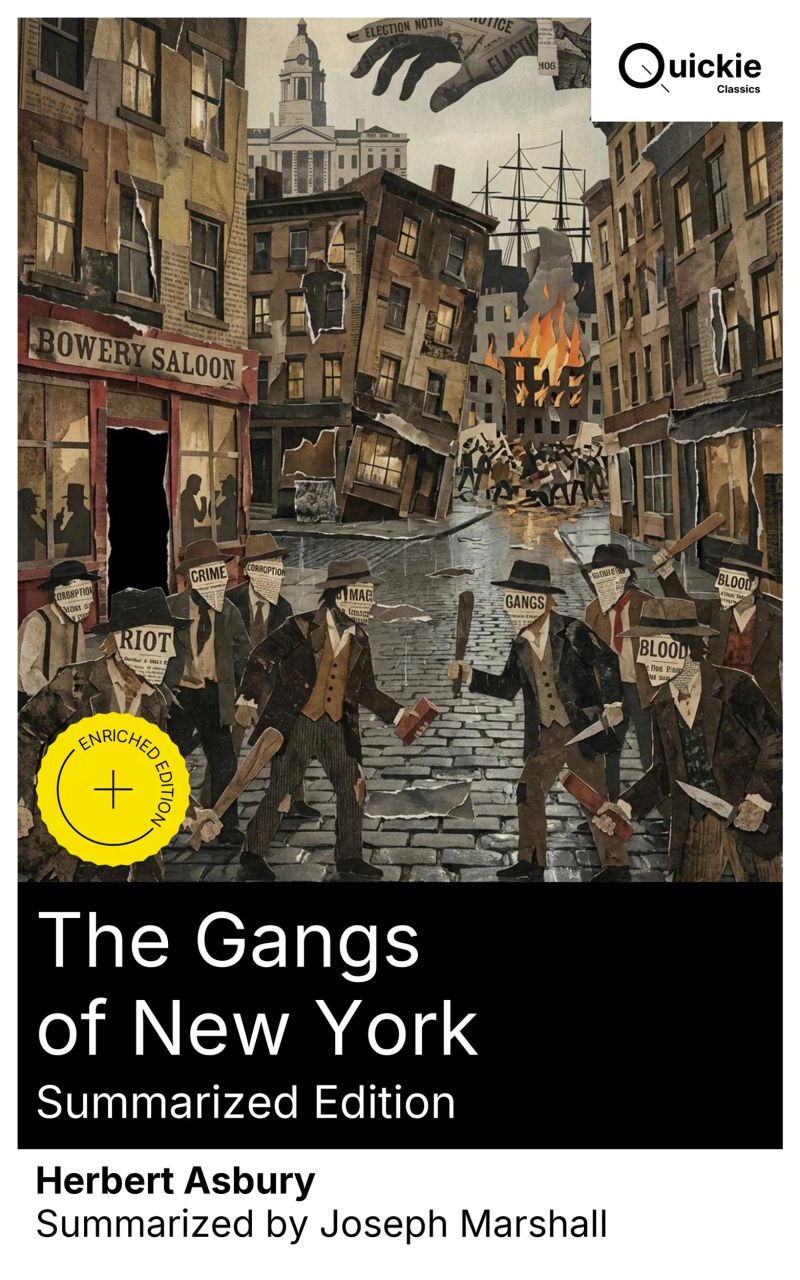
The Gangs of New York (Summarized Edition)
Enriched edition. An informal history of 19th‑century New York City's underworld: Bowery saloons, violent gangs, Tammany Hall, and corrupt politicsDe Herbert Asbury


Duração3h 5m
Sobre este audiolivro
The Gangs of New York charts nineteenth‑century Manhattan's underworld, from Five Points to the Bowery, profiling the Dead Rabbits, Plug Uglies, river pirates, and ward heelers in the orbit of Tammany Hall. Episodic and vivid, it braids court reports and newspaper lore into a picaresque history that peaks with the 1863 Draft Riots. Asbury's tabloid‑tinted yet controlled prose situates the book between dime‑novel swagger and emerging social history. Missouri‑born and long a New York reporter, Herbert Asbury mined police reminiscences, broadsides, and morgue files, privileging atmosphere over footnotes. Writing amid Jazz Age nostalgia for a rougher city, he sought to preserve the folklore of crime and politics before it vanished. His wider portraits of vice districts nationwide confirm a preoccupation with the junction of poverty, spectacle, and power. Recommend it to readers of urban history and true crime who relish narrative drive informed by research. Best read alongside modern scholarship for verification, the book remains unsurpassed for texture, incident, and civic anatomy. Students of American politics, social history, or even Scorsese's film adaptation will find Asbury's panorama unsettling, propulsive, and unexpectedly instructive.
Quickie Classics summarizes timeless works with precision, preserving the author's voice and keeping the prose clear, fast, and readable—distilled, never diluted. Enriched Edition extras: Introduction · Synopsis · Historical Context · Brief Analysis · 4 Reflection Q&As · Editorial Footnotes.
Detalhes do audiolivro
GêneroHistory
Duração3 h 5 min
Narrado porOuça com mais de 1.000 vozes
FormatoeBook com áudio
Data de publicação10 de jan. de 2026
IdiomaInglês
Sumário
1Introduction
5The Gangs of New York
2Introduction
6Analysis
3Synopsis
7Reflection
4Historical Context

A Brief History of IntelligenceMax S. Bennett12h 18min4.6 (6.6K)$29 · $0.00

Ghosts of HiroshimaCharles Pellegrino8h 59min4.5 (877)$23
Medium RawAnthony Bourdain9h4.1 (65.6K)$29 · $0.00

Suicidal EmpathyGad Saad8h 24min4.1 (736)$28 · $0.00

How Soccer Explains the WorldFranklin Foer7h 22min3.9 (14.9K)$24 · $0.00
The Assassination of Leon TrotskyH. Keith Melton, Nigel West14h 8min$33 · $0.00

All American PatriotismRachel Campos-Duffy8h 53min$29 · $0.00

History of the Decline and Fall of the Roman Empire — Volume 1Edward Gibbon20h 18min4.3 (14.6K) · 1244Grátis
Black AF HistoryMichael Harriot15h 43min4.7 (14.6K)$33 · $0.00

The Gulag Archipelago Volume 3Aleksandr I. Solzhenitsyn21h 56min4.7 (8.9K)$46 · $0.00
Pearl of Great PriceJoseph Smith3h 8min4.7 (7.2K)$1.20 · $0.00

The Happiest Man on EarthEddie Jaku3h 48min4.6 (178K)$7 · $0.00

MotherlandJulia Ioffe17h 52min4.7 (2.5K)$40 · $0.00

Where Cowards Go to DieBenjamin Sledge8h 42min4.7 (351)$20 · $0.00

RevolutionariesSanjeev Sanyal11h 23min4.6 (2.6K)$29 · $0.00
Days of Love and Rage: A Story of RevolutionAnand Gopal22h 36min4.7 (584)$34 · $0.00

We Crossed a Bridge and It TrembledWendy Pearlman6h4.6 (5.2K)$24 · $0.00

Unbroken Bonds of BattleJohnny Joey Jones8h 31min4.6 (2.6K)$8 · $0.00

The Daughter of AuschwitzTova Friedman, Malcolm Brabant7h 54min4.6 (16.7K)$26 · $0.00

Lily's PromiseLily Ebert, Dov Forman8h 54min4.6 (16.1K)$29 · $0.00
Você também pode gostar
The War on GunsJohn R. Lott Jr.5h 7min4.1 (862)$20
The Third CoastThomas Dyja17h 45min3.8 (2K)$23
Blood DiamondsGreg Campbell7h 3min4.1 (1.9K)$17 · $0.00

The WithdrawalNoam Chomsky, Vijay Prashad4h 40min4.2 (1.4K)$15
Dangerous RhythmsT. J. English15h 9min4.2 (1.4K)$33 · $0.00

The Joy of Home DistillingMorris, Rick6h 33min4.2 (1.3K)Grátis
Empire of MudJ. D. Dickey9h 21min3.7 (1K)$20
KiloToby Muse9h 15min4.1 (2.4K)$29 · $0.00

The Indian War of 1864Eugene Fitch Ware16h 30min4.1 (819)$1 · $0.00
Killing CastroLawrence Block4h 44min3.5 (1.3K)$20
The History of Trade Unionism (Revised edition, extended to 1920)Beatrice Webb, Sidney Webb34h 31min3.7 (26)$2 · $0.00
The Rise of IndustryChristopher Collier, James Lincoln Collier2h 12min4.1 (63)$15
The Great Riots of New York, 1712 to 1873Joel Tyler Headley7h 53min3.7 (54)$2 · $0.00

The Enduring World of PiracySantiago Machain6h 36min$25 · $0.00
The Kosher CaponesJoe Kraus7h 7min3.8 (188)$17

The Pirate Republic of NassauSantiago Machain5h 38min$25 · $0.00

Whatever It TakesCongressman J. D. Hayworth, Joseph J. Eule6h 26min3.5 (90)$14

The United States Lacks Comprehensive Plan to Destroy the Terrorist ThreatThe U.S. Government Accountability Office49min$2 · $0.00

America's Deadliest ElectionDana Bash10h 57min3.9 (926)$28 · $0.00

Pirates of the Americas after the Golden AgeSantiago Machain4h 44min$25 · $0.00