

THE ART OF WAR & THE PRINCE
Two Machiavellian Masterpieces in one eBookBy Niccolò Machiavelli


Length7h 9m
About this audiobook
Niccolò Machiavelli's 'The Art of War' and 'The Prince' are seminal works that provide valuable insights into politics, power, and leadership. 'The Art of War' is a treatise on military strategy, offering practical advice on tactics and maneuvering in times of conflict. Written in a straightforward and concise style, it reflects Machiavelli's belief in the importance of pragmatism and realpolitik. 'The Prince', on the other hand, explores the nature of political power and the strategies rulers should employ to maintain and expand their authority. Both works are characterized by their ruthless pragmatism and Machiavelli's rejection of traditional moral constraints. They are essential reading for anyone interested in the dynamics of power and governance. Machiavelli, a diplomat and philosopher in Renaissance Italy, wrote these books as a response to the turbulent political climate of his time. His experiences in political office and observation of powerful figures inspired him to analyze the nature of power and provide practical guidance for rulers. Machiavelli's works continue to be relevant today, offering timeless wisdom on the exercise of power and the realities of politics. Readers looking to deepen their understanding of political theory and strategy will find 'The Art of War' and 'The Prince' both enlightening and thought-provoking.
Audiobook details
Rating★★★★ 4.0 (1.8K)
Includes Goodreads, LibraryThing, Amazon, StoryGraph
GenrePhilosophy
Length7 hrs 9 mins
Narrated byListen with 1,000+ voices
FormateBook with Audio
Publish dateOct 6, 2017
LanguageEnglish
Table of contents
1Meditations of Marcus Aurelius
2The Prince
3Dedication: To the Magnificent Lorenzo Di Piero De’ Medici
4Chapter 1 - Of the Various Kinds of Princedom, and of the Ways in Which They Are Acquired
5Chapter 2 - Of Hereditary Princedoms
Mostrar todos os capítulosVer menos
6Chapter 3 - Of Mixed Princedoms
7Chapter 4 - Why the Kingdom of Darius, Conquered by Alexander, Did Not, on Alexander’s Death, Rebel Against His Successors
8Chapter 5 - How Cities or Provinces Which Before Their Acquisition Have Lived Under Their Own Laws Are To Be Governed
9Chapter 6 - Of New Princedoms Which a Prince Acquires With His Own Arms and by Merit
10Chapter 7 - Of New Princedoms Acquired By the Aid of Others and By Good Fortune
11Chapter 8 - Of Those Who By Their Crimes Come to Be Princes
12Chapter 9 - Of the Civil Princedom
13Chapter 10 - How the Strength of All Princedoms Should Be Measured
14Chapter 11 - Of Ecclesiastical Princedoms
15Chapter 12 - How Many Different Kinds of Soldiers There Are, and of Mercenaries
16Chapter 13 - Of Auxiliary, Mixed, and National Arms
17Chapter 14 - Of the Duty of a Prince In Respect of Military Affairs
18Chapter 15 - Of the Qualities In Respect of Which Men, and Most of all Princes, Are Praised or Blamed
19Chapter 16 - Of Liberality and Miserliness
20Chapter 17 - Of Cruelty and Clemency, and Whether It Is Better To Be Loved or Feared
21Chapter 18 - How Princes Should Keep Faith
22Chapter 19 - That a Prince Should Seek to Escape Contempt and Hatred
23Chapter 20 - Whether Fortresses, and Certain Other Expedients to Which Princes Often Have Recourse, are Profitable or Hurtful
24Chapter 21 - How a Prince Should Bear Himself So As to Acquire Reputation
25Chapter 22 - Of the Secretaries of Princes
26Chapter 23 - That Flatterers Should Be Shunned
27Chapter 24 - Why the Princes of Italy Have Lost Their States
28Chapter 25 - What Fortune Can Effect in Human Affairs, and How She May Be Withstood
29Chapter 26 - An Exhortation to Liberate Italy from the Barbarians
30PREFACE
31Book 1
32Book 2
33Book 3
34Book 4
35Book 5
36Book 6
37Book 7

Das Buch der hundert altitalienischen NovellenNiccolò Machiavelli, Pietro Fortini, Carlo Graf Gozzi, Eustachio Manfredi, Baldassare Castiglione, Francesco Molza, Liberale Motense, Ser Giovanni Fiorentino, Luigi da Porto49h 26m$1 · $0.00

Mensch und StaatNiccolò Machiavelli3h 10m4.3 (29)$1 · $0.00

Gesammelte Werke von Niccolò MachiavelliNiccolò Machiavelli39h 38m4.4 (124)$2 · $0.00

Machiavelli: The PrinceNiccolò Machiavelli5h 13m4.1 (730.3K)$1.99 · $0.00

THE STRATEGY: The Art of War & The Prince (2 Classics in One Edition)Niccolò Machiavelli7h 7m4.3 (123)$1.99 · $0.00
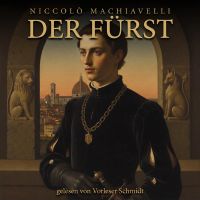
Der FürstNiccolò Machiavelli3h 57m4.0 (429K)$9 · $0.00

Die Kunst der Staatsführung: Regieren mit WeisheitNiccolò Machiavelli, Platon, Marcus Aurelius, Marcus Tullius Cicero, Carl von Clausewitz, Friedrich der Große, Benjamin Franklin, Otto von Bismarck, Friedrich Christoph Dahlmann, Karel Čapek, Hans Delbrück238h 47m$1 · $0.00
RuhtinasNiccolò Machiavelli4h 4m4.0 (17.2K)$1.99 · $0.00

Philosophie der RenaissanceNiccolò Machiavelli, Michel de Montaigne, Erasmus von Rotterdam, Thomas Morus, Francis Bacon, Tommaso Campanella, Martin Luther, Ludwig Kuhlenbeck66h 17m$1.50 · $0.00

Das Buch der hundert altitalienischen NovellenNiccolò Machiavelli, Pietro Fortini, Carlo Graf Gozzi, Eustachio Manfredi, Baldassare Castiglione, Francesco Molza, Liberale Motense, Ser Giovanni Fiorentino, Luigi da Porto49h 28m$1 · $0.00

Essenzielle Klassiker der politischen PhilosophieNiccolò Machiavelli, Montesquieu, Friedrich der Große, Platon, Aristoteles, Marcus Tullius Cicero, Tommaso Campanella, Thomas Morus, Samuel von Pufendorf, Abbé Castel de Saint-Pierre, Jean Jacques Rousseau, Immanuel Kant, Johann Gottlieb Fichte, Karl Marx, Friedrich Engels, Wilhelm von Humboldt, Friedrich Christoph Dahlmann, Franz Mehring, Johann Most, John Henry Mackay, Rosa Luxemburg, Erich Mühsam393h 52m$1 · $0.00

Die Discorsi (Deutsche Ausgabe) (Kommentiert)Niccolò Machiavelli17h 53m$1 · $0.00

Der Fürst (Il Principe) (Kommentiert)Niccolò Machiavelli7h 3m4.0 (76.6K)$1 · $0.00

Mensch und Staat (Kommentiert)Niccolò Machiavelli3h 18m4.3 (121)$1 · $0.00

Gesammelte Werke: Der Fürst + Die Discorsi + Mensch und Staat + Geschichte von Florenz (Kommentiert)Niccolò Machiavelli39h 44m4.4 (11)$2 · $0.00

Geschichte von Florenz (Kommentiert)Niccolò Machiavelli19h 51m3.8 (508)$1 · $0.00
Discourses on Livy (Annotated)Niccolò Machiavelli16h 35m4.1 (10.2K)$2 · $0.00

The Prince + The Art of War (2 Unabridged Machiavellian Masterpieces)Niccolò Machiavelli7h 51m$1 · $0.00
Discourses on the First Decade of Titus LiviusNiccolò Machiavelli15h 3m4.2 (11.3K)$2 · $0.00

WitnessAriel Burger8h 1m4.6 (1.3K)$20 · $0.00

The Magic PresenceGodfré Ray King10h 21m4.6 (307)$1.20 · $0.00

The Art of LivingThich Nhat Hanh5h 1m4.5 (14.2K)$24 · $0.00
Moral Letters to LuciliusLucius Annaeus Seneca24h 26m4.5 (71.7K)$1.99 · $0.00

Lessons in TruthH. Emilie Cady3h 50m4.5 (2.4K)$20 · $0.00
The Discourses of EpictetusP. E. MATHESOM12h 47m4.4 (17.7K)$1.20 · $0.00

IlluminationsWalter Benjamin10h 12m4.4 (16.2K)$20 · $0.00

That Bird Has My WingsJarvis Jay Masters9h 49m4.4 (13.7K)$29 · $0.00

Tâo Teh KingLaozi2h 34m4.4 (230.9K)$2 · $0.00

SymposiumPlato3h 26m4.4 (97.9K)$1.20 · $0.00

Buddhist Boot CampTimber Hawkeye2h 39m4.4 (8.4K)$18 · $0.00
Enchiridion & The Discourses of Epictetus (Annotated)Arrian Epictetus18h 9m4.4 (3.5K)$2 · $0.00

The Meditations of the Emperor Marcus Aurelius AntoninusEmperor of Rome Marcus Aurelius5h 41m4.4 (1.8M)$1 · $0.00

Crime and PunishmentFyodor Dostoevsky23h 11m4.4 (1.3M)$12 · $0.00

MeditationsMarcus Aurelius5h 52m4.4 (433.7K)$1 · $0.00

Everyday DharmaSuneel Gupta5h 2m4.5 (761)$20 · $0.00

The Joyful Wisdom ("La Gaya Scienza")Friedrich Wilhelm Nietzsche11h 37m4.4 (26.6K)$1 · $0.00
The Art of LivingEpictetus, Sharon Lebell3h 16m4.4 (50.1K)$18 · $0.00
MeditationsEmperor Of Rome Marcus Aurelius7h 23m4.3 (477.5K)$1.20 · $0.00

The Imitation of ChristThomas à Kempis6h 27m4.3 (84.6K)$21 · $0.00
You may also like

Learning to Eat Soup with a KnifeJohn A. Nagl8h 46m4.1 (2.6K)$20

RevolutionariesJack N. Rakove19h 28m4.0 (1.9K)$32

Muhammad AliThomas Hauser7h 54m4.4 (4K)$20 · $0.00

Fatal DiscordMichael Massing34h 52m4.5 (1.3K)$53 · $0.00

After Virtue, Third EditionAlasdair MacIntyre14h 28m4.3 (9K)$23

Leaves of GrassWalt Whitman13h 21m4.3 (348.9K)$1.20 · $0.00

HereticAyaan Hirsi Ali8h 56m4.3 (7K)$29 · $0.00

Taming Your Gremlin (Revised Edition)Rick Carson6h 2m4.0 (3.2K)$24 · $0.00

The Collected Biographies of Eminent VictoriansLytton Strachey11h 59m4.0 (5.1K)$1.99 · $0.00

The wisdom of life (translated)Arthur Schopenhauer4h 5m4.2 (18.9K)$4.60 · $0.00

Mencius (Bilingual Edition: English/Chinese)Mencius9h 3m4.3 (11.2K)$1.99 · $0.00

Daring to Be Bad, Thirtieth Anniversary EditionAlice Echols14h 9m4.0 (308)$23 · $0.00

ElectableAli Vitali10h 8m3.9 (686)$29 · $0.00

From Sail to Steam, Recollections of Naval LifeA. T. Mahan9h 54m4.1 (14)$1 · $0.00

History of the United States: A 30-Volume AnthologyJames Ford Rhodes, D. H. Montgomery, Julius E. Olson, Edward Everett Hale, Elizabeth Hodges, Carl Lotus Becker, Azel Ames, William Bradford, Bureau of Military and Civic Achievement, Herbert Eugene Bolton, Thomas Maitland Marshall, Madison Grant, James Truslow Adams, John Fiske, Robert W. Coakley, Stetson Conn, U.S. Army Center of Military History, L. Carroll Judson, John Jay, Helen Campbell, Emory Speer, U.S. Government, James Madison, Alexander Hamilton, Samuel Bryan, Patrick Henry, Joel Tyler Headley, Theodore Roosevelt, Henry Schoolcraft, Norman B. Wood, Frederic L. Paxson, George Cary Eggleston, Wilbur Fisk Gordy, Adam Gurowski, Felix Gregory De Fontaine, Susan B. Anthony, Elizabeth Cady Stanton, Matilda Gage, Harriot Stanton Blatch, Ida H. Harper, Richard W. Stewart797h 35m$1.99

The Auburn ConferenceTom Piazza6h 25m3.8 (548)$17 · $0.00

Why We're LiberalsEric Alterman12h 34m3.7 (385)$23 · $0.00
LutherHartmann Grisar124h 10m4.3 (50)$1.99 · $0.00

Victorian England: Portrait of an AgeG. M. Young10h 9m3.6 (204)$2 · $0.00
Transforming LeadershipJames MacGregor Burns10h 31m3.5 (280)$21 · $0.00