
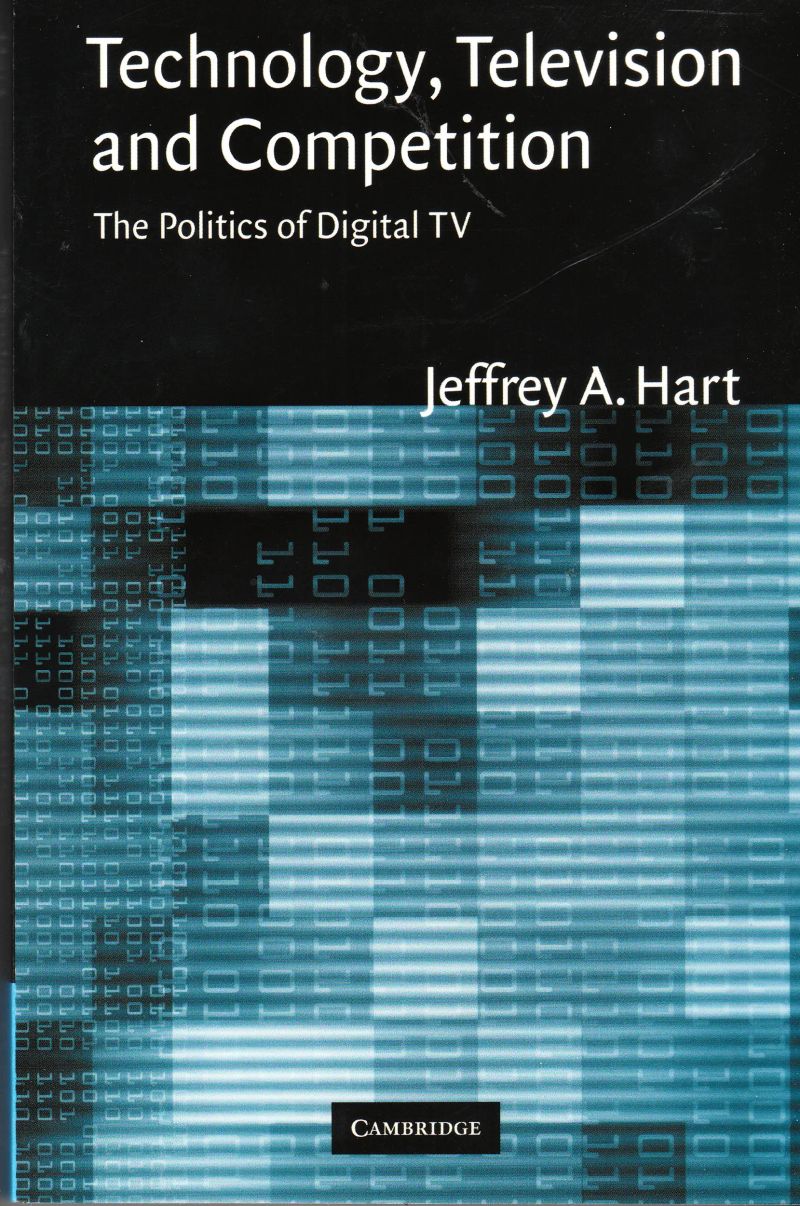
Television, Technology, and Competition: HDTV...
De Jeffrey A. Hart


Duração9h 28m
Sobre este audiolivro
High definition television (HDTV) became a contentious issue in American politics after the European Community rejected a bid in 1986 by the Japanese national broadcasting company, Nippon Hoso Kyokai (NHK), to have its HDTV production method adopted as an international standard. For some in the US, the Japanese HDTV initiative raised concerns about the need to respond more effectively to the increased competition from Japan and Western Europe. For others, HDTV was important because it might affect a wide range of industries -- broadcasting, film, video, consumer electronics, computers, and telecommunications -- and therefore needed to be considered more carefully before buying into the Japanese approach. As a result, the United States began a process to choose a standard for advanced TV that took until April 1997 to reach its conclusion. The U.S. choice of a digital television standard forced both Japan and Europe to reexamine their earlier decisions on HDTV.
Detalhes do audiolivro
GêneroBusiness and Economics
Duração9 h 28 min
Narrado porOuça com mais de 1.000 vozes
FormatoeBook com áudio
Data de publicação28 de jun. de 1998
IdiomaInglês
Mais de Jeffrey A. Hart

Responding to GlobalizationAseem Prakash and Jeffrey A. Hart12h 40min$9.99

The Politics of International Economic RelationsJoan Edelman Spiro and Jeffrey A. Hart17h 14min3.7 (87)$14.99

The Anglo-Icelandic Cod War of 1972-1973Jeffrey A. Hart2h 33min$4.99

Rival CapitalistsJeffrey A. Hart11h 35min$14.99

Interdependence in the Post-Multilateral EraJeffrey A. Hart, Hans van der Ven, and Stephen Woolcock6h 16min$9.99

The United States and the World Community in the EightiesJeffrey A. Hart, Paul Bunge, and Carol Grigsby4h 36min$9.99

Essays on the History and Politics of the InternetJeffrey A. Hart10h 48min$9.99

Never Split the DifferenceChris Voss, Tahl Raz8h 7min4.4 (277.7K)$26 · $0.00
The Intelligent Investor Rev Ed.Benjamin Graham17h 48min4.3 (191.5K)$40 · $0.00

The Hard Thing About Hard ThingsBen Horowitz7h 57min4.2 (134.3K)$26 · $0.00

Boundaries for LeadersHenry Cloud7h 36min4.3 (3.6K)$26 · $0.00

Good to GreatJim Collins9h 59min4.1 (325.2K)$29 · $0.00

The Way of ExcellenceBrad Stulberg6h 46min4.2 (1.1K)$24 · $0.00

Trillion Dollar CoachEric Schmidt, Jonathan Rosenberg, Alan Eagle5h 40min4.1 (22.2K)$24 · $0.00

Be ExceptionalJoe Navarro, Toni Sciarra Poynter9h 11min4.0 (1.3K)$29 · $0.00

The Power of the OtherHenry Cloud5h 52min4.2 (3.5K)$24 · $0.00

Level UpRob Dial7h 42min4.6 (3.3K)$26 · $0.00

Eat It!Jordan Syatt, Michael Vacanti4h 40min4.6 (1.5K)$20 · $0.00

Progress and Poverty, Volumes I and II (Annotated)Henry George19h 21min4.6 (574)$1.99 · $0.00

Not Everything Counts but Everything Matters: The powerful and inspirational new book about leadership and achieving success from the visionary multi-premiership winning Panthers coachIvan Cleary6h 1min4.6 (680)$24 · $0.00

BuildTony Fadell11h 5min4.5 (14.3K)$8 · $0.00

The Joys Of CompoundingGautam Baid17h 34min4.5 (2.5K)$18 · $0.00

Basic EconomicsThomas Sowell18h 32min4.5 (29.3K)$28 · $0.00

The Ambuja StoryNarotam Sekhsaria13h 59min4.5 (830)$33 · $0.00

The Secret Door to SuccessFlorence Scovel Shinn2h 25min4.5 (2.1K)$1.20 · $0.00

This Is Going to HurtAdam Kay5h 47min4.4 (444.7K)$24 · $0.00

Big TrustShadé Zahrai, Fayçal Sekkouah8h 36min4.6 (406)$26 · $0.00
Você também pode gostar

Some Principles of Maritime Strategy (Annotated)Julian Stafford Corbett11h 14min4.1 (385)$1.99 · $0.00

Tomcat FuryMike Guardia4h 34min4.3 (665)$15

To Govern the GlobeAlfred W. McCoy5h 4min4.4 (420)$25 · $0.00

The Influence of Sea Power Upon History, 1660-1783Alfred Thayer Mahan22h 4min4.1 (1.5K)$2.30

Disunited NationsPeter Zeihan16h 7min4.3 (5.4K)$33 · $0.00

The Art of War in the Middle Ages: Military History of Europe (378-1515) (Annotated)Charles Oman6h 12min4.1 (812)$2 · $0.00

How the States Got Their ShapesMark Stein6h 28min4.0 (14.4K)$24 · $0.00
Breakout NationsRuchir Sharma12h 21min3.9 (3.3K)$20 · $0.00

The Business of PlatformsMichael A. Cusumano, Annabelle Gawer, David B. Yoffie8h 7min4.1 (692)$26 · $0.00

Uncontrolled SpreadScott Gottlieb15h 36min4.2 (2.5K)$33 · $0.00

The History of Ancient Greece: 3rd millennium B.C. - 323 B.C.John Bagnell Bury37h 46min4.1 (1.1K)$1.99 · $0.00

Volt RushHenry Sanderson9h 24min4.2 (989)$20 · $0.00
Our Dollar, Your ProblemKenneth Rogoff12h 57min4.2 (984)$25

The Art of War in the Middle Ages (378-1515)Charles Oman6h 10min4.0 (674)$1.99 · $0.00

Cathedral, Forge, and WaterwheelFrances Gies, Joseph Gies9h 25min4.2 (2.4K)$20

The Big StickEliot A. Cohen9h 10min4.0 (657)$20 · $0.00

Fulton's "Steam Battery": Blockship and CatamaranHoward Irving Chapelle2h 25min$1 · $0.00

OpenAI's ChatGPT Search takes on GoogleMichael Spencer39min4.9 (8)Grátis

KC-390Bruno Américo Pereira, Flavio Neri Hadmann Jasper7h 47min$39 · $0.00

Canada Under British RuleJohn G. Bourinot12h 25min$1.99 · $0.00