
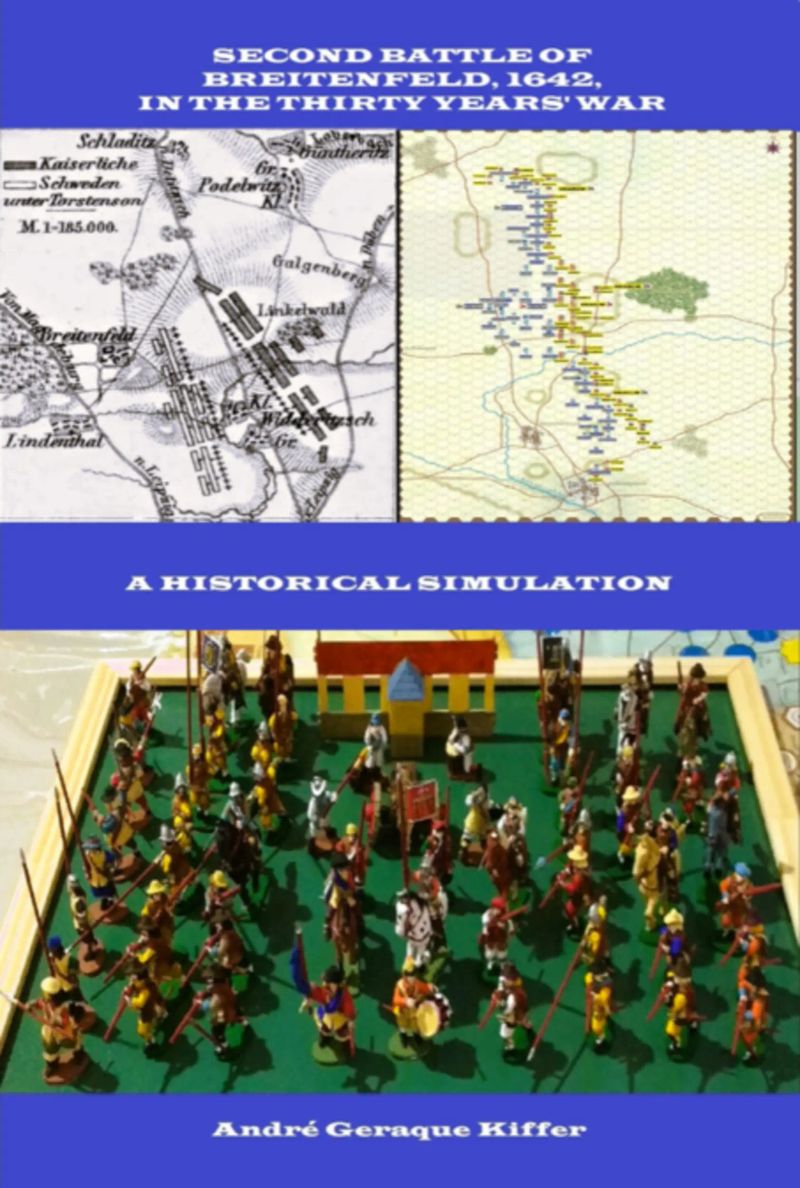
Second Battle Of Breitenfeld, 1642, In The Thirty Years' War
By André Geraque Kiffer

Length2h 19m
About this audiobook
The Thirty Years War from 1618 to 1648 is considered one of the most destructive wars in European history. It is estimated that between 4.5 and 8 million soldiers and civilians died as a direct result, while some areas of Germany suffered population declines of more than 50%, also from starvation and disease. This victory in Breitenfeld allowed the Swedes to occupy and establish a secure base in Leipzig, the second most important city in the Saxon electorate. However, although significantly weakened by defeat and forced on the defensive, the Imperial Army prevented them from fully exploiting their victory and prevented John George I, Elector of Saxony, from making peace with Sweden. In the battle simulation, I will try to correct the failures presented in the historical analysis, testing improvements in the maneuvers.
Audiobook details
GenreHistory, Other
Length2 hrs 19 mins
Narrated byListen with 1,000+ voices
FormateBook with Audio
Publish dateDec 26, 2022
LanguageEnglish
Table of contents
1ANDRÉ GERAQUE KIFFER
2PROLOGUE
3HISTORICAL FACT
4Richelieu, chief minister to King Louis XIII of
5French funding.
Mostrar todos os capítulosVer menos
6Portugal, then part of the Spanish Empire. After the
7After Bernhard died in July 1639, his German
8Lennart Torstensson in November with 7,000
9Gregorian calendar). Archduke Leopold Whilhelm of
10The rapid approach of an Imperial army under
11Im 5: Battle opening.
12HISTORICAL ANALYSIS
13Armies in the Thirty Years' War
14Im 7: Battle orders1.
15Im 8: Dutch and German infantry formations
16Independence. The German infantry battalion (or
17Im 10: Swedish cavalry formations.
18The Catholic League army and the Imperial
19Fig 13: Swedish infantry uniforms and flags2.
20greater courage in battle.
21Armor in the Thirty Years' War
22Cannons, Culverins and Falcons
23The Swedish king Gustavus Adolphus
24While the heavy variant of the arquebus
25Around 1500, in Europe, the wheellock type
26In the 1610s, in France, the flintlock type
27Some cavalry, such as the German (equestrian)
28the saber spread across Western Europe during the
29Im 20: Arsenal8.
30not ambidextrous. The most common type of handle
31Im 22: Shock in close combat.
32more than a few rounds.
33World War I).
34Im 23: Cavalry with pistols, sabers and arquebuses.
35Therefore, cavalry units, from the 16th century
36Artillery
37The biggest problem for the artillery in the
38Im 25: Techniques and tactics9.
39infantry or cavalry lines through which friendly
40Terrain of the Second Battle of Breitenfeld
41Im 27: Simulated geography.
42battle.
43SWEDEN ARMY
44Second Battle of Breitenfeld Units
45MORALE RATING
46Liljehök Heavy Infantry Regiment (with artillery)
47Wittenberg Regiment (2 squadrons) of Cuirassiers (Finnish)
48RESERVE INFANTRY WING (SvRIW)
49Borneval Cuirassiers Squadron
50Zaradetsky Heavy Infantry Regiment (with artillery)

Battle Of Falkirk, July 22, 1298André Geraque Kiffer1h 28m$5 · $0.00

Peloponnesian Athenian War, 431 - 404 BcAndré Geraque Kiffer4h 20m$5 · $0.00

Battle Of Pavia, 1525André Geraque Kiffer1h 28m$5 · $0.00

Battle Of Rocroi, 1643, In The Thirty Years' WarAndré Geraque Kiffer1h 58m$5 · $0.00

Battle Of Blenheim, 1704, In The War Of The Spanish SuccessionAndré Geraque Kiffer1h 55m$5 · $0.00

Batalhas Terrestres No Século XviAndré Geraque Kiffer4h 19m$5 · $0.00

Batalha De Mergentheim, Em 1645, Na Guerra Dos Trinta AnosAndré Geraque Kiffer1h 39m$5 · $0.00

Battle Of Oudenaarde, 1708, In The War Of The Spanish SuccessionAndré Geraque Kiffer1h 55m$5 · $0.00

Batalhas Navais No Século XviiAndré Geraque Kiffer2h 34m$5 · $0.00

Battle Of Leuthen (1757), As Studied By Napoleon BonaparteAndré Geraque Kiffer3h 13m$5 · $0.00

Batalhas Navais No Mediterrâneo No Século XviAndré Geraque Kiffer1h 37m$5 · $0.00

War In Colonial Brazil, 1554 To 1567André Geraque Kiffer1h 9m$5 · $0.00

Naval Battle Of Tsushima, 1905André Geraque Kiffer6h 22m$5 · $0.00

Arte Da Guerra De Napoleão BonaparteAndré Geraque Kiffer3h 14m$5 · $0.00

Batalha De Naseby, Em 1645, Nas Guerras Civis InglesasAndré Geraque Kiffer2h 30m$5 · $0.00
Cold War, 1947 To 1991André Geraque Kiffer3h 47m$5 · $0.00

Batalhas Dos Guararapes, 1648 E 1649André Geraque Kiffer1h 58m$5 · $0.00

Ecnomus Naval Campaign And Battle, 256 BcAndré Geraque Kiffer1h 32m$5 · $0.00

Combates De Submarinos Norte-americanos Na Segunda Guerra MundialAndré Geraque Kiffer1h 57m$5 · $0.00

Naval Battle Of Hampton Roads, 1862André Geraque Kiffer1h 30m$5 · $0.00

A Brief History of IntelligenceMax S. Bennett12h 18m4.6 (6.6K)$29 · $0.00

Black AF HistoryMichael Harriot15h 43m4.7 (14.6K)$33 · $0.00

The Gulag Archipelago Volume 3Aleksandr I. Solzhenitsyn21h 56m4.7 (8.9K)$46 · $0.00

Pearl of Great PriceJoseph Smith3h 8m4.7 (7.2K)$1.20 · $0.00

The Happiest Man on EarthEddie Jaku3h 48m4.6 (178K)$7 · $0.00

MotherlandJulia Ioffe17h 52m4.7 (2.5K)$40 · $0.00

Where Cowards Go to DieBenjamin Sledge8h 42m4.7 (351)$20 · $0.00

RevolutionariesSanjeev Sanyal11h 23m4.6 (2.6K)$29 · $0.00

Days of Love and Rage: A Story of RevolutionAnand Gopal22h 36m4.7 (584)$34 · $0.00

We Crossed a Bridge and It TrembledWendy Pearlman6h4.6 (5.2K)$24 · $0.00

Unbroken Bonds of BattleJohnny Joey Jones8h 31m4.6 (2.6K)$8 · $0.00

The Daughter of AuschwitzTova Friedman, Malcolm Brabant7h 54m4.6 (16.7K)$26 · $0.00

Lily's PromiseLily Ebert, Dov Forman8h 54m4.6 (16.1K)$29 · $0.00

On Democracies and Death CultsDouglas Murray10h 38m4.6 (6.5K)$29 · $0.00

Across the RiverKent Babb11h 40m4.6 (927)$29 · $0.00

Balcony Over Jerusalem: A Middle East Memoir - Israel, Palestine and BeyondJohn Lyons12h 37m4.6 (1.4K)$33 · $0.00

BeyondStephen Walker15h 39m4.6 (3.2K)$33 · $0.00
Kings and PawnsHoward Bryant10h 9m4.6 (678)$29 · $0.00

No EscapeNury Turkel9h 30m4.6 (809)$28 · $0.00

Jubal Stone: U.S. Marshal: Blood Trail To Hell: A Western Adventure NovelCasey Nash3h 42m4.6 (3.2K)$18 · $0.00
The Holy Bible - 1 SamuelKing James2h 13m4.8 (1.6K)$3 · $0.00

The American Standard Bible — The Gospel of MatthewMatthew3h 56m4.7 (3K)$2 · $0.00

Bad Fat Black GirlSesali Bowen6h 32m4.7 (2.8K)$24 · $0.00

The King James Audio Bible New Testament CompleteChristopher Glyn20h 2m4.7 (2.6K)$10 · $0.00
Faiths CheckbookCharles Spurgeon12h 44m4.7 (3.2K)$11 · $0.00

Ten Things I Wish You Knew About Your Child's Mental HealthDr. Billy Garvey4h 53m4.7 (2.4K)$20 · $0.00

Designing Terry Pratchett’s DiscworldPaul Kidby3h 52m4.7 (343)$20 · $0.00

The Chosen Book OneAmanda Jenkins, Kristen Hendricks, Dallas Jenkins3h 8m4.6 (4.9K)$10 · $0.00

The Lives of BrianBrian Johnson9h 45m4.6 (3.5K)$29 · $0.00

Expository Thoughts on the Gospel of LukeJ.C. Ryle27h 13m4.7 (536)$18 · $0.00

CrossroadsKaleb Dahlgren7h 56m4.6 (4.9K)$26 · $0.00
Across the RiverKent Babb11h 40m4.6 (927)$29 · $0.00

Brain Training for RidersAndrea Monsarrat Waldo5h 56m4.7 (550)$19 · $0.00

My Effin' LifeGeddy Lee17h 11m4.6 (13.1K)$40 · $0.00
Kings and PawnsHoward Bryant10h 9m4.6 (678)$29 · $0.00

The Elementia Chronicles #2: The New OrderSean Fay Wolfe11h 17m4.6 (841)$29 · $0.00

The ActsLuke2h 55m4.6 (19.7K)$12 · $0.00

New Testament - Easy NavigationWorld English Bible19h 35m4.6 (1.3K)$1.30 · $0.00

Woodcraft and Camping (Annotated)George Washington Sears3h 30m4.6 (1.2K)$1.99 · $0.00

The Hate U GiveAngie Thomas11h 50m4.5 (1.1M)$8 · $0.00
You may also like
Battle Of Oudenaarde, 1708, In The War Of The Spanish SuccessionAndré Geraque Kiffer1h 55m$5 · $0.00

Battle Of Kunersdorf, 1759, In The Seven Years' WarAndré Geraque Kiffer2h 52m$5 · $0.00
Battle Of Blenheim, 1704, In The War Of The Spanish SuccessionAndré Geraque Kiffer1h 55m$5 · $0.00

Battle Of Pavia, 1525André Geraque Kiffer1h 28m$5 · $0.00
Ecnomus Naval Campaign And Battle, 256 BcAndré Geraque Kiffer1h 32m$5 · $0.00

Egyptian Wars, 1560 - 1070 A. C.André Geraque Kiffer2h 23m$5 · $0.00

Battle Of Breitenfeld, 1631, In The Thirty Years' WarAndré Geraque Kiffer3h$5 · $0.00

Naval Battle Of Actium, September 2nd, 31 BcAndré Geraque Kiffer1h 21m$5 · $0.00

Battle Of The Granicus River, May 334 BcAndré Geraque Kiffer1h 57m$5 · $0.00

Battle Of Issus, November 333 BcAndré Geraque Kiffer1h 55m$5 · $0.00

Battle Of Legnica, April 9th, 1241André Geraque Kiffer1h 23m$5 · $0.00

Punic Wars, 264 BcAndré Geraque Kiffer4h 6m$5 · $0.00
Battle Of Leuthen (1757), As Studied By Napoleon BonaparteAndré Geraque Kiffer3h 13m$5 · $0.00

Paraguay War, 1864 To 1870André Geraque Kiffer2h 37m$5 · $0.00

Naval Battles In The 17th CenturyAndré Geraque Kiffer2h 24m$5 · $0.00
Battle Of Pavia, 1525André Geraque Kiffer1h 28m$5 · $0.00

Persian Campaigns In The Medes Wars, 494 - 479 BcAndré Geraque Kiffer1h 50m$5 · $0.00
Naval Battle Of Tsushima, 1905André Geraque Kiffer6h 22m$5 · $0.00
Battle Of Rocroi, 1643, In The Thirty Years' WarAndré Geraque Kiffer1h 58m$5 · $0.00

Suez Campaign, 1973André Geraque Kiffer1h 49m$5 · $0.00