
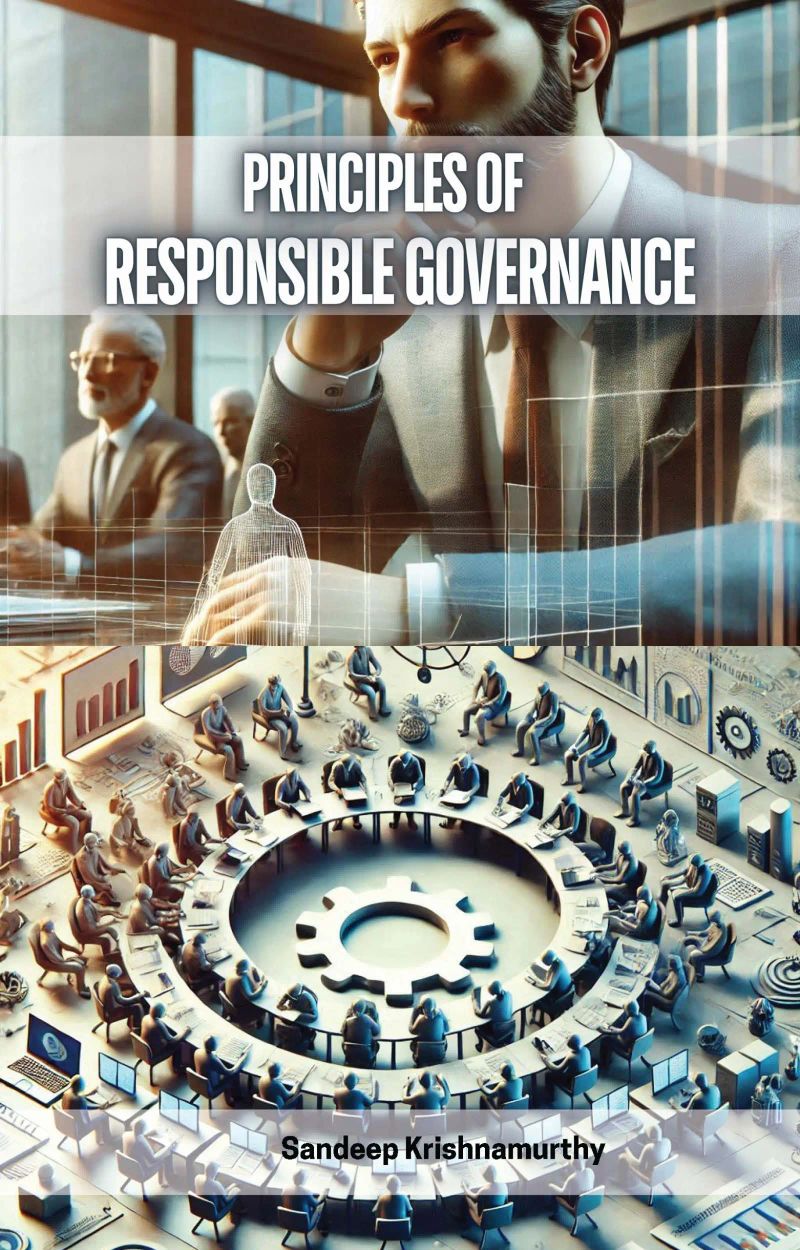
Principles of Responsible Governance
De Sandeep Krishnamurthy


Duração15h 31m
Sobre este audiolivro
"Principles of Responsible Governance" explores the structures and processes designed to ensure accountability, transparency, responsiveness, rule of law, stability, equity, inclusiveness, empowerment, and broad-based participation in governance. We demonstrate how ethics can constrain improper behavior through high-profile case studies that connect readers to fundamental ethical questions. Themes of public interest, natural law, and rule of law provide a framework for these case studies, which include topics such as torture, impeachment, competence, electoral violations, and historical corruption.
We also highlight the responsibilities and policy formation of governments and their impact on the public. Ethics, social responsibility, leadership, and governance are terms often heard but rarely integrated into policies and cultures guiding behavior and decisions. Our book addresses this gap by offering a broad-based and integrated approach to responsible leadership and governance.
With insights into emerging areas requiring future attention, "Principles of Responsible Governance" provides leading thinking on these issues. This book is a valuable resource for understanding the complexities of ethical governance and its role in promoting social justice and equity.
Detalhes do audiolivro
GêneroScience and Nature, Education and Learning
Duração15 h 31 min
Narrado porOuça com mais de 1.000 vozes
FormatoeBook com áudio
Data de publicação20 de fev. de 2025
IdiomaInglês
Sumário
1Chapter 1 What does governance mean?
21.1. Origin of the word
31.2. Summary
41.3.Questions: References
5Chapter 2 Types of governance
Mostrar todos os capítulosVer menos
62.1. Public governance
72.2. Global governance
82.3. Corporate governance
92.4. Internet governance
102.5. Multi-level governance
112.6. Summary
122.7. Questions: References
13Chapter 3 As a normative concept
143.1. Fair governance
153.2. Good governance
163.3. Effective governance
173.4. Measurement and assessment
183.5. Summary
193.6.Questions: References
20Chapter 4 What does good governance mean?
214.1. In politics
224.2. In business
234.3. Reforms and Standards
244.3.1.United Nations
254.3.2.International Monetary fund
264.3.3.World bank
274.4. Summary
284.5. Questions: References
29Chapter 5 Key attributes of good governance
305.1. Transperancy
315.2. Responsibility
325.3. Accountibility
335.4. Participation
345.5. Responsiveness
355.6. Summary
365.7.Questions: References
37Chapter 6 Principles of good governance
386.1. Consistent with the rule of law
396.2. Consensus oriented
406.3. Summary
416.4. Questions: References
42Chapter 7 Effects
437.1. International humanitarian funding
447.2. Democratization
457.3. Summary
467.4.Questions: References
47Chapter 8 Human Rights
488.1. History
498.2. Indivisibility and categorization of rights
508.3. Universal jurisdiction vs. State sovereignty
A Brief History of IntelligenceMax S. Bennett12h 18min4.6 (6.6K)$29 · $0.00
The Story of BirdsSteve Brusatte11h 49min4.6 (401)$29 · $0.00

LiftoffEric Berger9h 4min4.6 (9.5K)$29 · $0.00
Black Earth WisdomLeah Penniman11h 54min4.6 (577)$8 · $0.00

Total Cat MojoJackson Galaxy10h 13min4.5 (8.4K)$23 · $0.00

My Life Among the UnderdogsTia Torres5h 51min4.5 (4K)$24 · $0.00

What It Takes to Save a LifeKwane Stewart6h4.6 (556)$24 · $0.00

Pastoral SongJames Rebanks8h 35min4.5 (12K)$26 · $0.00
How Stella Learned to TalkChristina Hunger7h4.5 (10.9K)$24 · $0.00

Craig & FredCraig Grossi8h 6min4.5 (9.6K)$26 · $0.00

Celebrating BirdsNatalia Rojas, Ana Maria Martinez6h 47min4.6 (330)$24 · $0.00

Saving JemimaJulie Zickefoose4h 59min4.5 (749)$20 · $0.00

Will's Red CoatTom Ryan8h 23min4.5 (2.3K)$26 · $0.00

Of Time and TurtlesSy Montgomery10h 34min4.5 (5K)$29 · $0.00

THE WOLF TRILOGY: Call of the Wild, White Fang & The Son of the WolfJack London17h 31min4.5 (2.4K)$1.99 · $0.00

Zen and the Art of Saving the PlanetThich Nhat Hanh9h 20min4.5 (3.9K)$29 · $0.00

BLACK BEAUTY (With Original Illustrations)Anna Sewell7h 31min4.5 (1.3K)$1.99 · $0.00

Bottle of LiesKatherine Eban14h 25min4.4 (12K)$33 · $0.00
IngrainedCallum Robinson8h 10min4.5 (1.1K)$26 · $0.00

The Lion Tracker's Guide To LifeBoyd Varty3h 1min4.4 (4.8K)$18 · $0.00
A Brief History of IntelligenceMax S. Bennett12h 18min4.6 (6.6K)$29 · $0.00

HomeschooledStefan Merrill Block7h 10min3.6 (18.5K)$28 · $0.00

WitnessAriel Burger8h 1min4.6 (1.3K)$20 · $0.00

EducationEllen G. White9h 41min4.6 (1.5K)$2 · $0.00

Parents and Children (Annotated)Charlotte Mason9h 23min4.6 (988)$2 · $0.00

Children Under FireJohn Woodrow Cox10h 17min4.5 (1.6K)$29 · $0.00

The Secret Door to SuccessFlorence Scovel Shinn2h 14min4.5 (3K)$3 · $0.00

The State Must ProvideAdam Harris7h 15min4.5 (775)$24 · $0.00

The Call of the Wild and FreeAinsley Arment9h 7min4.4 (21.2K)$29 · $0.00
The Freelance WayRobert Vlach19h 48min4.5 (528)$40 · $0.00
Race to the BottomLuke Rosiak9h 20min4.5 (600)$29 · $0.00

They Came for the SchoolsMike Hixenbaugh9h 5min4.5 (2.6K)$8 · $0.00

Find Me UnafraidKennedy Odede, Jessica Posner11h 11min4.5 (2.7K)$29 · $0.00
World's Best Inspirational Books to Change Your Life (3 Books)Napoleon Hill, Joseph Murphy, Dale Carnegie29h 38min4.5 (1.3K)$20 · $0.00

Asking for ItKate Harding8h 55min4.4 (5.3K)$20 · $0.00

MeditationsMarcus Aurelius4h 26min4.4 (456.8K)$1 · $0.00
Defining Moments in Black HistoryDick Gregory7h 37min4.4 (6K)$26 · $0.00

The Emerald Tablets of Thoth the AtlanteanMaurice Doreal3h 4min4.4 (6K)$6 · $0.00

Learning AmericaLuma Mufleh6h 37min4.4 (564)$24 · $0.00
Math-ishJo Boaler7h 21min4.4 (588)$24 · $0.00
Você também pode gostar

No Treason (Complete Edition)Lysander Spooner3h 52min4.3 (3.9K)$1.99 · $0.00

How Soccer Explains the WorldFranklin Foer7h 22min3.9 (14.9K)$24 · $0.00

The Politically Incorrect Guide to American HistoryWoods, Thomas E.8h 49min4.0 (4K)Grátis

F*ck SilenceJoe Walsh6h 55min4.1 (1.4K)$24 · $0.00
The Breakdown of Higher EducationJohn M. Ellis7h 47min4.2 (296)$17 · $0.00

Sacred CowDiana Rodgers RD, Robb Wolf8h 28min4.4 (4.3K)$20
The Despot’s ApprenticeBrian Klaas9h 22min4.3 (778)$20

Adios, AmericaCoulter, Ann12h 51min4.0 (4.6K)Grátis
ShamelessBrian Tyler Cohen4h 38min4.5 (4.3K)$5 · $0.00
The Constitution of KnowledgeJonathan Rauch12h 23min4.3 (2.4K)$23 · $0.00
Over RuledNeil Gorsuch, Janie Nitze7h 29min4.4 (1.7K)$28 · $0.00
American WhitelashWesley Lowery7h4.3 (1.6K)$24 · $0.00

Corruption In American Politics And LifeRobert C. Brooks7h 57min$2.30
For ALL the PeopleMichael Slaby6h 36min4.1 (26)$20 · $0.00
Science in an Age of UnreasonJohn Staddon7h 2min3.8 (58)$17 · $0.00

Eighth report of the United Nations Verification Mission in GuatemalaUnited Nations Verification Mission in Guatemala58min$1 · $0.00

Proportional Representation: A Study in Methods of ElectionJohn H. Humphreys11h 53min$2 · $0.00

I Know Who You Are and I Saw What You DidLori B. Andrews9h 51min3.5 (322)$25 · $0.00

Common GroundCal Thomas, Bob Beckel8h 19min3.6 (116)$26 · $0.00

Political Scandalsthe Speech Resource Company7h 49min$20