
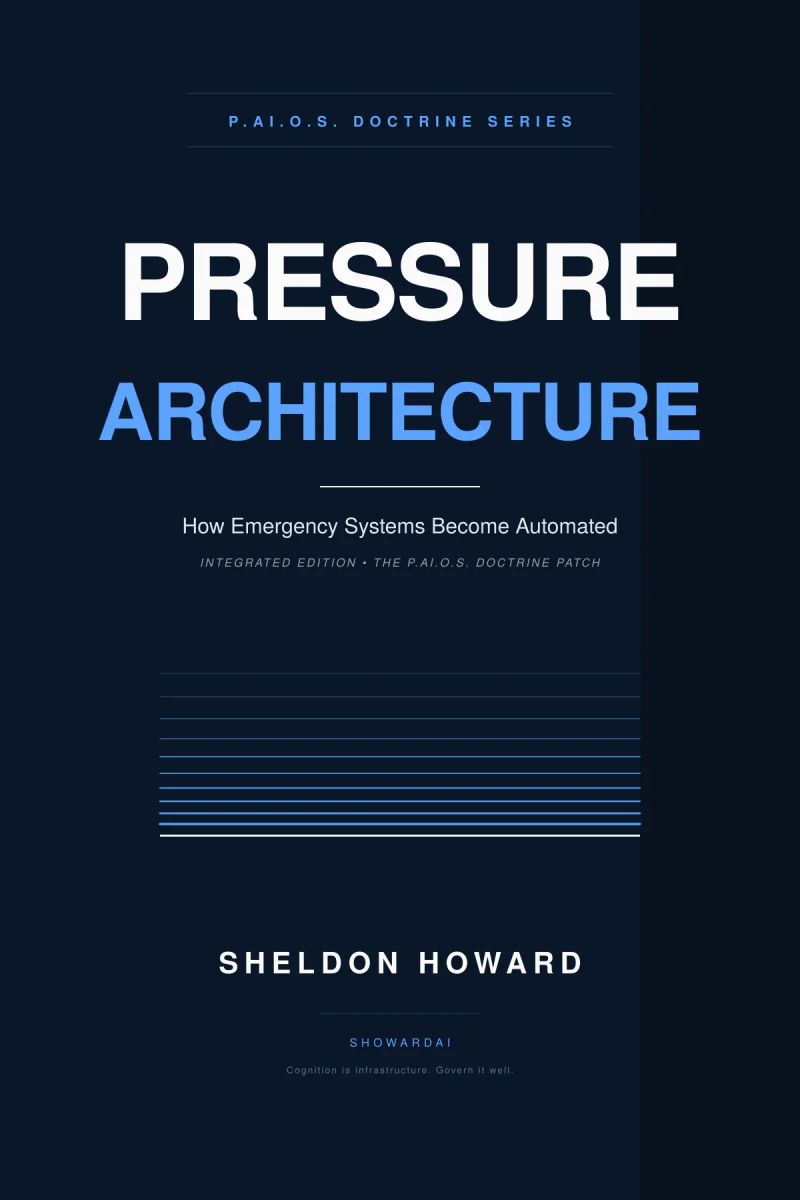
Pressure Architecture
How Emergency Systems Become Automated — Integrated Edition with the P.Ai.O.S. Doctrine PatchDe Sheldon Howard


Duração2h 31m
Sobre este audiolivro
The layered system of mandates, platforms, digital identity, and automated enforcement that can make normal life conditional — without needing a single central command.
This integrated edition adds the P.Ai.O.S. Doctrine Patch.
Pressure that cannot be named cannot be limited.
Detalhes do audiolivro
GêneroPolitics and Government, Psychology
Duração2 h 31 min
Narrado porOuça com mais de 1.000 vozes
FormatoeBook com áudio
Data de publicação21 de mai. de 2026
IdiomaInglês
Sumário
1Pressure Architecture How Emergency Systems Become Automated
2Disclaimer
3Evidence Note
4Introduction — The System Did Not Need a Gun
5Chapter 1 — What Pressure Architecture Is
Mostrar todos os capítulosVer menos
6Chapter 2 — The Hidden Engine: Behavioral Economics and Pressure
7Loss Aversion
8Present Bias
9Social Norms and Social Proof
10Defaults and Status Quo Bias
11Framing Effects
12Regret Aversion
13Nudge vs. Sludge
14AI Hypernudges
15How These Mechanisms Combine
16Implications for AI-Scaled Pressure
17The Governance Challenge
18Chapter 3 — The Institutional Engine: Public Choice, Capture, and the Revolving Door
19Government Is Not a Neutral Referee
20Concentrated Benefits, Diffuse Costs
21Regulatory Capture
22The Revolving Door
23Capture in AI and Digital Identity
24Why Safeguards Fail
25Capture-Resistant Design
26Chapter 4 — Emergency as a Compression Machine
27Emergency Declarations as the Trigger
28Institutional Fear and Liability Avoidance
29Reputation Management Under Crisis
30Why Crisis Rewards Certainty
31Why Ethics Must Be Designed Before Fear Arrives
32The Compression Is Predictable
33Chapter 5 — Distributed Pressure: No Central Command Required
34Shared Fear as the Coordinating Force
35Shared Reputational Risk
36Liability Pressure as an Accelerator
37Employers, Platforms, Schools, and Agencies
38Why Aligned Outcomes Do Not Require Central Planning
39The Architecture Becomes Self-Sustaining
40Chapter 6 — Conditional Participation
41Employment as Pressure Point
42Access as Policy Enforcement
43Exemptions and the Burden of Proof
44Later Reversal and Institutional Residue
45Chapter 7 — The Window of Acceptable Doubt
46The Danger Was Not Uncertainty
47Platform Moderation Under Distributed Pressure
48Public-Health Messaging and Manufactured Certainty
49The Reputational Cost of Asking Questions
50Why This Matters for Future Governance
Séries
Mais de Sheldon Howard

Suicidal EmpathyGad Saad8h 24min4.1 (736)$28 · $0.00

Unreasonable WomenJustine van der Leun10h 45min4.9 (13)$29 · $0.00

MotherlandJulia Ioffe17h 52min4.7 (2.5K)$40 · $0.00

HostageEli Sharabi5h 25min4.6 (10.8K)$24 · $0.00
Days of Love and Rage: A Story of RevolutionAnand Gopal22h 36min4.7 (584)$34 · $0.00

KrantikariSanjeev Sanyal11h 44min4.6 (1.3K)$16 · $0.00

Unbroken Bonds of BattleJohnny Joey Jones8h 31min4.6 (2.6K)$8 · $0.00

On Democracies and Death CultsDouglas Murray10h 38min4.6 (6.5K)$29 · $0.00

Balcony Over Jerusalem: A Middle East Memoir - Israel, Palestine and BeyondJohn Lyons12h 37min4.6 (1.4K)$33 · $0.00

RiggedMollie Hemingway12h 48min4.6 (4.2K)$23 · $0.00

SledgehammerDavid Friedman8h 21min4.7 (589)$26 · $0.00

Citizenship in a Republic (Annotated)Theodore Roosevelt2h 44min4.6 (1.4K)$2 · $0.00

No EscapeNury Turkel9h 30min4.6 (809)$28 · $0.00

Always FaithfulThomas Schueman, Zainullah Zaki12h 12min4.6 (977)$29 · $0.00
UnthinkableJamie Raskin15h 8min4.5 (9.3K)$8 · $0.00
My Fourth Time, We DrownedSally Hayden13h 59min4.6 (2.9K)$23 · $0.00

A Revolution of Common SenseScott Jennings9h 29min4.6 (528)$29 · $0.00

Statement From the Dock at the Rivonia TrialNelson Mandela2h 18min4.6 (1.3K)$1 · $0.00

Lessons from the EdgeMarie Yovanovitch17h 11min4.5 (5.9K)$40 · $0.00

To Rescue the American SpiritBret Baier10h 12min4.5 (2.7K)$8 · $0.00
Boundaries for LeadersHenry Cloud7h 36min4.3 (3.6K)$26 · $0.00
The Way of ExcellenceBrad Stulberg6h 46min4.2 (1.1K)$24 · $0.00
Suicidal EmpathyGad Saad8h 24min4.1 (736)$28 · $0.00
Unreasonable WomenJustine van der Leun10h 45min4.9 (13)$29 · $0.00
Be ExceptionalJoe Navarro, Toni Sciarra Poynter9h 11min4.0 (1.3K)$29 · $0.00

How Soccer Explains the WorldFranklin Foer7h 22min3.9 (14.9K)$24 · $0.00
What to Make of a LifeJim Collins13h 31min4.8 (4)$33 · $0.00
The Power of the OtherHenry Cloud5h 52min4.2 (3.5K)$24 · $0.00

Your Desired FutureHenry Cloud6h 43min$24 · $0.00

All About Lovebell hooks6h 10min4.3 (330.3K)$7 · $0.00

I Am The StormJanice Dean9h4.6 (1.5K)$8 · $0.00
On Democracies and Death CultsDouglas Murray10h 38min4.6 (6.5K)$29 · $0.00

TerraformPropaganda5h 39min4.7 (594)$24 · $0.00

Southern Horrors: Lynch Law in All Its Phases (Annotated)Ida B. Wells-Barnett2h 44min4.6 (1.3K)$2 · $0.00
Hour of the HeartIrvin D. Yalom, Benjamin Yalom8h 19min4.6 (2.3K)$26 · $0.00

Braving the TruthRachel Held Evans11h 31min4.7 (359)$29 · $0.00
Level UpRob Dial7h 42min4.6 (3.3K)$26 · $0.00

As a JewSarah Hurwitz8h 36min4.6 (1.2K)$26 · $0.00

Saint Joan (Annotated)George Bernard Shaw6h 20min4.6 (1.2K)$1.20 · $0.00
Burn the HaystackJennie Young, PhD9h 30min4.6 (543)$29 · $0.00
Você também pode gostar
Making SenseSam Harris22h 27min4.1 (3K)$46 · $0.00

We Have Been HarmonizedKai Strittmatter10h 29min4.3 (4.3K)$29 · $0.00
System ErrorRob Reich, Mehran Sahami, Jeremy M. Weinstein11h 29min4.0 (1.6K)$29 · $0.00

Machines of Loving GraceJohn Markoff11h 53min3.8 (1.4K)$29 · $0.00
The MANIACBenjamín Labatut9h 51min4.3 (32.8K)$26 · $0.00

The Immortal King RaoVauhini Vara12h 43min3.7 (6.1K)$33 · $0.00

The Exponential AgeAzeem Azhar9h 44min4.0 (1.6K)$20 · $0.00
Big DataViktor Mayer-Schönberger, Kenneth Cukier9h 41min4.0 (27.3K)$29 · $0.00
The AI ConEmily M. Bender, Alex Hanna7h 51min3.7 (1.7K)$26 · $0.00
MuskismQuinn Slobodian, Ben Tarnoff5h 59min3.9 (186)$24 · $0.00
Masters or Slaves?Jeremy Peckham6h 44min4.2 (23)$23
Screen PeopleMegan Garber7h 40min3.5 (100)$26 · $0.00

Beyond the ValleyRamesh Srinivasan12h 34min4.0 (186)$23 · $0.00
Mother of InventionKatrine Marçal6h 54min$17 · $0.00

ReplacedDisrupt.co.nz4h 4min$1.20 · $0.00
No More WorkJames Livingston3h 16min3.7 (449)$15

Agenda 2030Dawid Snowden27min$4 · $0.00
Pay AttentionDavid Pakman9h 27min$29 · $0.00

We Radiant ThingsFranny Choi6h 8min$24 · $0.00

Mindkind, The Cognitive CommunityJavier del Puerto, Rado Molina4h 12min$20 · $0.00