
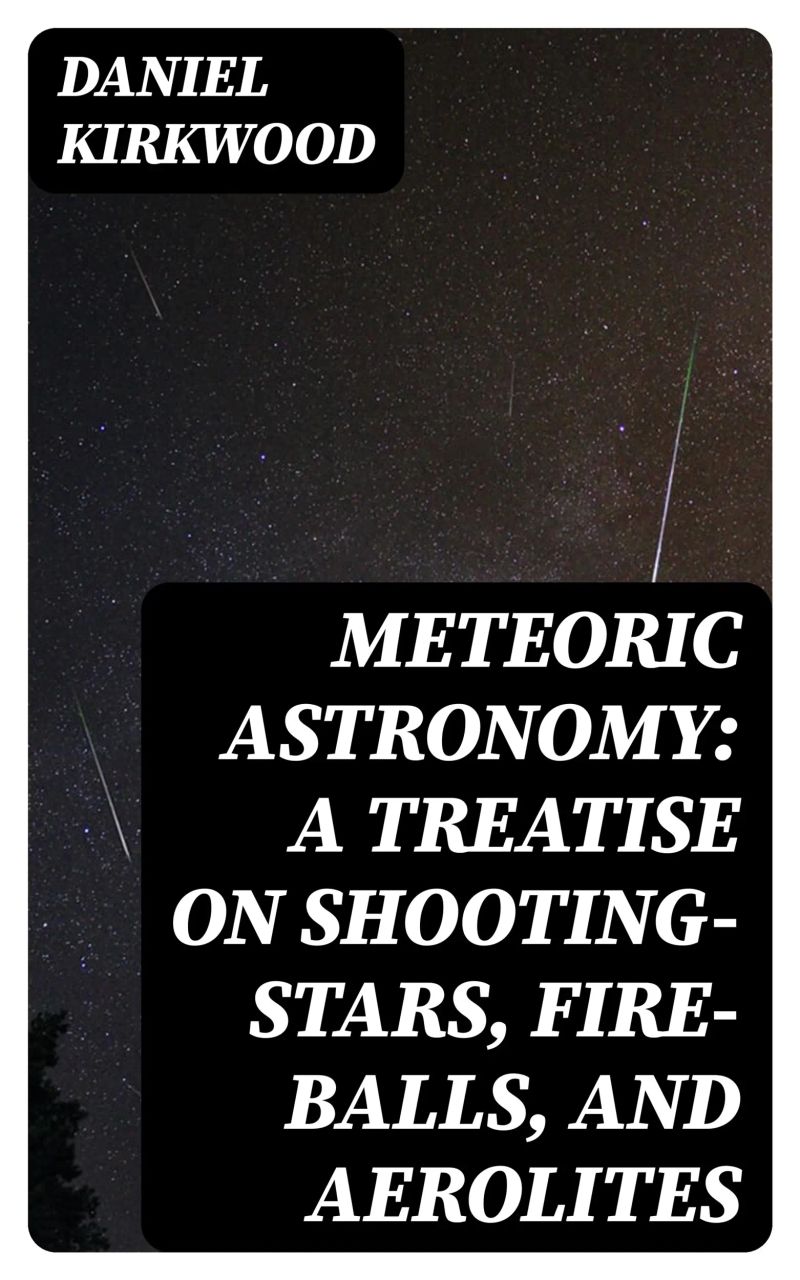
Meteoric astronomy: A treatise on shooting-stars, fire-balls, and aerolites
De Daniel Kirkwood


Duração2h 47m
Sobre este audiolivro
In "Meteoric Astronomy: A Treatise on Shooting-Stars, Fire-Balls, and Aerolites," Daniel Kirkwood masterfully bridges the early scientific inquiries into meteorology and astronomy, providing a comprehensive exploration of the phenomena associated with meteors. Utilizing empirical observation and a methodical approach, Kirkwood delves into the nature, origin, and classification of shooting stars, fireballs, and meteorites, meticulously documenting their characteristics and occurrences. His work reflects the burgeoning ethos of 19th-century science, where rational inquiry and systematic study began to transform our understanding of celestial phenomena, positioning astronomy as a groundbreaking field of scientific inquiry. Daniel Kirkwood (1814-1895) was a prominent American astronomer whose significant contributions to the field, particularly regarding the study of asteroids and meteors, underscore his intellectual depth. His academic pursuits, driven by a keen interest in celestial mechanics and the mathematical underpinnings of astronomy, laid a foundation for the systematic study of meteoroids, culminating in this seminal treatise. His work reflects not only his scientific rigor but also the awe and wonder associated with the cosmos during his era. "Meteoric Astronomy" is a must-read for anyone fascinated by the celestial wonders of our night sky. Not only does it offer insight into the historical context of astronomical study, but it also enriches the reader's appreciation for the intricate dance of meteors through our atmosphere. Whether you're a seasoned astronomer or a curious novice, Kirkwood's work invites you to explore the mesmerizing world of meteorites with newfound understanding.
Detalhes do audiolivro
GêneroScience and Nature
Duração2 h 47 min
Narrado porOuça com mais de 1.000 vozes
FormatoeBook com áudio
Data de publicação16 de set. de 2022
IdiomaInglês
Sumário
1PREFACE.
2INTRODUCTION. A GENERAL VIEW OF THE SOLAR SYSTEM.
3METEORIC ASTRONOMY.
4I. The Meteors of November 12th–14th.
5The Meteors of 1866 compared with those of former Displays.
Mostrar todos os capítulosVer menos
6Discussion of the Phenomena.
7Elements of the Orbit.
8II. The Meteors of August 6th–11th.
9III. The Meteors of April 18th–26th.
10IV. The Meteors of December 6th–13th.
11V. The Meteors of January 2d–3d.
12General Remarks.
13CHAPTER III. AEROLITES.
14The Epoch of November 29.
15I. The Epoch of November 11th–14th.
16II. The Epoch of August 7th–11th.
17III. The Epoch of December 6th–13th.
18IV. The Epoch of April 18th–26th.
19V. The Epoch of April 9th–12th.
20Meteoric Transits—Dark Days.
21Partial Interception of the Sun's Light and Heat.
22CHAPTER VII. FURTHER RESEARCHES OF REICHENBACH—THEORY OF METEORS—STABILITY OF THE SOLAR SYSTEM—DOCTRINE OF A RESISTING MEDIUM.
23CHAPTER VIII. DOES THE NUMBER OF AEROLITIC FALLS VARY WITH THE EARTH'S DISTANCE FROM THE SUN?—RELATIVE NUMBERS OBSERVED IN THE FORENOON AND AFTERNOON—EXTENT OF THE ATMOSPHERE AS INDICATED BY METEORS.
24The Meteoric Theory.
25Variable and Temporary Stars.
26The Lunar Theory.
27The Solar Theory.
28CHAPTER XII. THE RINGS OF SATURN.
29Remarks on the foregoing Table.
Mais de Daniel Kirkwood

A Brief History of IntelligenceMax S. Bennett12h 18min4.6 (6.6K)$29 · $0.00
The Story of BirdsSteve Brusatte11h 49min4.6 (401)$29 · $0.00

Total Cat MojoJackson Galaxy10h 13min4.5 (8.4K)$23 · $0.00

My Life Among the UnderdogsTia Torres5h 51min4.5 (4K)$24 · $0.00

What It Takes to Save a LifeKwane Stewart6h4.6 (556)$24 · $0.00

Pastoral SongJames Rebanks8h 35min4.5 (12K)$26 · $0.00

How Stella Learned to TalkChristina Hunger7h4.5 (10.9K)$24 · $0.00

Craig & FredCraig Grossi8h 6min4.5 (9.6K)$26 · $0.00
Celebrating BirdsNatalia Rojas, Ana Maria Martinez6h 47min4.6 (330)$24 · $0.00

Saving JemimaJulie Zickefoose4h 59min4.5 (749)$20 · $0.00

Will's Red CoatTom Ryan8h 23min4.5 (2.3K)$26 · $0.00
Of Time and TurtlesSy Montgomery10h 34min4.5 (5K)$29 · $0.00

THE WOLF TRILOGY: Call of the Wild, White Fang & The Son of the WolfJack London17h 31min4.5 (2.4K)$1.99 · $0.00

Zen and the Art of Saving the PlanetThich Nhat Hanh9h 20min4.5 (3.9K)$29 · $0.00

BLACK BEAUTY (With Original Illustrations)Anna Sewell7h 31min4.5 (1.3K)$1.99 · $0.00

Bottle of LiesKatherine Eban14h 25min4.4 (12K)$33 · $0.00
IngrainedCallum Robinson8h 10min4.5 (1.1K)$26 · $0.00

The Lion Tracker's Guide To LifeBoyd Varty3h 1min4.4 (4.8K)$18 · $0.00

Born for LoveBruce D. Perry, Maia Szalavitz11h 42min4.4 (4K)$29 · $0.00

The Mountains of California (With Original Drawings & Photographs) (Annotated)John Muir11h 35min4.5 (1.1K)$2 · $0.00
Você também pode gostar

Soap-Bubbles and the Forces Which Mould ThemC. V. Boys2h 16min4.2 (340)$2 · $0.00
Marie Curie: The Radio-Active SubstancesMarie Curie5h 50min4.3 (288)$1.99 · $0.00

Where Do Balloons Go?Jamie Lee Curtis4min4.0 (1.2K)$4 · $0.00
The Rise and Progress of PalaeontologyThomas Henry Huxley35min$2 · $0.00
CrystalsA. E. H. Tutton8h 23min$2 · $0.00

Practical Exercises in Elementary MeteorologyRobert DeCourcy Ward7h 16min$2 · $0.00
The Birth-Time of the World and Other Scientific EssaysJohn Joly8h 31min$1 · $0.00
Astronomy: The Science of the Heavenly BodiesDavid P. Todd11h 5min3.9 (48)$2 · $0.00
An Expository Outline of the "Vestiges of the Natural History of Creation"S. Laing2h 48min$2 · $0.00

The Coal Measures Amphibia of North AmericaRoy Lee Moodie9h 56min$2 · $0.00
Introduction to the Study of Palæontological BotanyJohn Hutton Balfour3h 4min$2 · $0.00
Fossil ButterfliesSamuel Hubbard Scudder3h 18min$2 · $0.00
On adipocire, and its formationCharles Mayer Wetherill1h 7min$2 · $0.00

The Genus PinusGeorge Russell Shaw4h 11min$2 · $0.00
Spinning TopsJohn Perry1h 31min3.8 (18)$2 · $0.00

Pennsylvanian invertebrates of the Mazon Creek Area, Illinois: EurypteridaErik Norman Kjellesvig-Waering45min$2 · $0.00
On the various forces of nature and their relations to each other (Annotated)Michael Faraday5h 4min4.5 (12)$1.99 · $0.00

Ancient Egyptian and Greek LoomsH. Ling Roth1h 38min$1 · $0.00

Amazon Aurora The Ultimate Step-By-Step GuideGerardus Blokdyk4h 8min$71
The Nature of Animal LightE. Newton Harvey1h 15min$2 · $0.00