
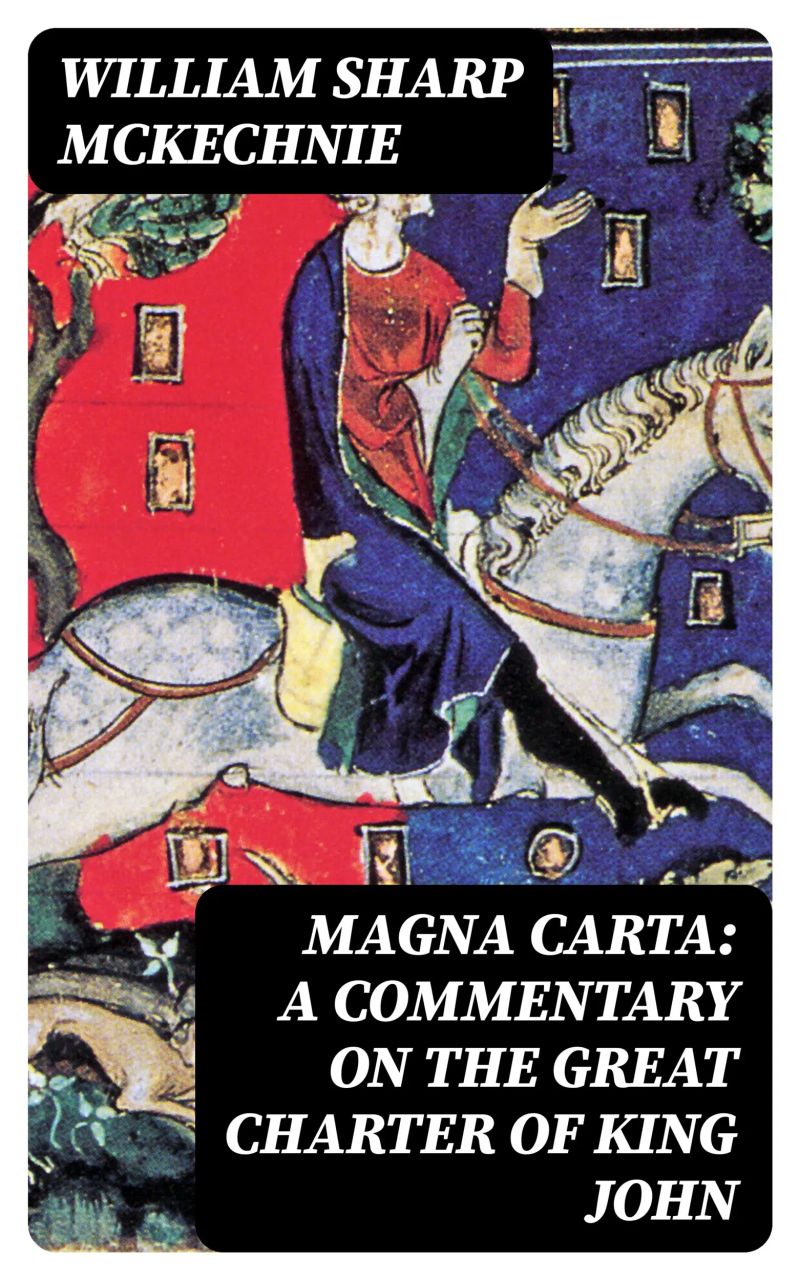
Magna Carta: A Commentary on the Great Charter of King John
With an Historical IntroductionDe William Sharp McKechnie


Duração22h 46m
Sobre este audiolivro
William Sharp McKechnie's "Magna Carta: A Commentary on the Great Charter of King John" serves as a thorough exploration of one of history's most significant documents. McKechnie's scholarly commentary dissects the legal, political, and historical ramifications of the Magna Carta, revealing its role in shaping constitutional law. Employing a meticulous blend of historical context and legal analysis, McKechnie elucidates the Charter's provisions, emphasizing its enduring impact on the rights of individuals and the limitations imposed on monarchical power, which laid foundational principles for modern democratic governance. William Sharp McKechnie, a prominent Scottish legal scholar and historian, possessed a profound interest in constitutional law and its evolution. His rigorous academic background and commitment to understanding the roots of legal systems led him to investigate the Magna Carta in depth. McKechnie's scholarship not only reflects his expertise but also his passion for uncovering the historical narratives that inform contemporary legal thought, allowing readers to grasp the significance of the Magna Carta in a broader socio-political landscape. This book is highly recommended for scholars, students, and anyone interested in the foundations of modern democracy and legal frameworks. McKechnie's insightful analysis invites readers to appreciate the complexities of the Magna Carta, making it an indispensable resource for understanding its relevance and legacy in today's world.
Detalhes do audiolivro
Avaliação★★★★ 4,2 (43)
Inclui Goodreads, LibraryThing, Amazon
GêneroHistory
Duração22 h 46 min
Narrado porOuça com mais de 1.000 vozes
FormatoeBook com áudio
Data de publicação13 de jun. de 2022
IdiomaInglês
Sumário
1PREFACE
2HISTORICAL INTRODUCTION.
3PART I. EVENTS LEADING TO MAGNA CARTA.
4I. William I. to Henry II.—Main Problem: the Monarchy.
5II. William I. to Henry II.—Problem of Local Government.
Mostrar todos os capítulosVer menos
6III. William I. to Henry II.—Problem of Church and State.
7IV. Richard I. and John.
8V. The Years of Crisis, 1213–15.
9VI. Runnymede, and after.
10PART II. FEUDAL GRIEVANCES AND MAGNA CARTA.
11I. The Immediate Causes of the Crisis.
12II. The Crown and Feudal Obligations.
13III. Royal Justice and Feudal Justice.
14PART III. MAGNA CARTA: ITS FORM AND CONTENTS.
15I. Its Prototypes: Earlier Charters.
16II. Magna Carta: its Form and Juridical Nature.
17III. Magna Carta: its Contents and Characteristics.
18IV. Magna Carta: an Estimate of its Value.
19VI. Magna Carta: Value of Traditional Interpretations.
20VII. Magna Carta. Its traditional relation to Trial by Jury.
21PART IV. HISTORICAL SEQUEL TO MAGNA CARTA.
22I. Re-issues and Confirmations of the Great Charter.
23II. Magna Carta and the Reforms of Edward I.
24PART V.
25I. Manuscripts of Magna Carta and Relative Documents.
26II. Previous Editions and Commentaries.
27TEXT, TRANSLATION, AND COMMENTARY.
28MAGNA CARTA.
29PREAMBLE.[322]
30CHAPTER ONE.
31CHAPTER TWO.
32CHAPTER THREE.
33CHAPTER FOUR.
34CHAPTER FIVE.
35CHAPTER SIX.
36CHAPTER SEVEN.
37CHAPTER EIGHT.
38CHAPTER NINE.
39CHAPTER TEN.
40CHAPTER ELEVEN.
41CHAPTER TWELVE.
42CHAPTER THIRTEEN.
43CHAPTER FOURTEEN.
44CHAPTER FIFTEEN.
45CHAPTER SIXTEEN.
46CHAPTER SEVENTEEN.
47CHAPTER EIGHTEEN.
48CHAPTER NINETEEN.
49CHAPTER TWENTY.
50CHAPTER TWENTY-ONE.
Mais de William Sharp McKechnie


A Brief History of IntelligenceMax S. Bennett12h 18min4.6 (6.6K)$29 · $0.00

Ghosts of HiroshimaCharles Pellegrino8h 59min4.5 (877)$23

Medium RawAnthony Bourdain9h4.1 (65.6K)$29 · $0.00

Suicidal EmpathyGad Saad8h 24min4.1 (736)$28 · $0.00

How Soccer Explains the WorldFranklin Foer7h 22min3.9 (14.9K)$24 · $0.00
The Assassination of Leon TrotskyH. Keith Melton, Nigel West14h 8min$33 · $0.00

All American PatriotismRachel Campos-Duffy8h 53min$29 · $0.00

History of the Decline and Fall of the Roman Empire — Volume 1Edward Gibbon20h 18min4.3 (14.6K) · 1297Grátis

MotherlandJulia Ioffe17h 52min4.7 (2.5K)$40 · $0.00

Where Cowards Go to DieBenjamin Sledge8h 42min4.7 (351)$20 · $0.00

RevolutionariesSanjeev Sanyal11h 23min4.6 (2.6K)$29 · $0.00
Days of Love and Rage: A Story of RevolutionAnand Gopal22h 36min4.7 (584)$34 · $0.00

We Crossed a Bridge and It TrembledWendy Pearlman6h4.6 (5.2K)$24 · $0.00

Unbroken Bonds of BattleJohnny Joey Jones8h 31min4.6 (2.6K)$8 · $0.00

The Daughter of AuschwitzTova Friedman, Malcolm Brabant7h 54min4.6 (16.7K)$26 · $0.00

Lily's PromiseLily Ebert, Dov Forman8h 54min4.6 (16.1K)$29 · $0.00

On Democracies and Death CultsDouglas Murray10h 38min4.6 (6.5K)$29 · $0.00

Across the RiverKent Babb11h 40min4.6 (927)$29 · $0.00

Balcony Over Jerusalem: A Middle East Memoir - Israel, Palestine and BeyondJohn Lyons12h 37min4.6 (1.4K)$33 · $0.00

BeyondStephen Walker15h 39min4.6 (3.2K)$33 · $0.00
Você também pode gostar
The Proletarian Revolution and the Renegade KautskyVladimir Lenin4h 34min4.3 (1K)$1.99 · $0.00
Marx in 90 MinutesPaul Strathern1h 24min3.5 (1.6K)$7

The FormulaJoshua Robinson, Jonathan Clegg10h 41min4.4 (6.9K)$29 · $0.00

The French Revolution and NapoleonJean-Jacques Rousseau, Alexis de Tocqueville, Montesquieu, Charles Downer Hazen62h 54min4.1 (574)$2 · $0.00
The Autobiography of Thomas JeffersonThomas Jefferson8h 32min4.0 (2.8K)$1.99 · $0.00

Opium Inc.Thomas Manuel9h 27min4.2 (263)$29 · $0.00
The American Heritage History of the Civil WarBruce Catton8h4.4 (1.7K)$20

Look Away!William C. Davis23h 39min4.0 (662)$30
The Constitution of the United States and The Declaration of IndependenceDelegates of The Constitutional Convention1h 7min4.6 (12.3K)Grátis

America’s Great DepressionMurray N. Rothbard10h 5min4.4 (2K)$20

The Wealth of Nations (Annotated)Adam Smith42h 48min4.2 (35.4K)$2 · $0.00

Socialism: Utopian and Scientific (Annotated)Frederick Engels3h 35min4.3 (29.7K)$1.99 · $0.00

Two Tracts on Civil Liberty, the War with America, and the Debts and Finances of the KingdomRichard Price9h 22min$1 · $0.00
History of the ReformationThomas M. Lindsay38h 40min4.2 (121)$1.99 · $0.00

The PlaybookJoshua Robinson, Jonathan Clegg8h 50min$29 · $0.00

England's Alarm! On the prevailing doctrine of libels as laid by the Earl of MansfieldWilliam Jones, Manasseh Dawes1h 2min$2 · $0.00

The Ancien RégimeCharles Kingsley2h 1min$2 · $0.00
The Complete WorksThomas Jefferson210h 44min4.4 (197)$1.99 · $0.00
Popular EconomicsTamny, John8h 14min3.9 (401)Grátis

Saigon at the Turn of the MillenniumKlaus H. Carl1h 35min$8