
Só áudio


Duração9h 21m
Sobre este audiolivro
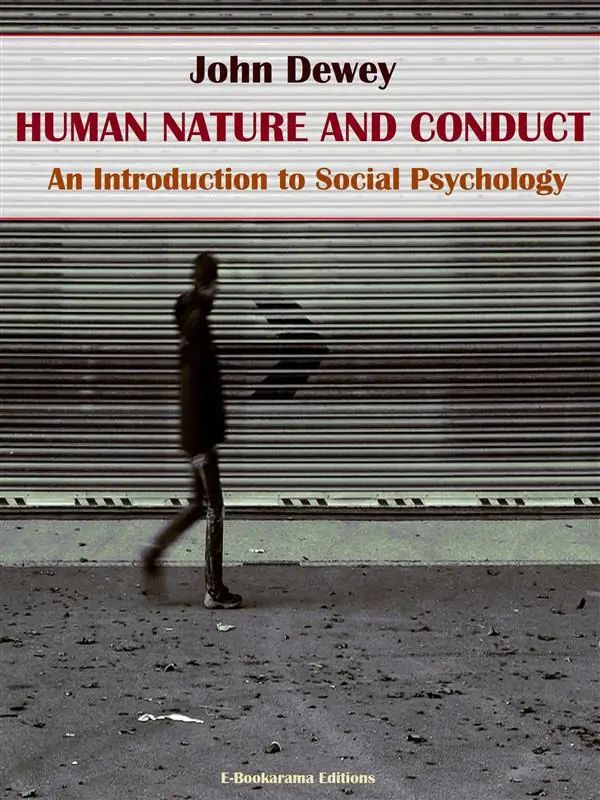
In "Human Nature and Conduct", John Dewey extends the principles of the his pragmatic philosophy into the realm of developmental and social psychology.
First published in 1922, the work was a notable departure from the deterministic theories of contemporaries, such as the physiological psychology of Wilhelm Wundt, the behaviourism of Ivan Pavlov, and Freud's emphasis on the unconscious. Refuting in particular the dualistic implications of the Pavlovian stimulus-response model of human behaviour and the arbitrariness by which those terms are assigned, he posits instead a holistic and humanistic paradigm in which a creative response to one's environment becomes the mark of a healthy individual.
Dewey brings the rigour of natural sciences to the quest for a better moral system. By studying habit, impulse, and intelligence, he arrives at a morality that is firmly rooted the context of the world, accounting for thinking humans with individual circumstances that do, indeed, make a difference when determining right and wrong.
Students of sociology, philosophy, and psychology will be interested to see moral judgement investigated as a scientific question by one of America's most influential philosophers.
Detalhes do audiolivro
Avaliação★★★★ 4,2 (1,5 mil)
Inclui Goodreads, LibraryThing, Amazon, StoryGraph
GêneroPsychology, Philosophy, Science and Nature
Duração9 h 21 min
Narrado porOuça com mais de 1.000 vozes
FormatoeBook com áudio
Data de publicação3 de jun. de 2020
IdiomaInglês
Sumário
1Preface
2Introduction
3PART ONE. THE PLACE OF HABIT IN CONDUCT
4Section 1. Habits As Social Functions
5Section 2. Habits And Will
Mostrar todos os capítulosVer menos
6Section 3. Character And Conduct
7Section 4. Custom And Habit
8Section 5. Custom And Morality
9Section 6. Habit And Social Psychology
10PART TWO. THE PLACE OF IMPULSE IN CONDUCT
11Section 1. Impulses And Change Of Habits
12Section 2. Plasticity Of Impulse
13Section 3. Changing Human Nature
14Section 4. Impulse And Conflict Of Habits
15Section 5. Classification Of Instincts
16Section 6. No Separate Instincts
17Section 7. Impulse And Thought
18PART THREE. THE PLACE OF INTELLIGENCE IN CONDUCT
19Section 1. Habit And Intelligence
20Section 2. The Psychology Of Thinking
21Section 3. The Nature Of Deliberation
22Section 4. Deliberation And Calculation
23Section 5. The Uniqueness Of Good
24Section 6. The Nature Of Aims
25Section 7. The Nature Of Principles
26Section 8. Desire And Intelligence
27Section 9. The Present And Future
28PART FOUR. CONCLUSION
29Section 1. The Good Of Activity
30Section 2. Morals Are Human
31Section 3. What Is Freedom?
32Section 4. Morality Is Social
Mais de John Dewey


On Democracies and Death CultsDouglas Murray10h 38min4.6 (6.5K)$29 · $0.00

TerraformPropaganda5h 39min4.7 (594)$24 · $0.00

Southern Horrors: Lynch Law in All Its Phases (Annotated)Ida B. Wells-Barnett2h 44min4.6 (1.3K)$2 · $0.00

Hour of the HeartIrvin D. Yalom, Benjamin Yalom8h 19min4.6 (2.3K)$26 · $0.00

Braving the TruthRachel Held Evans11h 31min4.7 (359)$29 · $0.00
Level UpRob Dial7h 42min4.6 (3.3K)$26 · $0.00

As a JewSarah Hurwitz8h 36min4.6 (1.2K)$26 · $0.00

Saint Joan (Annotated)George Bernard Shaw6h 20min4.6 (1.2K)$1.20 · $0.00

Burn the HaystackJennie Young, PhD9h 30min4.6 (543)$29 · $0.00

Woman and the New Race (Annotated)Margaret Sanger6h 30min4.6 (1K)$1.99 · $0.00

Good InsideBecky Kennedy9h 55min4.5 (59.3K)$29 · $0.00

The Mis-Education of the NegroCarter Godwin Woodson5h 4min4.5 (29.4K)$1.20 · $0.00

Du Bois: EssaysW.E.B. Du Bois6h 22min4.6 (1.5K)$1 · $0.00

The North American Indian (Illustrated Edition)Edward S. Curtis, Frederick Webb Hodge5h 59min4.6 (1.4K)$2 · $0.00

Valley of the BirdtailAndrew Stobo Sniderman, Douglas Sanderson10h 1min4.6 (2.4K)$29 · $0.00

Lies My Therapist Told MeGreg E. Gifford9h 3min4.6 (503)$29 · $0.00

Disturbed in Their NestsAlephonsion Deng, Judy A. Bernstein11h 22min4.6 (595)$23 · $0.00

No Name in the StreetJames Baldwin5h4.5 (8.5K)$20 · $0.00
Narrative of the Life of Frederick DouglassFrederick Douglass4h 13min4.5 (309.9K)$1.20 · $0.00

Magic SeasonWade Rouse6h 41min4.6 (855)$24 · $0.00

Kahlil Gibran. Classic CollectionKahlil Gibran2h 55min4.5 (4K)$10 · $0.00
The Magic PresenceGodfré Ray King10h 21min4.6 (307)$1.20 · $0.00

The Art of LivingThich Nhat Hanh5h 1min4.5 (14.2K)$24 · $0.00

Moral Letters to LuciliusLucius Annaeus Seneca24h 26min4.5 (71.7K)$1.99 · $0.00

Complete Works of Marcus AureliusMarcus Aurelius5h 1min4.5 (2.4K)$10 · $0.00

Lessons in TruthH. Emilie Cady3h 50min4.5 (2.4K)$20 · $0.00

Letters from a StoicSeneca6h 5min4.4 (80.4K)$6 · $0.00
The Discourses of EpictetusP. E. MATHESOM12h 47min4.4 (17.7K)$1.20 · $0.00

IlluminationsWalter Benjamin10h 12min4.4 (16.2K)$20 · $0.00
The Awakening of IntelligenceJ. Krishnamurti19h 1min4.5 (2.7K)$7 · $0.00

That Bird Has My WingsJarvis Jay Masters9h 49min4.4 (13.7K)$29 · $0.00

Tâo Teh KingLaozi2h 34min4.4 (230.9K)$2 · $0.00

SymposiumPlato3h 26min4.4 (97.9K)$1.20 · $0.00

Buddhist Boot CampTimber Hawkeye2h 39min4.4 (8.4K)$18 · $0.00

Commentaries On Living 2J Krishnamurti9h 58min4.5 (606)$6 · $0.00

Enchiridion & The Discourses of Epictetus (Annotated)Arrian Epictetus18h 9min4.4 (3.5K)$2 · $0.00

The Meditations of the Emperor Marcus Aurelius AntoninusEmperor of Rome Marcus Aurelius5h 41min4.4 (1.8M)$1 · $0.00

Crime and PunishmentFyodor Dostoevsky23h 11min4.4 (1.3M)$12 · $0.00

Everyday DharmaSuneel Gupta5h 2min4.5 (761)$20 · $0.00

The Joyful Wisdom ("La Gaya Scienza")Friedrich Wilhelm Nietzsche11h 37min4.4 (26.6K)$1 · $0.00

A Brief History of IntelligenceMax S. Bennett12h 18min4.6 (6.6K)$29 · $0.00
The Story of BirdsSteve Brusatte11h 49min4.6 (401)$29 · $0.00

My Life Among the UnderdogsTia Torres5h 51min4.5 (4K)$24 · $0.00

What It Takes to Save a LifeKwane Stewart6h4.6 (556)$24 · $0.00

Pastoral SongJames Rebanks8h 35min4.5 (12K)$26 · $0.00

How Stella Learned to TalkChristina Hunger7h4.5 (10.9K)$24 · $0.00

Craig & FredCraig Grossi8h 6min4.5 (9.6K)$26 · $0.00

Celebrating BirdsNatalia Rojas, Ana Maria Martinez6h 47min4.6 (330)$24 · $0.00

Saving JemimaJulie Zickefoose4h 59min4.5 (749)$20 · $0.00

Will's Red CoatTom Ryan8h 23min4.5 (2.3K)$26 · $0.00

Of Time and TurtlesSy Montgomery10h 34min4.5 (5K)$29 · $0.00

THE WOLF TRILOGY: Call of the Wild, White Fang & The Son of the WolfJack London17h 31min4.5 (2.4K)$1.99 · $0.00

Zen and the Art of Saving the PlanetThich Nhat Hanh9h 20min4.5 (3.9K)$29 · $0.00

BLACK BEAUTY (With Original Illustrations)Anna Sewell7h 31min4.5 (1.3K)$1.99 · $0.00

Bottle of LiesKatherine Eban14h 25min4.4 (12K)$33 · $0.00

IngrainedCallum Robinson8h 10min4.5 (1.1K)$26 · $0.00

The Lion Tracker's Guide To LifeBoyd Varty3h 1min4.4 (4.8K)$18 · $0.00

Born for LoveBruce D. Perry, Maia Szalavitz11h 42min4.4 (4K)$29 · $0.00

The Mountains of California (With Original Drawings & Photographs) (Annotated)John Muir11h 35min4.5 (1.1K)$2 · $0.00

The New GuysMeredith Bagby16h 50min4.4 (1.2K)$40 · $0.00
Você também pode gostar

Nicomachean EthicsAristotle11h 37min4.2 (71.7K)$3
PersuadableAl Pittampalli7h 3min4.2 (296)$24 · $0.00

The War on the WestDouglas Murray12h 42min4.3 (15.4K)$33 · $0.00

Nicomachean Ethics (Annotated)Aristotle11h 24min4.2 (118.9K)$1.99 · $0.00

Magic WordsJonah Berger6h 54min3.9 (2.6K)$24 · $0.00

BuildTony Fadell11h 5min4.5 (14.3K)$8 · $0.00
Executive Presence 2.0Sylvia Ann Hewlett9h 10min3.5 (2.6K)$29 · $0.00

Impact PlayersLiz Wiseman10h 49min4.1 (4K)$29 · $0.00

The Essays of Arthur Schopenhauer: the Wisdom of LifeArthur Schopenhauer3h 43min4.2 (17.6K)Grátis

LEVIATHAN (Complete Edition)Thomas Hobbes23h 49min3.9 (69.8K)$1.99 · $0.00

THE PRINCIPLES OF PSYCHOLOGY (Complete Edition In 2 Volumes)William James63h 34min4.3 (5K)$1.99 · $0.00
The Law of Success in Sixteen LessonsNapoleon Hill1h 14min4.4 (13.3K)$2 · $0.00
No Fears, No ExcusesLarry Smith7h 32min4.2 (726)$26 · $0.00

Bad FeministRoxane Gay11h 47min4.0 (127.1K)$29 · $0.00

How to Set BoundariesMax Paradox6h 29min4.2 (553)$5.10

The Wisdom Of LifeArthur Schopenhauer4h 4min4.2 (18.3K)$2

The Greatest Works of Immanuel Kant (Annotated)Immanuel Kant83h 52min$2 · $0.00

Feel My Big GuitarUnknown Author7h 26min$25 · $0.00

How Social Science Creates the World - A Conversation with Mark BevirHoward Burton1h 47min$3

Office Politics: How to Navigate Workplace Power, Influence and Hidden Agendas Without Losing YourselfEdward Runyan1h 22min$3.40 · $0.00