
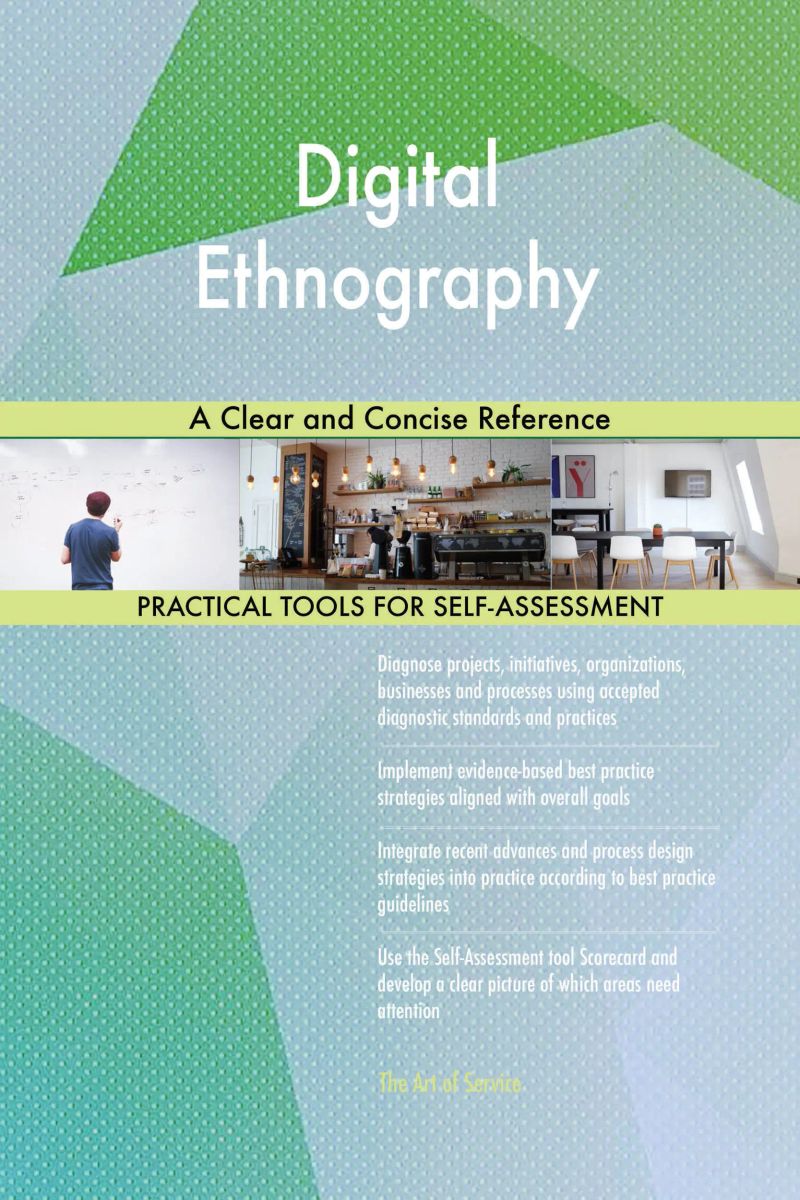
Digital Ethnography A Clear and Concise Reference
De Gerardus Blokdyk

Duração4h 7m
Sobre este audiolivro
How much does Digital Ethnography help? How do the Digital Ethnography results compare with the performance of your competitors and other organizations with similar offerings? Have you identified your Digital Ethnography key performance indicators? What is the total cost related to deploying Digital Ethnography, including any consulting or professional services? Do we cover the five essential competencies-Communication, Collaboration,Innovation, Adaptability, and Leadership that improve an organization's ability to leverage the new Digital Ethnography in a volatile global economy?
Defining, designing, creating, and implementing a process to solve a challenge or meet an objective is the most valuable role… In EVERY group, company, organization and department.
Unless you are talking a one-time, single-use project, there should be a process. Whether that process is managed and implemented by humans, AI, or a combination of the two, it needs to be designed by someone with a complex enough perspective to ask the right questions. Someone capable of asking the right questions and step back and say, 'What are we really trying to accomplish here? And is there a different way to look at it?'
This Self-Assessment empowers people to do just that - whether their title is entrepreneur, manager, consultant, (Vice-)President, CxO etc... - they are the people who rule the future. They are the person who asks the right questions to make Digital Ethnography investments work better.
This Digital Ethnography All-Inclusive Self-Assessment enables You to be that person.
All the tools you need to an in-depth Digital Ethnography Self-Assessment. Featuring 703 new and updated case-based questions, organized into seven core areas of process design, this Self-Assessment will help you identify areas in which Digital Ethnography improvements can be made.
In using the questions you will be better able to:
- diagnose Digital Ethnography projects, initiatives, organizations, businesses and processes using accepted diagnostic standards and practices
- implement evidence-based best practice strategies aligned with overall goals
- integrate recent advances in Digital Ethnography and process design strategies into practice according to best practice guidelines
Using a Self-Assessment tool known as the Digital Ethnography Scorecard, you will develop a clear picture of which Digital Ethnography areas need attention.
Your purchase includes access details to the Digital Ethnography self-assessment dashboard download which gives you your dynamically prioritized projects-ready tool and shows your organization exactly what to do next. You will receive the following contents with New and Updated specific criteria:
- The latest quick edition of the book in PDF
- The latest complete edition of the book in PDF, which criteria correspond to the criteria in...
- The Self-Assessment Excel Dashboard, and...
- Example pre-filled Self-Assessment Excel Dashboard to get familiar with results generation
…plus an extra, special, resource that helps you with project managing.
INCLUDES LIFETIME SELF ASSESSMENT UPDATES
Every self assessment comes with Lifetime Updates and Lifetime Free Updated Books. Lifetime Updates is an industry-first feature which allows you to receive verified self assessment updates, ensuring you always have the most accurate information at your fingertips.
Detalhes do audiolivro
GêneroBusiness and Economics
Duração4 h 7 min
Narrado porOuça com mais de 1.000 vozes
FormatoeBook com áudio
Data de publicação28 de jul. de 2018
IdiomaInglês
Sumário
1About The Art of Service
2Acknowledgments
3Included Resources - how to access
4Your feedback is invaluable to us
5Purpose of this Self-Assessment
Mostrar todos os capítulosVer menos
6How to use the Self-Assessment
7Digital EthnographyScorecard Example
8Digital EthnographyScorecard
9BEGINNING OF THE SELF-ASSESSMENT:
10CRITERION #1: RECOGNIZE
11CRITERION #2: DEFINE:
12CRITERION #3: MEASURE:
13CRITERION #4: ANALYZE:
14CRITERION #5: IMPROVE:
15CRITERION #6: CONTROL:
16CRITERION #7: SUSTAIN:
17Digital Ethnography and Managing Projects, Criteria for Project Managers:
18Digital Ethnography: Change Log
19Digital Ethnography: Risk Data Sheet
20Digital Ethnography: Team Directory
21Digital Ethnography: Network Diagram
22Digital Ethnography: Cost Baseline
23Digital Ethnography: Activity Cost Estimates
24Digital Ethnography: Requirements Documentation
25Digital Ethnography: Risk Register
26Digital Ethnography: Communications Management Plan
27Digital Ethnography: Team Performance Assessment
28Digital Ethnography: Duration Estimating Worksheet
29Digital Ethnography: Requirements Management Plan
30Digital Ethnography: Project Schedule
31Digital Ethnography: Variance Analysis
32Digital Ethnography: Quality Metrics
33Digital Ethnography: Initiating Process Group
34Digital Ethnography: Activity Resource Requirements
35Digital Ethnography: Formal Acceptance
36Digital Ethnography: Requirements Traceability Matrix
37Digital Ethnography: Lessons Learned
38Digital Ethnography: Project Portfolio management
39Digital Ethnography: Human Resource Management Plan
40Digital Ethnography: Cost Management Plan
41Digital Ethnography: Procurement Audit
42Digital Ethnography: Project or Phase Close-Out
43Digital Ethnography: Stakeholder Management Plan
44Digital Ethnography: Activity List
45Digital Ethnography: Project Performance Report
46Digital Ethnography: Activity Duration Estimates
47Digital Ethnography: Contract Close-Out
48Digital Ethnography: Team Member Status Report
49Digital Ethnography: Project Charter
50Digital Ethnography: Quality Management Plan
Corporate Training A Complete Guide - 2020 EditionGerardus Blokdyk4h 32min$78
Text Analytics Complete Self-Assessment GuideGerardus Blokdyk1h 57min$42
Security Strategy Second EditionGerardus Blokdyk1h 56min$42
Public Knowledge Project A Complete Guide - 2020 EditionGerardus Blokdyk4h 36min$78

Corporate Management A Complete Guide - 2020 EditionGerardus Blokdyk4h 35min$78
JIRA Service Desk A Complete Guide - 2020 EditionGerardus Blokdyk4h 42min$78

Certified Hotel Administrator A Complete Guide - 2020 EditionGerardus Blokdyk4h 38min$78
Transformation Projects A Complete Guide - 2019 EditionGerardus Blokdyk4h 35min$71
Augmented Analytics A Complete Guide - 2019 EditionGerardus Blokdyk4h 32min$71
IT Systems A Complete Guide - 2019 EditionGerardus Blokdyk4h 29min$71

Security Software A Complete Guide - 2019 EditionGerardus Blokdyk4h 42min$71
Deployment Flexibility A Complete Guide - 2019 EditionGerardus Blokdyk4h 35min$71
Data Cleansing A Complete Guide - 2020 EditionGerardus Blokdyk4h 30min$71

Analysis Of Alternatives A Complete Guide - 2021 EditionGerardus Blokdyk4h 43min$78
Data Communication Equipment A Complete Guide - 2020 EditionGerardus Blokdyk4h 41min$78
Technical surveillance counter-measures A Complete GuideGerardus Blokdyk4h 27min$71
Software Designer A Complete Guide - 2020 EditionGerardus Blokdyk4h 32min$78
Search algorithm Standard RequirementsGerardus Blokdyk1h 56min$42
OpenStack Swift Third EditionGerardus Blokdyk4h 6min$71

Never Split the DifferenceChris Voss, Tahl Raz8h 7min4.4 (277.7K)$26 · $0.00
The Intelligent Investor Rev Ed.Benjamin Graham17h 48min4.3 (191.5K)$40 · $0.00
The Hard Thing About Hard ThingsBen Horowitz7h 57min4.2 (134.3K)$26 · $0.00
Boundaries for LeadersHenry Cloud7h 36min4.3 (3.6K)$26 · $0.00

Good to GreatJim Collins9h 59min4.1 (325.2K)$29 · $0.00
The Way of ExcellenceBrad Stulberg6h 46min4.2 (1.1K)$24 · $0.00

Trillion Dollar CoachEric Schmidt, Jonathan Rosenberg, Alan Eagle5h 40min4.1 (22.2K)$24 · $0.00
Be ExceptionalJoe Navarro, Toni Sciarra Poynter9h 11min4.0 (1.3K)$29 · $0.00
The Power of the OtherHenry Cloud5h 52min4.2 (3.5K)$24 · $0.00
Basic EconomicsThomas Sowell18h 32min4.5 (29.3K)$28 · $0.00

The Ambuja StoryNarotam Sekhsaria13h 59min4.5 (830)$33 · $0.00

The Secret Door to SuccessFlorence Scovel Shinn2h 25min4.5 (2.1K)$1.20 · $0.00

This Is Going to HurtAdam Kay5h 47min4.4 (444.7K)$24 · $0.00
Big TrustShadé Zahrai, Fayçal Sekkouah8h 36min4.6 (406)$26 · $0.00
The Intelligent Investor Third EditionBenjamin Graham, Jason Zweig20h4.4 (156.6K)$46 · $0.00

Bottle of LiesKatherine Eban14h 25min4.4 (12K)$33 · $0.00

The Antiracist Business BookTrudi Lebrón6h 10min4.6 (275)$17 · $0.00

The FormulaJoshua Robinson, Jonathan Clegg10h 41min4.4 (6.9K)$29 · $0.00

Let Them LeadJohn U. Bacon7h 10min4.5 (1.4K)$24 · $0.00

Secrets of the Millionaire MindT. Harv Eker5h 11min4.4 (301.4K)$24 · $0.00
Você também pode gostar

Dropshipping Guide How to Build, Market, and Scale Your Online StoreLeo C. Harrington9h 13min$1.20 · $0.00
Customer Experience Design A Complete Guide - 2019 EditionGerardus Blokdyk4h 35min$71

Business Intelligence Solutions A Complete Guide - 2020 EditionGerardus Blokdyk4h 43min$71
Agile Project A Complete Guide - 2019 EditionGerardus Blokdyk4h 38min$71
Adherence management coaching Second EditionGerardus Blokdyk1h 59min$42
Virtual Mobile Infrastructure A Complete Guide - 2020 EditionGerardus Blokdyk4h 40min$78
Learning Management Systems A Complete Guide - 2019 EditionGerardus Blokdyk4h 51min$71
Cloud-Based IT Environment Second EditionGerardus Blokdyk4h 14min$71
Virtual Device A Complete Guide - 2020 EditionGerardus Blokdyk4h 26min$78
Business Manager The Ultimate Step-By-Step GuideGerardus Blokdyk1h 55min$42

Microsoft Azure Complete Self-Assessment GuideGerardus Blokdyk1h 58min$42
Transformation Strategy A Complete Guide - 2019 EditionGerardus Blokdyk4h 36min$71
Mobile Monitoring The Ultimate Step-By-Step GuideGerardus Blokdyk4h 11min$71
Recovery Assurance A Clear and Concise ReferenceGerardus Blokdyk4h 8min$71
Enterprise Technology Architecture ETA Second EditionGerardus Blokdyk4h 22min$71
Data Management Security A Complete Guide - 2019 EditionGerardus Blokdyk4h 40min$71
Social Media Monitoring Tools A Complete Guide - 2020 EditionGerardus Blokdyk4h 43min$71
Application Security Vulnerabilities A Complete Guide - 2019 EditionGerardus Blokdyk4h 39min$71

Materials Data Management A Complete Guide - 2020 EditionGerardus Blokdyk4h 39min$78

New Directions A Complete Guide - 2024 EditionGerardus Blokdyk4h 40min$78