
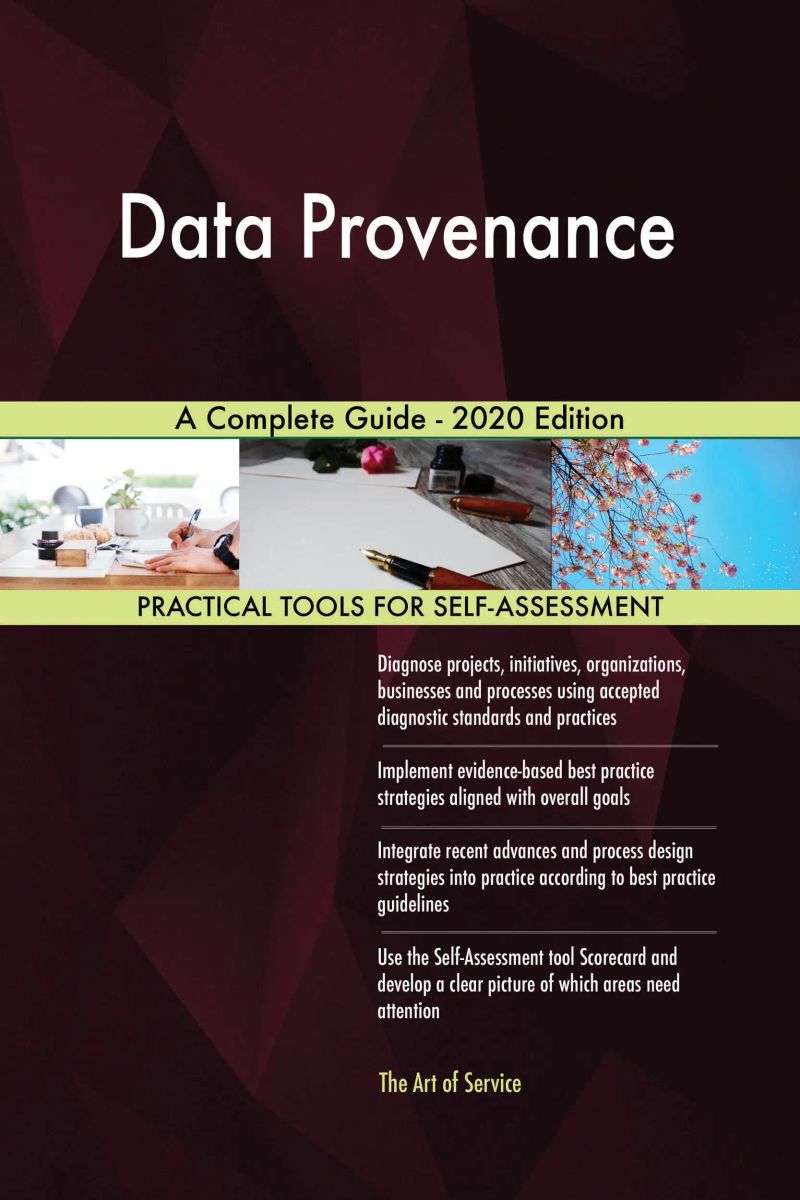
Data Provenance A Complete Guide - 2020 Edition
De Gerardus Blokdyk


Duração4h 28m
Sobre este audiolivro
Do you all define Data Provenance in the same way? Are the Data Provenance requirements complete? How do you manage Data Provenance Knowledge Management (KM)? What are the core elements of the Data Provenance business case? Who is the Data Provenance process owner?
Defining, designing, creating, and implementing a process to solve a challenge or meet an objective is the most valuable role… In EVERY group, company, organization and department.
Unless you are talking a one-time, single-use project, there should be a process. Whether that process is managed and implemented by humans, AI, or a combination of the two, it needs to be designed by someone with a complex enough perspective to ask the right questions. Someone capable of asking the right questions and step back and say, 'What are we really trying to accomplish here? And is there a different way to look at it?'
This Self-Assessment empowers people to do just that - whether their title is entrepreneur, manager, consultant, (Vice-)President, CxO etc... - they are the people who rule the future. They are the person who asks the right questions to make Data Provenance investments work better.
This Data Provenance All-Inclusive Self-Assessment enables You to be that person.
All the tools you need to an in-depth Data Provenance Self-Assessment. Featuring 945 new and updated case-based questions, organized into seven core areas of process design, this Self-Assessment will help you identify areas in which Data Provenance improvements can be made.
In using the questions you will be better able to:
- diagnose Data Provenance projects, initiatives, organizations, businesses and processes using accepted diagnostic standards and practices
- implement evidence-based best practice strategies aligned with overall goals
- integrate recent advances in Data Provenance and process design strategies into practice according to best practice guidelines
Using a Self-Assessment tool known as the Data Provenance Scorecard, you will develop a clear picture of which Data Provenance areas need attention.
Your purchase includes access details to the Data Provenance self-assessment dashboard download which gives you your dynamically prioritized projects-ready tool and shows your organization exactly what to do next. You will receive the following contents with New and Updated specific criteria:
- The latest quick edition of the book in PDF
- The latest complete edition of the book in PDF, which criteria correspond to the criteria in...
- The Self-Assessment Excel Dashboard
- Example pre-filled Self-Assessment Excel Dashboard to get familiar with results generation
- In-depth and specific Data Provenance Checklists
- Project management checklists and templates to assist with implementation
INCLUDES LIFETIME SELF ASSESSMENT UPDATES
Every self assessment comes with Lifetime Updates and Lifetime Free Updated Books. Lifetime Updates is an industry-first feature which allows you to receive verified self assessment updates, ensuring you always have the most accurate information at your fingertips.
Detalhes do audiolivro
GêneroBusiness and Economics
Duração4 h 28 min
Narrado porOuça com mais de 1.000 vozes
FormatoeBook com áudio
Data de publicação17 de nov. de 2019
IdiomaInglês
Sumário
1About The Art of Service
2Included Resources - how to access
3Purpose of this Self-Assessment
4How to use the Self-Assessment
5Data ProvenanceScorecard Example
Mostrar todos os capítulosVer menos
6Data ProvenanceScorecard
7BEGINNING OF THE SELF-ASSESSMENT:
8CRITERION #1: RECOGNIZE
9CRITERION #2: DEFINE:
10CRITERION #3: MEASURE:
11CRITERION #4: ANALYZE:
12CRITERION #5: IMPROVE:
13CRITERION #6: CONTROL:
14CRITERION #7: SUSTAIN:
15Data Provenance and Managing Projects, Criteria for Project Managers:
161.0 Initiating Process Group: Data Provenance
171.1 Project Charter: Data Provenance
181.2 Stakeholder Register: Data Provenance
191.3 Stakeholder Analysis Matrix: Data Provenance
202.0 Planning Process Group: Data Provenance
212.1 Project Management Plan: Data Provenance
222.2 Scope Management Plan: Data Provenance
232.3 Requirements Management Plan: Data Provenance
242.4 Requirements Documentation: Data Provenance
252.5 Requirements Traceability Matrix: Data Provenance
262.6 Project Scope Statement: Data Provenance
272.7 Assumption and Constraint Log: Data Provenance
282.8 Work Breakdown Structure: Data Provenance
292.9 WBS Dictionary: Data Provenance
302.10 Schedule Management Plan: Data Provenance
312.11 Activity List: Data Provenance
322.12 Activity Attributes: Data Provenance
332.13 Milestone List: Data Provenance
342.14 Network Diagram: Data Provenance
352.15 Activity Resource Requirements: Data Provenance
362.16 Resource Breakdown Structure: Data Provenance
372.17 Activity Duration Estimates: Data Provenance
382.18 Duration Estimating Worksheet: Data Provenance
392.19 Project Schedule: Data Provenance
402.20 Cost Management Plan: Data Provenance
412.21 Activity Cost Estimates: Data Provenance
422.22 Cost Estimating Worksheet: Data Provenance
432.23 Cost Baseline: Data Provenance
442.24 Quality Management Plan: Data Provenance
452.25 Quality Metrics: Data Provenance
462.26 Process Improvement Plan: Data Provenance
472.27 Responsibility Assignment Matrix: Data Provenance
482.28 Roles and Responsibilities: Data Provenance
492.29 Human Resource Management Plan: Data Provenance
502.30 Communications Management Plan: Data Provenance
Azure AD Connect A Clear and Concise ReferenceGerardus Blokdyk4h 9min$71
Digital Transformation A Complete Guide - 2024 EditionGerardus Blokdyk4h 25min$78
Automated Driving System A Complete Guide - 2020 EditionGerardus Blokdyk4h 37min$78
Master Service Agreement A Complete Guide - 2019 EditionGerardus Blokdyk4h 24min$71
Digital Business Opportunities A Complete Guide - 2019 EditionGerardus Blokdyk4h 36min$71
Back-to-back user agent Third EditionGerardus Blokdyk1h 57min$42
Operations Manager Complete Self-Assessment GuideGerardus Blokdyk1h 55min$42
BPO Complete Self-Assessment GuideGerardus Blokdyk1h 55min$42
Operations And Technology A Complete Guide - 2021 EditionGerardus Blokdyk4h 46min$78
Smart Grid A Complete Guide - 2021 EditionGerardus Blokdyk4h 37min$78
Data Archive A Complete Guide - 2020 EditionGerardus Blokdyk4h 24min$78
IBM Blueworks Live A Complete Guide - 2019 EditionGerardus Blokdyk4h 32min$71
Workspace Integration Third EditionGerardus Blokdyk4h 10min$71
data discovery A Complete Guide - 2019 EditionGerardus Blokdyk4h 19min$71
Enterprise PMO A Complete Guide - 2019 EditionGerardus Blokdyk4h 44min$71
Ecosystem Maturity A Complete Guide - 2019 EditionGerardus Blokdyk4h 35min$71
Oracle BPEL Process Manager Third EditionGerardus Blokdyk4h 5min$42
Unit Adoption A Clear and Concise ReferenceGerardus Blokdyk4h 4min$71
SLA A Complete GuideGerardus Blokdyk3h 59min$42
Never Split the DifferenceChris Voss, Tahl Raz8h 7min4.4 (277.7K)$26 · $0.00
The Intelligent Investor Rev Ed.Benjamin Graham17h 48min4.3 (191.5K)$40 · $0.00
The Hard Thing About Hard ThingsBen Horowitz7h 57min4.2 (134.3K)$26 · $0.00
Boundaries for LeadersHenry Cloud7h 36min4.3 (3.6K)$26 · $0.00
Good to GreatJim Collins9h 59min4.1 (325.2K)$29 · $0.00
The Way of ExcellenceBrad Stulberg6h 46min4.2 (1.1K)$24 · $0.00

Trillion Dollar CoachEric Schmidt, Jonathan Rosenberg, Alan Eagle5h 40min4.1 (22.2K)$24 · $0.00
Be ExceptionalJoe Navarro, Toni Sciarra Poynter9h 11min4.0 (1.3K)$29 · $0.00
The Power of the OtherHenry Cloud5h 52min4.2 (3.5K)$24 · $0.00
Basic EconomicsThomas Sowell18h 32min4.5 (29.3K)$28 · $0.00

The Ambuja StoryNarotam Sekhsaria13h 59min4.5 (830)$33 · $0.00

The Secret Door to SuccessFlorence Scovel Shinn2h 25min4.5 (2.1K)$1.20 · $0.00

This Is Going to HurtAdam Kay5h 47min4.4 (444.7K)$24 · $0.00

Big TrustShadé Zahrai, Fayçal Sekkouah8h 36min4.6 (406)$26 · $0.00
The Intelligent Investor Third EditionBenjamin Graham, Jason Zweig20h4.4 (156.6K)$46 · $0.00
Bottle of LiesKatherine Eban14h 25min4.4 (12K)$33 · $0.00

The Antiracist Business BookTrudi Lebrón6h 10min4.6 (275)$17 · $0.00

The FormulaJoshua Robinson, Jonathan Clegg10h 41min4.4 (6.9K)$29 · $0.00

Let Them LeadJohn U. Bacon7h 10min4.5 (1.4K)$24 · $0.00

Secrets of the Millionaire MindT. Harv Eker5h 11min4.4 (301.4K)$24 · $0.00
Você também pode gostar
My Boss Told Me to Automate Something Nobody Understands - How to Organize a Process Before Implementing AI and Measure the Real GainsMax Paradox5h 47min$7.40
Beacons The Ultimate Step-By-Step GuideGerardus Blokdyk3h 59min$71
Carbon Disclosure Project A Complete Guide - 2019 EditionGerardus Blokdyk4h 47min$71
Product Revenue A Complete Guide - 2020 EditionGerardus Blokdyk4h 31min$71
Software requirements Third EditionGerardus Blokdyk1h 57min$42
SCCM Software Change And Configuration Management A Complete Guide - 2021 EditionGerardus Blokdyk4h 58min$78
Corporate Training A Complete Guide - 2020 EditionGerardus Blokdyk4h 32min$78
Public Knowledge Project A Complete Guide - 2020 EditionGerardus Blokdyk4h 36min$78
Corporate Management A Complete Guide - 2020 EditionGerardus Blokdyk4h 35min$78
BMC Remedy ITSM Suite Complete Self-Assessment GuideGerardus Blokdyk1h 56min$42
Augmented Analytics A Complete Guide - 2019 EditionGerardus Blokdyk4h 32min$71
IT Systems A Complete Guide - 2019 EditionGerardus Blokdyk4h 29min$71
Software Designer A Complete Guide - 2020 EditionGerardus Blokdyk4h 32min$78
Government Policies A Clear and Concise ReferenceGerardus Blokdyk4h 9min$71
Demand Forecasting A Complete Guide - 2020 EditionGerardus Blokdyk4h 45min$71
Systems administrator Information A Clear and Concise ReferenceGerardus Blokdyk4h 16min$71
Tactical Risk Management A Complete Guide - 2020 EditionGerardus Blokdyk4h 37min$78
Network Fault Monitoring Tools Standard RequirementsGerardus Blokdyk4h 17min$71
Messaging security A Clear and Concise ReferenceGerardus Blokdyk1h 54min$42
Microsoft Intune A Complete Guide - 2019 EditionGerardus Blokdyk4h 11min$71