
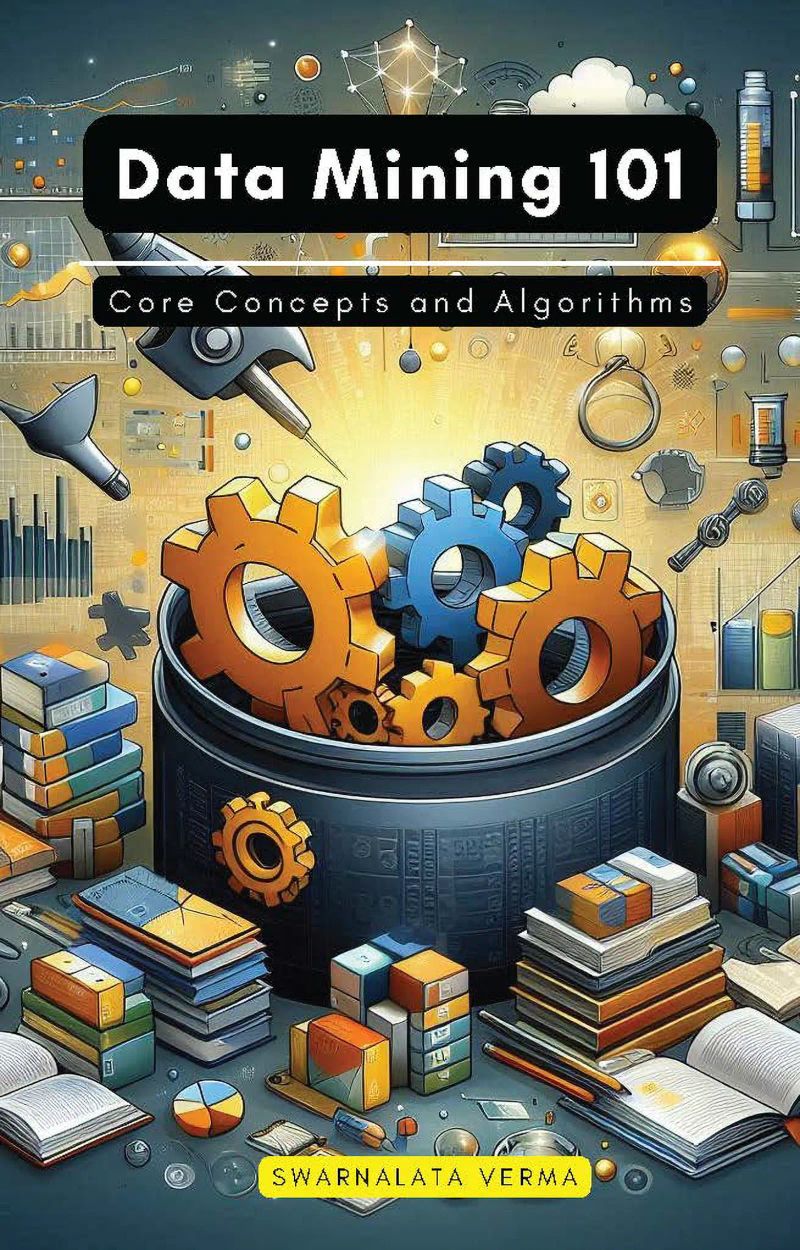


Duração7h 36m
Sobre este audiolivro
Data Mining 101: Core Concepts and Algorithms provides an in-depth exploration of data science and big data methodologies. This book is divided into several chapters, covering a wide range of topics from inductive mining techniques and software tools to the entire process of mining, from discovery to predictive analytics.
We discuss the decision-making capabilities of research methods and how they enhance pattern recognition and data structure representation. In turn, these characterizations improve the efficiency of decision-making algorithms. Starting with a general introduction to data science and process mining, the book builds a solid foundation for understanding key concepts.
Our textbook offers a broad yet detailed overview of data mining, integrating related machine learning and statistical concepts. Topics include data analysis, pattern mining, clustering, classification, kernel methods, high-dimensional data analysis, and complex graphs and networks. Designed for students, researchers, and practitioners, this book provides comprehensive guidance and a wealth of examples.
Data Mining 101: Core Concepts and Algorithms is your essential resource for mastering the art and science of data mining.
Detalhes do audiolivro
GêneroTechnology, Science and Nature
Duração7 h 36 min
Narrado porOuça com mais de 1.000 vozes
FormatoeBook com áudio
Data de publicação7 de jan. de 2025
IdiomaInglês
Sumário
11.1 New Problems and New Opportunities
21.2 What is a Model?
31.3 A Matter of Style
42.1 Old Friend and Linear Models
52.2 Computational Aspects
Mostrar todos os capítulosVer menos
62.3 Likelihood
7 2.4 Logistic Regression and GLM
82.5 Questions
93.1 Matching the conceptual frame and
10real life
113.2 A Simple Prototype Problem
123.3 If we knew f(x)…..
133.4 But As We Don’t Know f(x)
143.5 Methods For Model Selection
153.6 Reduction Of Dimensions And Selection Of
16Most appropriate Model
173.7 Questions
184.1 Non-parametric Estimation: Why?
194.2 Logical Regression
204.3 The Curse Of Dimensionality
214.4 Splines
224.6 Projection Pursuit
234.7 Inferential Aspects
244.8 Regression Trees
254.9 Neural Networks
264.11 Summary
274.12 Questions
285.1 Prediction of Categorical Variables
295.2 An Introduction Based On A Marketing
30Problem
31 5.3 Extension To Several Categories
325.4 Classification Via Linear Regression
335.5 Discriminant Analysis
345.6 Some Nonparametric Methods
355.7 Classification Trees
365.8 Other TOPICS
375.9 Combination Of Classifiers
385.10 Case Studies
395.11 Questions
406.1 Cluster Analysis
416.2 Associations Among Variables
426.3 Case Study: Web Usage Mining
436.4 Questions
44A–B–C
45Optimism, Conflicts, and Trade-offs
46Prediction of Quantitative Analysis and Variables
47Methods of Classification
48Methods Of Internal Analysis
49Appendix A: Symbols and acronyms
50Glossary
Collected Writings of Nikola TeslaThomas Commerford Martin, Nikola Tesla19h 42min4.4 (2.8K)$1.99 · $0.00

Operation PedestalMax Hastings12h 29min4.4 (5.2K)$29 · $0.00

When the Heavens Went on SaleAshlee Vance18h 20min4.4 (3K)$40 · $0.00

Everybody Has a Podcast (Except You)Justin McElroy, Travis McElroy, Griffin McElroy5h 9min4.3 (2.3K)$24 · $0.00

Hands of TimeRebecca Struthers8h 8min4.4 (1.3K)$26 · $0.00
Never Lost AgainBill Kilday10h 1min4.4 (805)$29 · $0.00

How the Internet HappenedBrian McCullough13h 28min4.3 (2.7K)$23 · $0.00

Collected Writings of Nikola TeslaNikola Tesla, Thomas Commerford Martin21h 50min4.3 (1.7K)$1 · $0.00

Just AspireAjai Chowdhry9h 13min4.4 (260)$29 · $0.00

The Little Book of AliensAdam Frank8h 20min4.3 (1.3K)$26 · $0.00
The inventions, researches and writings of Nikola Tesla (Annotated)Thomas Commerford Martin16h 59min4.3 (1.3K)$2 · $0.00

KargilV.P. Malik15h 18min4.3 (2K)$24 · $0.00
Experiments with Alternating CurrentsNikola Tesla9h 16min4.3 (874)$1.99 · $0.00

Fire on the HorizonTom Shroder, John Konrad8h 23min4.3 (858)$26 · $0.00

The Smell of Kerosene (Annotated)National Aeronautics and Space Administration, Donald L. Mallick, Peter W. Merlin11h 32min4.3 (523)$2 · $0.00

The Boy Who Harnessed the WindWilliam Kamkwamba, Bryan Mealer10h 5min4.2 (78.9K)$29 · $0.00

Across the Airless WildsEarl Swift10h 8min4.3 (1.3K)$29 · $0.00

Console WarsBlake J. Harris20h 41min4.2 (13.7K)$46 · $0.00

Improvised Munitions HandbookU.S. Department of Defense4h 49min4.3 (1.6K)$1.99 · $0.00
Escaping GravityLori Garver10h 54min4.2 (2.2K)$20 · $0.00

A Brief History of IntelligenceMax S. Bennett12h 18min4.6 (6.6K)$29 · $0.00
The Story of BirdsSteve Brusatte11h 49min4.6 (401)$29 · $0.00

LiftoffEric Berger9h 4min4.6 (9.5K)$29 · $0.00
Black Earth WisdomLeah Penniman11h 54min4.6 (577)$8 · $0.00

Total Cat MojoJackson Galaxy10h 13min4.5 (8.4K)$23 · $0.00

My Life Among the UnderdogsTia Torres5h 51min4.5 (4K)$24 · $0.00

What It Takes to Save a LifeKwane Stewart6h4.6 (556)$24 · $0.00

Pastoral SongJames Rebanks8h 35min4.5 (12K)$26 · $0.00

How Stella Learned to TalkChristina Hunger7h4.5 (10.9K)$24 · $0.00

Craig & FredCraig Grossi8h 6min4.5 (9.6K)$26 · $0.00

Celebrating BirdsNatalia Rojas, Ana Maria Martinez6h 47min4.6 (330)$24 · $0.00

Saving JemimaJulie Zickefoose4h 59min4.5 (749)$20 · $0.00

Will's Red CoatTom Ryan8h 23min4.5 (2.3K)$26 · $0.00

Of Time and TurtlesSy Montgomery10h 34min4.5 (5K)$29 · $0.00

THE WOLF TRILOGY: Call of the Wild, White Fang & The Son of the WolfJack London17h 31min4.5 (2.4K)$1.99 · $0.00

Zen and the Art of Saving the PlanetThich Nhat Hanh9h 20min4.5 (3.9K)$29 · $0.00

BLACK BEAUTY (With Original Illustrations)Anna Sewell7h 31min4.5 (1.3K)$1.99 · $0.00

Bottle of LiesKatherine Eban14h 25min4.4 (12K)$33 · $0.00

IngrainedCallum Robinson8h 10min4.5 (1.1K)$26 · $0.00

The Lion Tracker's Guide To LifeBoyd Varty3h 1min4.4 (4.8K)$18 · $0.00
Você também pode gostar

Day Trading AttentionGary Vaynerchuk8h 25min4.3 (1.8K)$28 · $0.00
Google ItAnna Crowley Redding4h 18min4.0 (711)$15
Collected Writings of Nikola TeslaThomas Commerford Martin, Nikola Tesla19h 42min4.4 (2.8K)$1.99 · $0.00

Reengineering the CorporationMichael Hammer, James Champy1h 29min3.8 (7.3K)$16 · $0.00
The Nine Billion Names of GodArthur C. Clarke15min4.2 (10.6K)$1 · $0.00

Video Technology Standard RequirementsGerardus Blokdyk4h 6min$71

How To Code For Quantum ComputersNivio Dos Santos2h 19min5.0 (1)$46 · $0.00

The Golden BitcoinMichael A. Duniec6h 44min5.0 (1)$14.99 · $0.00

Introduction manual to S&OPCristina Peña1h 34min4.4 (15)$23 · $0.00

The Definitive Guide To The World's Leading Artificial IntelligenceKael Novera6h 51min$8 · $0.00

Business-Englisch lernen Audio - Eine kraftvolle PräsentationMelita Cameron-Wood58min$17

The Hidden Power of AI for Financial GrowthNora V. Halden3h 33min5.0 (1)$2.30 · $0.00

The Evolution of Technologythe Speech Resource Company9h 30min$20

Appreciating Analytic Philosophy - A Conversation with Scott SoamesHoward Burton1h 27min$3

Digital Banking Transformation A Complete Guide - 2020 EditionGerardus Blokdyk7h 4min$21

Blockchain : The technology that will transform commerceUnknown Author1h 9min$17 · $0.00

Ai cash machineJOHN J CARPENTER1h 49min$5.80 · $0.00

ChatGPT Secrets for Nonfiction AuthorsDaniel Roberts3h 4min$12 · $0.00

ICT In Education A Complete Guide - 2020 EditionGerardus Blokdyk4h 41min$78

Artificial IntelligenceJ.C.Lesko2h 43min$15 · $0.00