
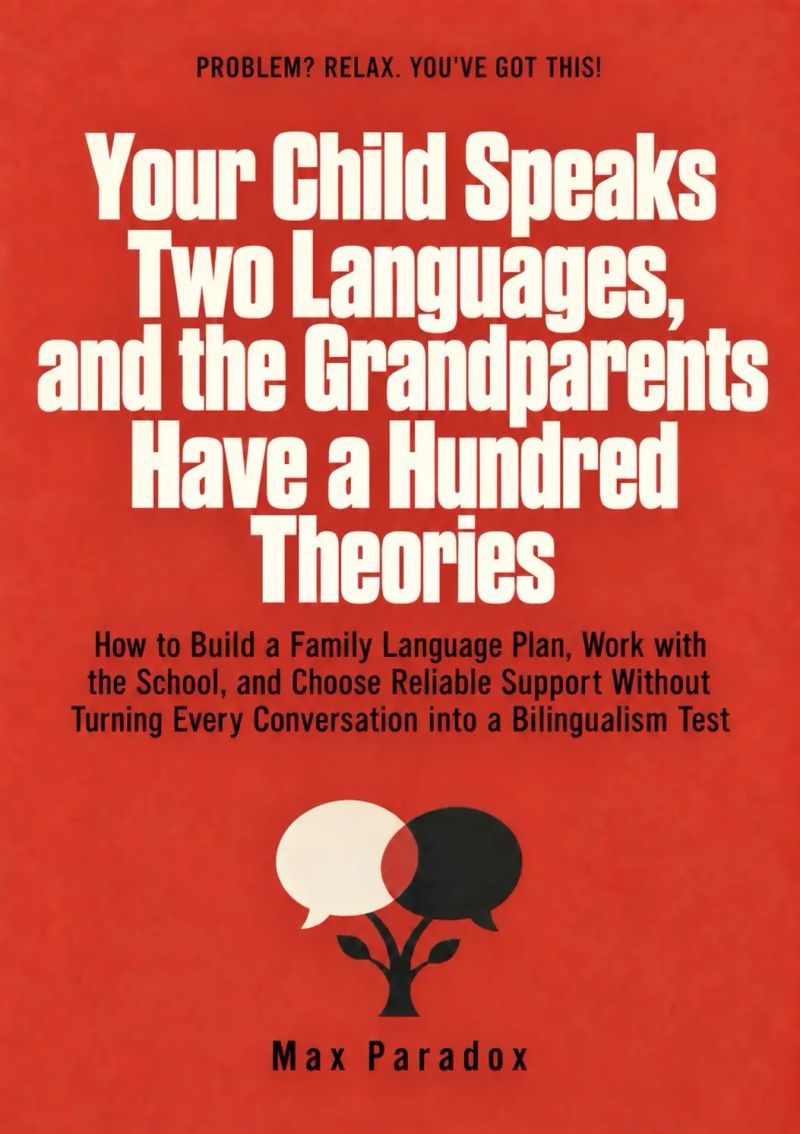
Your Child Speaks Two Languages, and the Grandparents Have a Hundred Theories - How to Build a Family Language Plan, Work with the School, and Choose Reliable Support Without Turning Every Conversation into a Bilingualism Test
By Max Paradox


Length6h 44m
About this audiobook
Your child speaks two languages. Your family has seventeen opinions, three conflicting strategies, and a grandmother who would like to conduct an oral examination before dessert.
Welcome to bilingual parenting, where an innocent sentence can trigger an international debate about grammar, childhood development, and whether someone is doing everything terribly wrong.
One grandparent thinks mixing languages is dangerous. Another insists that children should always answer in the language they're spoken to. The teacher has concerns that don't match what you see at home. Meanwhile, an internet expert promises perfect bilingualism in thirty days, provided you purchase the premium package.
And your child? They were just trying to tell you what happened at school.
In Your Child Speaks Two Languages, and the Grandparents Have a Hundred Theories, Max Paradox takes a funny, thoughtful, and practical look at the real challenges of raising bilingual children.
This isn't another guide demanding perfect consistency, endless worksheets, or a household schedule so complicated it requires its own project manager. It's about understanding how children actually use their languages, recognising what they need, and creating a family approach that works even when ordinary life refuses to cooperate.
Inside this book, you'll discover how to:
Build a realistic family language plan that respects school, work, relationships, and limited time.
Understand why a child may speak one language confidently while preferring another in certain situations.
Respond to language switching without turning every conversation into a grammar lesson.
Handle grandparents' conflicting advice while protecting important family relationships.
Encourage meaningful speaking opportunities without pressure, bribery, or compulsory performances.
Work constructively with teachers when classroom concerns differ from what you observe at home.
Identify when professional assessment may be appropriate and choose support that matches the actual difficulty.
Develop reading and writing skills without making every evening a second school day.
Navigate relocation, changing family arrangements, adolescence, and periods when a language receives less attention.
The book also explores more complicated circumstances, including developmental communication difficulties, the challenges of maintaining a heritage language, and the emotional consequences of turning language choices into questions of family loyalty.
Throughout twenty chapters, Max Paradox combines relatable family situations, clear explanations, practical decisions, and observational humour. You'll learn to distinguish normal differences in language experience from concerns that deserve closer attention, recognise when a strategy needs adjusting, and avoid wasting money or energy on solutions that don't address the problem.
Most importantly, you'll discover how to keep communication at the centre of bilingual family life.
Because raising a bilingual child isn't about producing a miniature professional translator who can recite vocabulary on command, impress every relative, and maintain identical proficiency in every subject.
It's about helping a young person communicate, learn, participate, and maintain meaningful relationships in the languages that matter to them.
Two languages should open doors, not turn your living room into an examination centre.
If you're tired of conflicting advice, unrealistic expectations, and family debates about every borrowed word, this book offers a more thoughtful and considerably more enjoyable way forward.
Your child has enough to learn already. They shouldn't also have to defend their bilingualism before a committee of grandparents.
This publication was prepared using tools that support the creative process, including artificial intelligence solutions. The final concept, structure and editing are the responsibility of the author.
Audiobook details
GenreSelf-Help
Length6 hrs 44 mins
Narrated byListen with 1,000+ voices
FormateBook with Audio
Publish dateNov 1, 2026
LanguageEnglish
Table of contents
1INTRO
2Chapter 1 - Two Languages, One Child, and an Entire Committee of Self-Appointed Experts
3Chapter 2 - Who Speaks What to Whom? Mapping the Languages Your Family Actually Lives In
4Chapter 3 - Grandma Knows Best, and Apparently Everyone Else Is Doing It Wrong
5Chapter 4 - Congratulations, You've Turned Every Conversation into a Test
Show all chaptersShow less
6Chapter 5 - The Perfect Family Language Plan, Until Actual Family Life Shows Up
7Chapter 6 - Please Don't Speak That Language in Front of My Friends
8Chapter 7 - The School Says There's a Problem, but Which Problem Are We Actually Talking About?
9Chapter 8 - The Internet Has Diagnosed Your Child Before You've Finished Reading the Question
10Chapter 9 - From Understanding to Speaking: Giving Your Child a Reason to Use Both Languages
11Chapter 10 - The Parent-Teacher Meeting That Actually Ends with a Plan
12Chapter 11 - Speech Therapist, Language Specialist, or Internet Miracle Worker? Finding Help That Actually Fits the Problem
13Chapter 12 - Two Languages, Two Writing Systems, and One Child Who Is Officially Done with Homework
14Chapter 13 - The Family's Official Translator Is Twelve Years Old and Would Like to Resign
15Chapter 14 - New Country, New School, and a Language That Suddenly Has a Different Job
16Chapter 15 - The Language That Went Quiet: Rebuilding Confidence After a Long Break
17Chapter 16 - When Bilingualism Isn't the Whole Explanation: Supporting a Child with Genuine Communication Difficulties
18Chapter 17 - Two Homes, Two Languages, and a Child Who Refuses to Choose Sides
19Chapter 18 - The Long Game: Keeping a Family Language Plan Useful as Your Child Grows
20Chapter 19 - Warning Lights, False Alarms, and Knowing When Your Family Language Plan Needs Attention
21Chapter 20 - Your Child Has Two Languages and One Life: Knowing When to Stop Managing and Start Trusting

The Building Association Raises the Repair Fund, and I Raise My Blood Pressure - How to Read Your Building's Budget, Ask Questions About Repairs, and Take Part in Building Decisions Without Voting Based Solely on the Latest Argument at the Owners' MeMax Paradox6h 47m$7.60

Dziecko Mówi Dwoma Językami, a Dziadkowie Mają Sto Teorii - Jak budować rodzinny plan używania języków, współpracować ze szkołą i wybierać rzetelne wsparcie bez robienia z każdej rozmowy egzaminu z dwujęzycznościMax Paradox6h 17m$7.60

My Bike Should Take Me to Work, Not Stand in the Hallway - How to Plan Your Route, Gear, Parking, and Bad-Weather Options, and Gradually Make Cycling Part of Your Everyday Commute Without Buying a Pro Cyclist Identity Along with Your HelmetMax Paradox6h 21m$7.60

Dzielimy Mieszkanie po Rodzicach i Każdy Ma Inny Kalkulator - Jak uzgadniać korzystanie z odziedziczonej nieruchomości, koszty i kierunek dalszych decyzji oraz przygotować się do mediacji bez rodzinnej licytacji na zasługiMax Paradox6h 18m$7.60

The Hearing Aid Didn't Fix Every Conversation - How to Agree on Communication Conditions with Loved Ones and Coworkers, Use Available Accommodations, and Stay Connected Without Pretending You Heard EverythingMax Paradox6h 25m$7.60

My Child Has an Allergy, and Everyone Has Good Advice and a Cookie - How to Agree on a Daily Safety Plan with Specialists, School, and Loved Ones, Share Instructions, and Organize Outings Without Explaining Everything from Scratch Every Time SomeoneMax Paradox6h 37m$7.60

I Can't Drive Anymore, but Life Is Still Twenty Kilometers Away - How to Organize Shopping, Appointments, and Social Connections After Giving Up Driving and Build a Transportation Support Network Without Letting Others Control Your Entire CalendarMax Paradox6h 30m$7.60

Nie Mogę Już Prowadzić, a Życie Nadal Jest Dwadzieścia Kilometrów Dalej - Jak zorganizować zakupy, wizyty i kontakty po rezygnacji z prowadzenia auta oraz stworzyć sieć transportowego wsparcia bez oddawania całego kalendarza innym ludziomMax Paradox6h 19m$7.60

W Domu Jest Trzydzieści Stopni, a Klimatyzacja Jest w Planach - Jak organizować mieszkanie, obowiązki i pomoc dla bardziej narażonych domowników podczas upałów oraz planować potrzebne dostosowania bez czekania na kolejne rekordowe latoMax Paradox5h 55m$7.60

My Child Has a Special Education Ruling, but the School Has Its Own Interpretation - How to Organize Recommendations, Prepare for Meetings, and Monitor Agreed Educational Accommodations Without Fighting a Daily Battle Over Every Need Your Child HasMax Paradox6h 37m$7.60

Nasze Dziecko Jest Pierwsze w Rodzinie, Które Idzie na Studia - Jak wspierać wybór uczelni, przeprowadzkę i samodzielność, poznawać akademickie zasady oraz rozmawiać o kosztach bez udawania rodzinnego doświadczenia, którego jeszcze nie maMax Paradox6h 7m$7.60

Woda Wyszła z Domu, a My Nadal Nie Wiemy, od Czego Zacząć - Jak uporządkować dokumentację szkód, zadania i dostępne wsparcie po zalaniu lub powodzi oraz planować powrót do codzienności bez podejmowania wszystkich decyzji pierwszego dniaMax Paradox6h 20m$7.60

Rodzice Się Rozwodzą, a Ja Mam Czterdzieści Lat - Jak nie zostać mediatorem, powiernikiem i kurierem pretensji, ustalić własne relacje z obojgiem rodziców oraz odnaleźć się w zmianie rodzinnego układuMax Paradox6h 12m4.6 (25)$7.60

The Heat Pump Is New, and I Still Don't Know What to Set - How to Gather Installation Documentation, Understand Basic Settings and Energy Consumption, and Work with Your Installer to Optimize Performance Without Experimenting with the Entire HeatingMax Paradox6h 31m$7.60

The Adult Child Moves Back Home and Brings Their Own Rulebook - How to Agree on Costs, Responsibilities, Privacy, and the Ground Rules for Living Together Again Without Recreating the Parent-and-Teenager DynamicMax Paradox6h 36m$7.60

Kupujemy Mieszkanie Razem, Ale Nie Jesteśmy Małżeństwem - Jak przygotować rozmowy o wkładach, odpowiedzialności i możliwym rozstaniu oraz zebrać pytania do specjalistów bez zakładania, że miłość zastępuje wszystkie ustaleniaMax Paradox6h 12m$7.60

Studiuję, Pracuję i Podobno To Ma Być Najlepszy Czas Życia - Jak łączyć wymagania uczelni z zarabianiem, planować sesję i szukać dostępnego wsparcia bez finansowania studiów wyłącznie własnym snemMax Paradox6h 28m$7.60

My Partner Is from Another Country, and Our Families Have Two Recipes for Everything - How to Navigate Traditions, Language, and Family Expectations as an Intercultural Couple Without Deciding Whose Family Is Right at Every HolidayMax Paradox6h 51m$7.60

My Father Has Fallen in Love Again, and I Have No Ready-Made Role for This - How to Talk to Your Parent About a New Relationship, Sort Through Your Emotions, and Build a Connection with His Partner Without Taking Responsibility for Other Adults' LiveMax Paradox6h 33m$7.60

We're Buying an Apartment Together, but We're Not Married - How to Discuss Contributions, Responsibilities, and a Possible Breakup, and Prepare Questions for Professionals Without Assuming Love Can Replace Clear AgreementsMax Paradox6h 35m$7.60
Learning to PrayJames Martin13h 24m4.5 (3.4K)$33 · $0.00

Truth Without ApologyAcharya Prashant6h 41m4.8 (2.2K)$18 · $0.00

Autism Out Loud: the instant New York Times Bestseller. Moving Stories and Parenting Lessons Learned from Three Mothers of Children with AutismKate Swenson, Carrie Cariello, Adrian Wood8h 41m4.8 (2.1K)$26 · $0.00

The StepsSylvester Stallone9h 4m4.8 (635)$29 · $0.00

Swayam Ki AwaazPrem Rawat8h 34m4.7 (1.1K)$26 · $0.00

Forever BoyKate Swenson9h 27m4.7 (5K)$29 · $0.00

You Are Worth ItKyle Carpenter, Don Yaeger8h 53m4.7 (4.8K)$29 · $0.00

The Happiest Man on EarthEddie Jaku3h 48m4.6 (178K)$7 · $0.00

Finding MeViola Davis9h 15m4.6 (256.4K)$29 · $0.00

Spiritual AnatomyDaaji Kamlesh D. Patel9h 47m4.7 (319)$29 · $0.00

The Dangerous Truth about Today’s MarijuanaLaura Stack CSP, MBA9h 57m4.7 (385)$20 · $0.00

The Gospel according to Spiritualism (Translated)Allan Kardec14h 39m4.6 (3.9K)$5.70 · $0.00

Birdie & HarlowTaylor Wolfe7h 50m4.6 (6.5K)$26 · $0.00

CrossroadsKaleb Dahlgren7h 56m4.6 (4.9K)$26 · $0.00

Life on the BridgeKaelynn Partlow5h 40m4.6 (1.1K)$24 · $0.00

Keep Your Love OnDanny Silk9h 4m4.6 (8.1K)$10 · $0.00

The Tao of Joy Every DayDerek Lin10h 24m4.6 (762)$20 · $0.00

UndividedVicky Beeching9h 2m4.6 (1.3K)$29 · $0.00

HE CAN WHO THINKS HE CAN & OTHER BOOKS ON SUCCESSOrison Swett Marden5h 54m4.6 (1.2K)$1.99 · $0.00

Level UpRob Dial7h 42m4.6 (3.3K)$26 · $0.00
You may also like
The Art of Talking with ChildrenRebecca Rolland12h 29m4.1 (442)$29 · $0.00

#AskGaryVeeGary Vaynerchuk11h 38m4.2 (5K)$29 · $0.00

Just Show UpCal Ripken Jr., James Dale3h 33m4.0 (4K)$18 · $0.00

You Learn by LivingEleanor Roosevelt5h 29m4.2 (6.5K)$24 · $0.00

KAMA SUTRA (Annotated)Richard Francis Burton7h 57m3.7 (26.7K)$2 · $0.00

Well EndowedVivian Tu8h 11m3.9 (1.7K)$12 · $0.00

HOW TO WIN FRIENDS AND INFLUENCE PEOPLEDale Carnegie11h 13m4.3 (1.4M)$0.99 · $0.00
My Partner Is from Another Country, and Our Families Have Two Recipes for Everything - How to Navigate Traditions, Language, and Family Expectations as an Intercultural Couple Without Deciding Whose Family Is Right at Every HolidayMax Paradox6h 51m$7.60

My Child Doesn't Want to Do Homework. Neither Do I - How to Build a Calmer Study Routine, Cut Down on Daily Negotiations, and Help Your Child Without Doing School for ThemMax Paradox4h 52m$7.70 · $0.00
My Child Has a Special Education Ruling, but the School Has Its Own Interpretation - How to Organize Recommendations, Prepare for Meetings, and Monitor Agreed Educational Accommodations Without Fighting a Daily Battle Over Every Need Your Child HasMax Paradox6h 37m$7.60

A Parent Moves In with Us, Along with Their Armchair and Rules - How to Prepare for Multigenerational Living, Agree on Shared Space and Everyday Decisions, and Divide Household and Caregiving Roles Without Sacrificing Anyone's PrivacyMax Paradox6h 33m$7.60

I No Longer Have a Place Beyond Home and Work - How to Find a Community of My Own, Regular Places to Go, and People Outside My Responsibilities Without Signing Up for Seven Clubs Right AwayMax Paradox6h 45m$7.70 · $0.00

I Need Help at Home, But I Don't Want to Hand Over My Whole Life - How to Choose and Arrange Help with Everyday Tasks, Stay in Charge of Your Decisions, and Assess the Quality of Support Without Turning Your Home into Someone Else's WorkplaceMax Paradox6h 19m$7.60

Connecticut Home Health Aide Competency Exam Review 2026/2027Rosalind Kettering12h 7m$22
My Child Has an Allergy, and Everyone Has Good Advice and a Cookie - How to Agree on a Daily Safety Plan with Specialists, School, and Loved Ones, Share Instructions, and Organize Outings Without Explaining Everything from Scratch Every Time SomeoneMax Paradox6h 37m$7.60

Parents on the Sidelines Are Louder Than the Kids - How to Support Your Child in Sports, Handle Pressure and Defeats, and Stop Turning a Weekend Game into a Family Olympic ProjectMax Paradox6h 33m$7.70 · $0.00

I'm Planning My Wedding and Suddenly Everyone's a Consultant - How to Set a Budget, Priorities, and Boundaries with Family and Vendors Without Turning a Single Day into the Biggest Operations Project of the DecadeMax Paradox6h 34m$7.70 · $0.00

Mornings with Kids Should Be an Olympic Sport - How to Simplify Family Mornings, Get Out the Door on Time, and Reduce the Number of Meltdowns Caused by a Sock, Breakfast, and a Missing BackpackMax Paradox5h 13m4.6 (59)$7.80 · $0.00

I’ll Be There in Five Minutes. Meaning Twenty - How to Stop Being Late, Plan Your Departures Realistically, and Leave Yourself a Time Buffer Without Setting Five Fake AlarmsMax Paradox7h 7m$7.80 · $0.00

My Child Is Quiet and I Don't Want to Fix Them - How to Support a Calm, Shy, or Introverted Child, Build Their Confidence, and Stop Pushing Them to Be the Life of the PartyMax Paradox6h 32m$7.60 · $0.00