
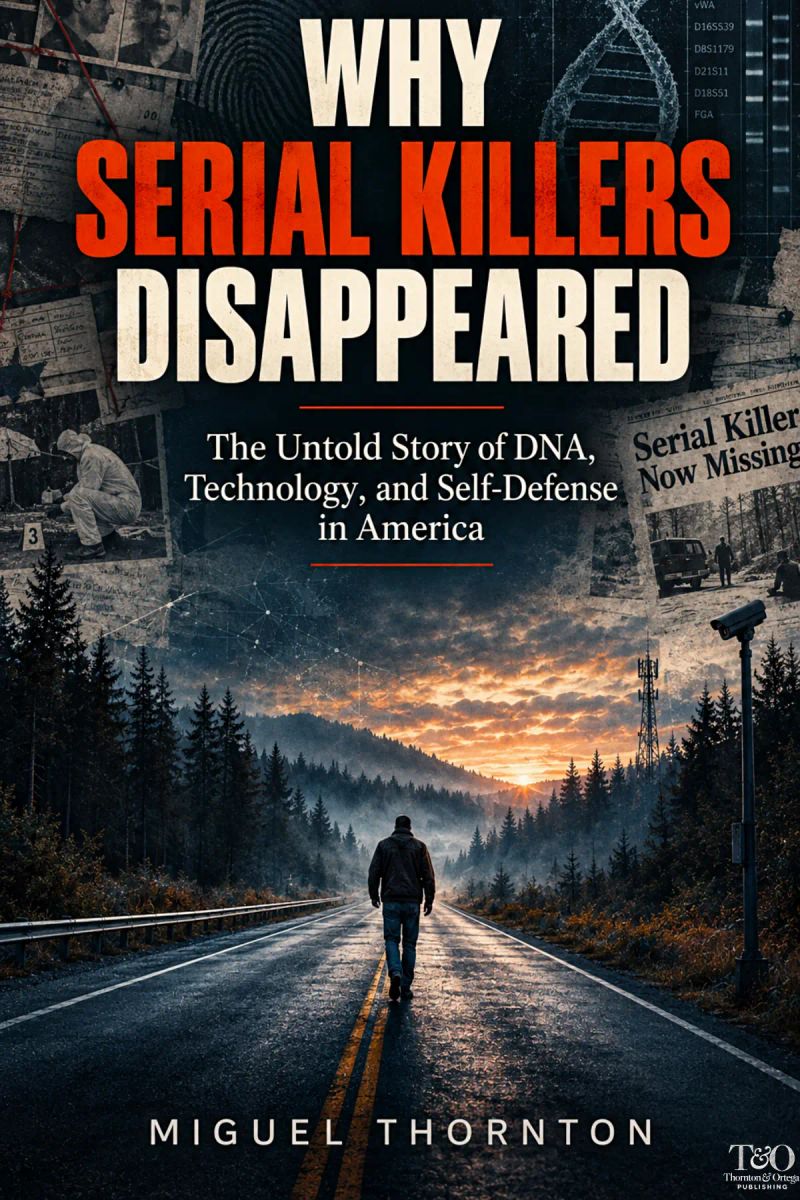
Why Serial Killers Disappeared
The Untold Story of DNA, Technology, and Self-Defense in AmericaBy Miguel Thornton


Length3h 43m
About this audiobook
Ted Bundy was caught because a Pensacola patrolman noticed a Volkswagen weaving down an empty street. David Berkowitz fell to a parking ticket, John Wayne Gacy to a smell rising from his furnace vents. The most widely used database shows active American serial killers falling from 768 in the 1980s to about 120 between 2010 and 2016.
This book argues that serial murder stopped working, and shows why, mechanism by mechanism. Case by case, it asks what each killer relied on and whether that still exists: a wilderness that left no record, victims whose absence started no search, a phone line BTK could cut with wire cutters.
In 1975, Bundy’s name sat on a King County list of roughly 3,500 suspects, submitted by four people; it took a detective a month on the county payroll computer to surface it. In 1987, investigators took Gary Ridgway’s saliva and could do nothing with it until DNA testing matched it in 2001.
Audiobook details
GenreTrue Crime, History
Length3 hrs 43 mins
Narrated byListen with 1,000+ voices
FormateBook with Audio
Publish dateNov 24, 2026
LanguageEnglish
Table of contents
1Opening
2Introduction
3Chapter 1: The Riddle of the Decline — Why Serial Killers Have Nearly Disappeared
4Chapter 2: The Golden Age of Monsters — America in the 1970s and 1980s
5Chapter 3: How Killers of the Past Really Operated
Show all chaptersShow less
6Chapter 4: Ted Bundy — The Perfect Hunter in a World Without Technology
7Chapter 5: Gacy, Dahmer, Ramirez, and the Others — Opportunity in the Dark
8Chapter 6: The DNA and Database Revolution
9Chapter 7: Cameras, Digital Fingerprints, and Omnipresent Surveillance
10Chapter 8: Home Alarms and Connected Security Systems
11Chapter 9: The Cell Phone — The End of Isolation and Impunity
12Chapter 10: Proactive Policing and National Tools
13Chapter 11: The Second Amendment — A Constitutional Line of Defense
14Chapter 12: Defensive Gun Uses and Citizens Who Stopped Active Threats
15Chapter 13: Soft Targets — Why Killers Often Chose Disarmed or Poorly Protected Places
16Chapter 14: The Quantifiable Decline — The Numbers, Tested
17Chapter 15: The Other Explanations — Lead, Abortion, Demographics, Prisons, and Security
18Chapter 16: The Unique American Synergy — Technology and an Armed, Vigilant Citizenry
19Chapter 17: International Lessons — Serial Killers in Countries with Strict Gun Control
20Chapter 18: The Angels of Death — The One Category That Did Not Collapse
21Chapter 19: The Arguments for Stricter Gun Control, Examined
22Chapter 20: What This Implies for American Policy
23Chapter 21: What a Killer Would Have to Do Today
24Chapter 22: Forty-Seven Days
25Conclusion
26About the Publisher
More from Miguel Thornton

Blame It on LBJMiguel Thornton 4h 54m$4.99 · $0.00

No Plank, No Parrot, No Peg LegMiguel Thornton3h 41m$4.99 · $0.00
The Poverty MythMiguel Thornton5h 8m$4.99 · $0.00

Trump, Out of ContextMiguel Thornton3h 19m$4.99 · $0.00

Everything You Know About the Samurai Is WrongMiguel Thornton2h 51m$4.99 · $0.00

Not a HolocaustMiguel Thornton3h 47m$4.99 · $0.00

The JFK They Sold YouMiguel Thornton2h 49m$4.99 · $0.00

Area 51: What They Were Really HidingMiguel Thornton4h 3m$4.99 · $0.00

America Won More Wars Than You ThinkMiguel Thornton4h 48m$4.99 · $0.00

The Real Opus DeiMiguel Thornton3h 45m$4.99 · $0.00

Trump UnmaskedMiguel Thornton3h 47m$4.99 · $0.00

Reagan VindicatedMiguel Thornton2h 10m$4.99 · $0.00

20 Myths About White Americans and SlaveryMiguel Thornton 4h 48m$4.99 · $0.00

Serial Killers Aren’t Who You ThinkMiguel Thornton 3h 58m$4.99 · $0.00
The Assassination of Leon TrotskyH. Keith Melton, Nigel West14h 8m$33 · $0.00

The Cause of DeathCynric Temple-Camp8h 59m4.4 (1.4K)$29 · $0.00

GanglandJared Savage9h 21m4.4 (1.4K)$29 · $0.00
Riding with EvilKen Croke, Dave Wedge9h 42m4.3 (3.4K)$29 · $0.00

The Two FBIsNicole Parker10h 8m4.4 (499)$29 · $0.00
I Catch KillersGary Jubelin15h 32m4.3 (6.6K)$33 · $0.00

The Redemption Of Bobby LoveBobby Love, Cheryl Love9h 13m4.4 (956)$29 · $0.00

The Life We ChoseMatt Birkbeck8h 57m4.4 (1K)$29 · $0.00

The Truth About AaronJonathan Hernandez5h 15m4.3 (2.5K)$24 · $0.00

No Ordinary BirdArtis Henderson6h 23m4.4 (597)$24 · $0.00

I'll Be Gone in the DarkMichelle McNamara10h 7m4.3 (302.5K)$29 · $0.00

Beyond the Body FarmBill Bass, Jon Jefferson6h 17m4.3 (10.2K)$24 · $0.00

The Killer Across the TableJohn E. Douglas, Mark Olshaker11h 7m4.3 (37.5K)$8 · $0.00

Inside the CartelMartin Suarez, Ian Frisch10h 50m4.4 (583)$29 · $0.00

White Hot HateDick Lehr12h 27m4.3 (1.4K)$29 · $0.00

Scarface and the UntouchableMax Allan Collins, A. Brad Schwartz18h 35m4.3 (2.4K)$40 · $0.00

Hack AttackNick Davies18h 7m4.3 (2.4K)$23 · $0.00

Russians Among UsGordon Corera12h 48m4.3 (4.1K)$33 · $0.00

Broken FaithMitch Weiss, Holbrook Mohr12h 19m4.2 (5K)$27 · $0.00

Member of the FamilyDianne Lake, Deborah Herman12h 30m4.2 (11.8K)$33 · $0.00

A Brief History of IntelligenceMax S. Bennett12h 18m4.6 (6.6K)$29 · $0.00

Ghosts of HiroshimaCharles Pellegrino8h 59m4.5 (877)$23

Medium RawAnthony Bourdain9h4.1 (65.6K)$29 · $0.00

Suicidal EmpathyGad Saad8h 24m4.1 (736)$28 · $0.00

How Soccer Explains the WorldFranklin Foer7h 22m3.9 (14.9K)$24 · $0.00
The Assassination of Leon TrotskyH. Keith Melton, Nigel West14h 8m$33 · $0.00

All American PatriotismRachel Campos-Duffy8h 53m$29 · $0.00

History of the Decline and Fall of the Roman Empire — Volume 1Edward Gibbon20h 18m4.3 (14.6K) · 1334Free

We Crossed a Bridge and It TrembledWendy Pearlman6h4.6 (5.2K)$24 · $0.00

Unbroken Bonds of BattleJohnny Joey Jones8h 31m4.6 (2.6K)$8 · $0.00

The Daughter of AuschwitzTova Friedman, Malcolm Brabant7h 54m4.6 (16.7K)$26 · $0.00

Lily's PromiseLily Ebert, Dov Forman8h 54m4.6 (16.1K)$29 · $0.00

On Democracies and Death CultsDouglas Murray10h 38m4.6 (6.5K)$29 · $0.00

Across the RiverKent Babb11h 40m4.6 (927)$29 · $0.00

Balcony Over Jerusalem: A Middle East Memoir - Israel, Palestine and BeyondJohn Lyons12h 37m4.6 (1.4K)$33 · $0.00

BeyondStephen Walker15h 39m4.6 (3.2K)$33 · $0.00
Kings and PawnsHoward Bryant10h 9m4.6 (678)$29 · $0.00

No EscapeNury Turkel9h 30m4.6 (809)$28 · $0.00

Jubal Stone: U.S. Marshal: Blood Trail To Hell: A Western Adventure NovelCasey Nash3h 42m4.6 (3.2K)$18 · $0.00

Fall and RiseMitchell Zuckoff17h 23m4.6 (9.8K)$40 · $0.00
You may also like

Girl, 11Amy Suiter Clarke10h 36m3.9 (16.6K)$29 · $0.00
I'll Be Gone in the DarkMichelle McNamara10h 7m4.3 (302.5K)$29 · $0.00
Ted BundyStephen G. Michaud, Hugh Aynesworth9h 37m4.0 (10.3K)$29 · $0.00

The Devil Behind the BadgeRick Jervis10h 28m4.0 (1.4K)$29 · $0.00

The Last WordElly Griffiths8h 40m3.8 (12.2K)$7 · $0.00

The Man on the BalconyMaj Sjöwall, Per Wahlöö5h 34m4.0 (9.8K)$14

The LogderMarie Adelaide Belloc Lowndes9h 8m3.7 (4.4K)$2 · $0.00

Kidnapping Cold CaseLaura Scott5h 46m4.5 (397)$24 · $0.00

The Killer's ShadowJohn E. Douglas, Mark Olshaker8h 7m4.0 (7K)$26 · $0.00

Dust and ShadowLyndsay Faye9h 21m4.1 (10.5K)$20 · $0.00

A Question of IdentitySusan Hill10h 28m4.0 (11.9K)$30

Under the WigWilliam Clegg QC7h 37m4.2 (4.8K)$13 · $0.00

Field of BonesJ. A. Jance10h 48m4.2 (14.6K)$29 · $0.00

The Cutting RoomAshley Dyer14h 11m3.7 (1.4K)$33 · $0.00

Killer SecretsKathleen Donnelly9h 16m4.5 (1.5K)$28 · $0.00

The Life, Trial, Confession and Execution of Albert W. HicksAlbert W. Hicks3h 39m$1 · $0.00

Ted BundyLifeInk Press2h 5m4.0 (653)$4 · $0.00

Killing WomenRod Sadler13h 5m3.9 (878)$23
FBI's Most Wanted – Incredible History of the Innovative ProgramFederal Bureau of Investigation3h 19m4.1 (12)$1.99 · $0.00
Ted Bundy: The Yearly Journal, Vol. 1Kevin Sullivan3h 32m3.6 (31)$15 · $0.00