
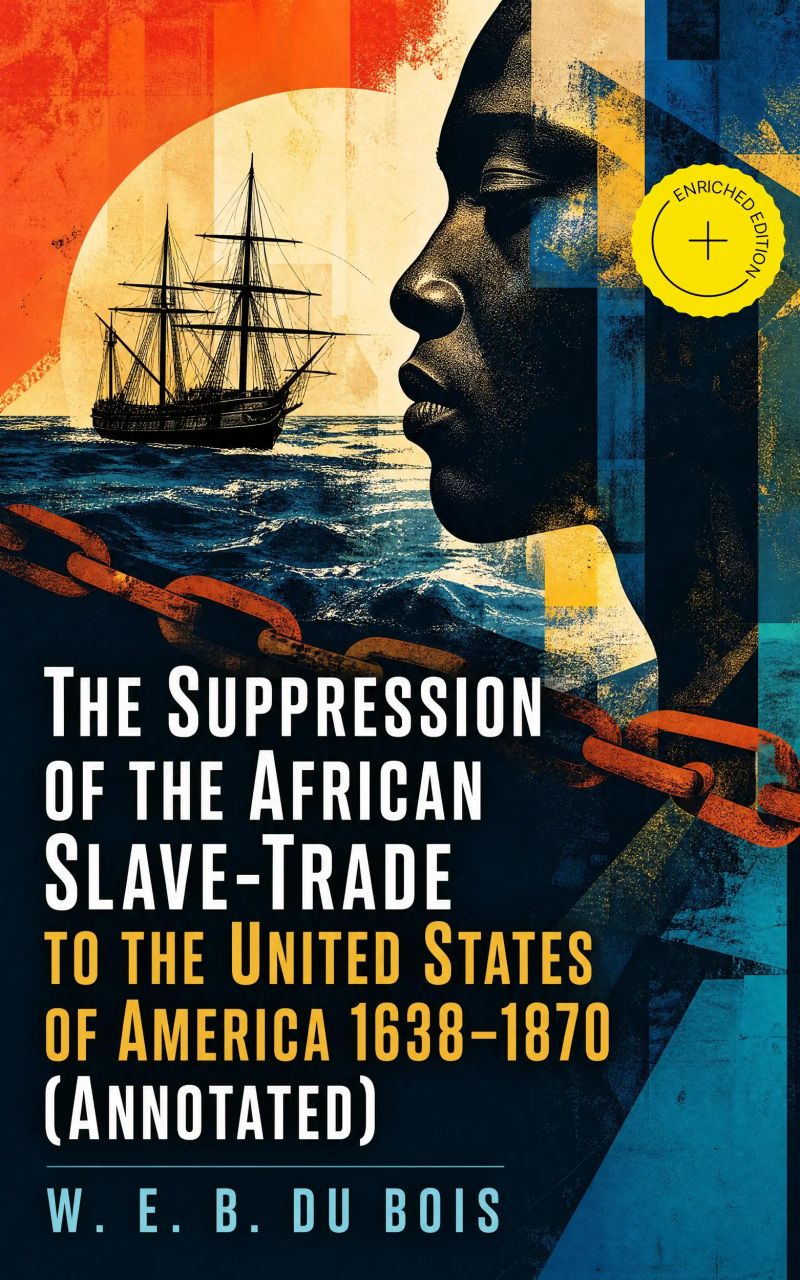
The Suppression of the African Slave-Trade to the United States of America 1638–1870 (Annotated)
Enriched Edition. Legal and Political Struggles Against the Transatlantic Slave TradeBy W. E. B. Du Bois


Length15h 48m
About this audiobook
The Suppression of the African Slave-Trade to the United States of America 1638–1870 is a rigorous historical study tracing the legal, political, and moral struggle over the transatlantic slave trade from colonial beginnings through Reconstruction. Written in a disciplined scholarly style, it combines documentary evidence, legislative analysis, and moral clarity. As Du Bois's Harvard doctoral dissertation and the first volume in the Harvard Historical Studies series, the book stands at the intersection of professional history, abolitionist memory, and emerging African American social science. W. E. B. Du Bois, one of the foremost intellectuals of the twentieth century, brought to this work his training at Fisk, Harvard, and Berlin, as well as his lifelong concern with race, democracy, and historical truth. His experience as a Black scholar in an age of segregation sharpened his attention to the gap between American ideals and American practice, a tension central to this study. Readers seeking a foundational account of slavery's legal and political history will find this book indispensable. It is especially valuable for students of African American history, Atlantic slavery, constitutional development, and the origins of modern civil rights thought.
This enriched edition has been carefully crafted to add value to your reading experience.
- A succinct Introduction situates the work's timeless appeal and themes.
- The Synopsis outlines the central plot, highlighting key developments without spoiling critical twists.
- A detailed Historical Context immerses you in the era's events and influences that shaped the writing.
- An Author Biography reveals milestones in the author's life, illuminating the personal insights behind the text.
- A thorough Analysis dissects symbols, motifs, and character arcs to unearth underlying meanings.
- Reflection questions prompt you to engage personally with the work's messages, connecting them to modern life.
- Hand‐picked Memorable Quotes shine a spotlight on moments of literary brilliance.
- Interactive footnotes clarify unusual references, historical allusions, and archaic phrases for an effortless, more informed read.
Audiobook details
Rating★★★★ 4.3 (318)
Includes Amazon, Goodreads, LibraryThing, StoryGraph
GenreHistory
Length15 hrs 48 mins
Narrated byListen with 1,000+ voices
FormateBook with Audio
Publish dateJun 15, 2020
LanguageEnglish
Table of contents
1The Suppression of the African Slave-Trade to the United States of America 1638–1870 (Annotated)
2Introduction
3Synopsis
4Historical Context
5Author Biography
Show all chaptersShow less
6The Suppression of the African Slave-Trade to the United States of America 1638–1870
7Preface
8Chapter I. Introductory
9Chapter II. The Planting Colonies
10Chapter III. The Farming Colonies.
11Chapter IV. The Trading Colonies.
12Chapter V. The Period of the Revolution. 1774–1787.
13Chapter VI. The Federal Convention. 1787.
14Chapter VII. Toussaint l'Ouverture and Anti-Slavery Effort, 1787–1806.
15Chapter VIII. The Period of Attempted Suppression. 1807–1825.
16Chapter IX. The International Status of the Slave-Trade. 1783–1862.
17Chapter X. The Rise of the Cotton Kingdom. 1820–1850.
18Chapter XI. The Final Crisis. 1850–1870.
19Chapter XII. The Essentials in the Struggle.
20Appendix A. A Chronological Conspectus of Colonial and State Legislation Restricting the African Slave-trade. 1641-1787.
21Appendix B. A Chronological Conspectus of State, National, and International Legislation. 1788–1871. (pt. 1)
22Appendix B. A Chronological Conspectus of State, National, and International Legislation. 1788–1871. (pt. 2)
23Appendix C. Typical Cases of Vessels Engaged in the American Slave-trade. 1619-1864.
24Appendix D. Bibliography.
25Analysis
26Reflection
27Memorable Quotes
More from W. E. B. Du Bois

Du Bois: The Gift of Black Folk to AmericaW. E. B. Du Bois10h 4m4.4 (924)$1.99 · $0.00

Sellected Du Bois EssaysW. E. B. Du Bois6h 37m4.5 (16)$1.99 · $0.00

Darkwater - Voices from Within the VeilW. E. B. Du Bois8h 44m4.4 (1.9K)$1.99 · $0.00

Essays (Annotated)W. E. B. Du Bois6h 45m4.1 (21)$2 · $0.00

The Collected WorksW. E. B. Du Bois34h 37m4.7 (115)$1 · $0.00

The Gift of Black Folk (Annotated)W. E. B. Du Bois10h 3m4.4 (1.6K)$1.99 · $0.00
The Collected Works (Annotated)W. E. B. Du Bois35h 51m4.7 (115)$1.99 · $0.00

Darkwater (Annotated)W. E. B. Du Bois9h 13m4.4 (1.7K)$1.99 · $0.00

A Brief History of IntelligenceMax S. Bennett12h 18m4.6 (6.6K)$29 · $0.00

We Crossed a Bridge and It TrembledWendy Pearlman6h4.6 (5.2K)$24 · $0.00

Unbroken Bonds of BattleJohnny Joey Jones8h 31m4.6 (2.6K)$8 · $0.00

The Daughter of AuschwitzTova Friedman, Malcolm Brabant7h 54m4.6 (16.7K)$26 · $0.00

Lily's PromiseLily Ebert, Dov Forman8h 54m4.6 (16.1K)$29 · $0.00

On Democracies and Death CultsDouglas Murray10h 38m4.6 (6.5K)$29 · $0.00

Across the RiverKent Babb11h 40m4.6 (927)$29 · $0.00

Balcony Over Jerusalem: A Middle East Memoir - Israel, Palestine and BeyondJohn Lyons12h 37m4.6 (1.4K)$33 · $0.00

BeyondStephen Walker15h 39m4.6 (3.2K)$33 · $0.00
Kings and PawnsHoward Bryant10h 9m4.6 (678)$29 · $0.00

No EscapeNury Turkel9h 30m4.6 (809)$28 · $0.00

Jubal Stone: U.S. Marshal: Blood Trail To Hell: A Western Adventure NovelCasey Nash3h 42m4.6 (3.2K)$18 · $0.00

Fall and RiseMitchell Zuckoff17h 23m4.6 (9.8K)$40 · $0.00

The SurvivorJosef Lewkowicz, Michael Calvin9h 22m4.6 (2.5K)$29 · $0.00

Always FaithfulThomas Schueman, Zainullah Zaki12h 12m4.6 (977)$29 · $0.00

The State of Society in France Before the Revolution of 1789 (Annotated)Alexis de Tocqueville17h 25m4.6 (1.2K)$2 · $0.00

All the Gallant MenDonald Stratton, Ken Gire5h 55m4.6 (11.8K)$24 · $0.00
Saint Joan (Annotated)George Bernard Shaw6h 20m4.6 (1.2K)$1.20 · $0.00

Medgar and MyrlieJoy-Ann Reid10h 52m4.5 (27.8K)$29 · $0.00

The History of the Peloponnesian War (Annotated)Thucydides24h 3m4.6 (1.1K)$2 · $0.00
You may also like

The Proud TowerBarbara W. Tuchman22h 13m4.2 (13.1K)$30

War Is a RacketButler, Smedley D3h 18m4.4 (10.8K)Free

American MidnightAdam Hochschild15h 6m4.3 (6.6K)$33 · $0.00

M: Son of the CenturyAntonio Scurati26h 47m4.2 (8.2K)$53 · $0.00

1920Eric Burns12h 41m3.9 (1.1K)$23

Opium Inc.Thomas Manuel9h 27m4.2 (263)$29 · $0.00

The Proletarian Revolution and the Renegade KautskyVladimir Lenin5h 30m4.3 (793)$2 · $0.00
The Suppression of the African Slave Trade to America (1638–1870)W.E.B. Du Bois15h 41m4.2 (1.5K)$1.99 · $0.00

The Rising SunJohn Toland41h 5m4.5 (22.4K)$30

The History of Trade Unionism (Revised edition, extended to 1920)Beatrice Webb, Sidney Webb34h 29m$1 · $0.00

The Bombay City Police: A Historical Sketch, 1672-1916S. M. Edwardes8h 20m$2 · $0.00

Trial of the Major War Criminals Before the International Military Tribunal, Volume 15, Nuremburg 14 November 1945-1 October 1946Various31h 21m$2.30

Trial of the Major War Criminals Before the International Military Tribunal, Volume 13, Nuremburg 14 November 1945-1 October 1946Various29h 33m$2.30

The Case of Edith CavellJames M. Beck1h 28m3.9 (21)$2.30

Recollections of the Civil WarCharles Anderson Dana8h 46m4.0 (264)$1 · $0.00

The Nuremberg Trials: Complete Tribunal Proceedings (V. 3)International Military Tribunal20h 24m$2 · $0.00

The Nuremberg Trials: Complete Tribunal Proceedings (V.10)International Military Tribunal31h 47m$1.99 · $0.00

How to Start a WarMichael Trapani9h 48m4.7 (47)$23

Opium. The Flowers of EvilDonald Wigal1h 25m3.2 (15)$15 · $0.00

Lord Lyons (Vol. 1&2) (Annotated)Thomas Wodehouse Legh Newton28h 19m$2 · $0.00