
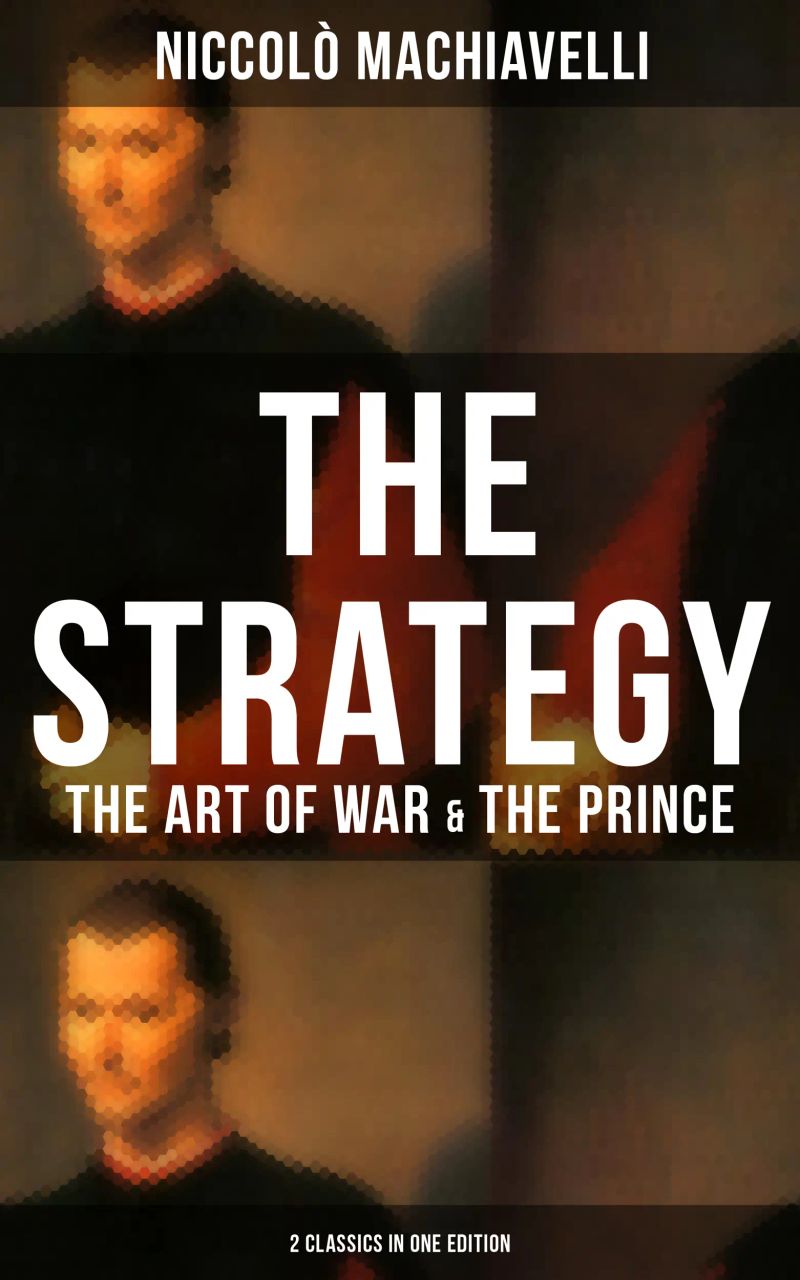
THE STRATEGY: The Art of War & The Prince (2 Classics in One Edition)
By Niccolò Machiavelli


Length7h 6m
About this audiobook
In 'THE STRATEGY: The Art of War & The Prince', Niccolò Machiavelli combines two of his most influential works in one edition, providing readers with a comprehensive guide on leadership and power dynamics. 'The Art of War' explores military strategy, tactics, and the art of war, drawing upon Machiavelli's personal experiences as a military official. 'The Prince', on the other hand, delves into political philosophy, emphasizing the importance of effective leadership and governance. Machiavelli's pragmatic and often controversial advice is presented in a straightforward and direct style, reflective of his Renaissance Italian context. Niccolò Machiavelli, a renowned Italian diplomat and philosopher, wrote 'THE STRATEGY' during a time of political turmoil in Italy. His disillusionment with the corrupt practices of his era fueled his desire to analyze and critique the nature of power and leadership. Machiavelli's bold and unapologetic approach to political theory challenged conventional beliefs and continues to provoke thought and discussion today. I highly recommend 'THE STRATEGY: The Art of War & The Prince' to readers interested in political philosophy, military strategy, and leadership principles. Machiavelli's timeless wisdom offers valuable insights into the complexities of power dynamics and has enduring relevance in contemporary society.
Audiobook details
Rating★★★★ 4.3 (123)
Includes Amazon, Goodreads
GenrePolitics and Government
Length7 hrs 6 mins
Narrated byListen with 1,000+ voices
FormateBook with Audio
Publish dateOct 6, 2017
LanguageEnglish
Table of contents
1The 9/11 Commission Report: Complete Edition
2The Prince
3Dedication: To the Magnificent Lorenzo Di Piero De’ Medici
4Chapter 1 - Of the Various Kinds of Princedom, and of the Ways in Which They Are Acquired
5Chapter 2 - Of Hereditary Princedoms
Show all chaptersShow less
6Chapter 3 - Of Mixed Princedoms
7Chapter 4 - Why the Kingdom of Darius, Conquered by Alexander, Did Not, on Alexander’s Death, Rebel Against His Successors
8Chapter 5 - How Cities or Provinces Which Before Their Acquisition Have Lived Under Their Own Laws Are To Be Governed
9Chapter 6 - Of New Princedoms Which a Prince Acquires With His Own Arms and by Merit
10Chapter 7 - Of New Princedoms Acquired By the Aid of Others and By Good Fortune
11Chapter 8 - Of Those Who By Their Crimes Come to Be Princes
12Chapter - 9 Of the Civil Princedom
13Chapter - 10 How the Strength of All Princedoms Should Be Measured
14Chapter 11 - Of Ecclesiastical Princedoms
15Chapter 12 - How Many Different Kinds of Soldiers There Are, and of Mercenaries
16Chapter 13 - Of Auxiliary, Mixed, and National Arms
17Chapter 14 - Of the Duty of a Prince In Respect of Military Affairs
18Chapter 15 - Of the Qualities In Respect of Which Men, and Most of all Princes, Are Praised or Blamed
19Chapter 16 - Of Liberality and Miserliness
20Chapter 17 - Of Cruelty and Clemency, and Whether It Is Better To Be Loved or Feared
21Chapter 18 - How Princes Should Keep Faith
22Chapter 19 - That a Prince Should Seek to Escape Contempt and Hatred
23Chapter 20 - Whether Fortresses, and Certain Other Expedients to Which Princes Often Have Recourse, are Profitable or Hurtful
24Chapter 21 - How a Prince Should Bear Himself So As to Acquire Reputation
25Chapter 22 - Of the Secretaries of Princes
26Chapter 23 - That Flatterers Should Be Shunned
27Chapter 24 - Why the Princes of Italy Have Lost Their States
28Chapter 25 - What Fortune Can Effect in Human Affairs, and How She May Be Withstood
29Chapter 26 - An Exhortation to Liberate Italy from the Barbarians
30The Art of War
31PREFACE
32Book 1
33Book 2
34Book 3
35Book 4
36Book 5
37Book 6
38Book 7
Der FürstNiccolò Machiavelli3h 57m4.0 (429K)$9 · $0.00
Philosophie der RenaissanceNiccolò Machiavelli, Michel de Montaigne, Erasmus von Rotterdam, Thomas Morus, Francis Bacon, Tommaso Campanella, Martin Luther, Ludwig Kuhlenbeck66h 17m$1.50 · $0.00

Das Buch der hundert altitalienischen NovellenNiccolò Machiavelli, Pietro Fortini, Carlo Graf Gozzi, Eustachio Manfredi, Baldassare Castiglione, Francesco Molza, Liberale Motense, Ser Giovanni Fiorentino, Luigi da Porto49h 28m$1 · $0.00

Essenzielle Klassiker der politischen PhilosophieNiccolò Machiavelli, Montesquieu, Friedrich der Große, Platon, Aristoteles, Marcus Tullius Cicero, Tommaso Campanella, Thomas Morus, Samuel von Pufendorf, Abbé Castel de Saint-Pierre, Jean Jacques Rousseau, Immanuel Kant, Johann Gottlieb Fichte, Karl Marx, Friedrich Engels, Wilhelm von Humboldt, Friedrich Christoph Dahlmann, Franz Mehring, Johann Most, John Henry Mackay, Rosa Luxemburg, Erich Mühsam393h 52m$1 · $0.00
Die Discorsi (Deutsche Ausgabe) (Kommentiert)Niccolò Machiavelli17h 53m$1 · $0.00

Der Fürst (Il Principe) (Kommentiert)Niccolò Machiavelli7h 3m4.0 (76.6K)$1 · $0.00

Mensch und Staat (Kommentiert)Niccolò Machiavelli3h 18m4.3 (121)$1 · $0.00

Gesammelte Werke: Der Fürst + Die Discorsi + Mensch und Staat + Geschichte von Florenz (Kommentiert)Niccolò Machiavelli39h 44m4.4 (11)$2 · $0.00

Geschichte von Florenz (Kommentiert)Niccolò Machiavelli19h 51m3.8 (508)$1 · $0.00
Discourses on Livy (Annotated)Niccolò Machiavelli16h 35m4.1 (10.2K)$2 · $0.00

The Prince + The Art of War (2 Unabridged Machiavellian Masterpieces)Niccolò Machiavelli7h 51m$1 · $0.00
Discourses on the First Decade of Titus LiviusNiccolò Machiavelli15h 3m4.2 (11.3K)$2 · $0.00
Discourses on LivyNiccolò Machiavelli16h 2m4.2 (12.5K)$2 · $0.00

SELF-MASTERY: 30 Best Books to Guide You To Your GoalsNiccolò Machiavelli, James Allen, William Walker Atkinson, Orison Swett Marden, Benjamin Franklin, Thorstein Veblen, Kahlil Gibran, P. T. Barnum, Marcus Aurelius, Wallace D. Wattles, Lao Tzu, Russell Conwell, Henry Harrison Brown, Émile Coué104h 27m$1 · $0.00

La mandragola - La Clizia - BelfagorNiccolò Machiavelli2h 24m4.1 (1.3K)$2 · $0.00

History of Florence and of the Affairs of ItalyNiccolò Machiavelli18h 49m4.0 (738)$2 · $0.00

Geschichte von FlorenzNiccolò Machiavelli17h 38m4.0 (869)$2 · $0.00

The Secret of ProsperityNiccolò Machiavelli, James Allen, William Walker Atkinson, Orison Swett Marden, Benjamin Franklin, Thorstein Veblen, Kahlil Gibran, P. T. Barnum, Marcus Aurelius, Wallace D. Wattles, Lao Tzu, Russell Conwell, Henry Harrison Brown, Émile Coué104h 12m4.5 (39)$1 · $0.00

Discourses on LivyNiccolò Machiavelli16h 44m4.2 (12.5K)$2 · $0.00

Balcony Over Jerusalem: A Middle East Memoir - Israel, Palestine and BeyondJohn Lyons12h 37m4.6 (1.4K)$33 · $0.00

RiggedMollie Hemingway12h 48m4.6 (4.2K)$23 · $0.00

SledgehammerDavid Friedman8h 21m4.7 (589)$26 · $0.00

Citizenship in a Republic (Annotated)Theodore Roosevelt2h 44m4.6 (1.4K)$2 · $0.00

No EscapeNury Turkel9h 30m4.6 (809)$28 · $0.00

Always FaithfulThomas Schueman, Zainullah Zaki12h 12m4.6 (977)$29 · $0.00

UnthinkableJamie Raskin15h 8m4.5 (9.3K)$8 · $0.00

My Fourth Time, We DrownedSally Hayden13h 59m4.6 (2.9K)$23 · $0.00

A Revolution of Common SenseScott Jennings9h 29m4.6 (528)$29 · $0.00
Statement From the Dock at the Rivonia TrialNelson Mandela2h 18m4.6 (1.3K)$1 · $0.00

Lessons from the EdgeMarie Yovanovitch17h 11m4.5 (5.9K)$40 · $0.00

To Rescue the American SpiritBret Baier10h 12m4.5 (2.7K)$8 · $0.00

StonewalledSharyl Attkisson15h 19m4.5 (4.3K)$33 · $0.00
The World According to Orwell: 1984 & Animal FarmGeorge Orwell15h 42m4.6 (1.1K)$1 · $0.00

Basic EconomicsThomas Sowell18h 32m4.5 (29.3K)$28 · $0.00
To Rescue the RepublicBret Baier, Catherine Whitney11h 42m4.5 (8.6K)$29 · $0.00

Modern WarriorsPete Hegseth7h 10m4.5 (4.7K)$24 · $0.00
Philosophy and Opinions of Marcus Garvey (Annotated)Marcus Mosiah Garvey4h 42m4.5 (1.7K)$1.99 · $0.00

A Plague Upon Our HouseScott W. Atlas MD10h 37m4.5 (3.4K)$20 · $0.00

One Bright MoonAndrew Kwong12h 21m4.5 (813)$29 · $0.00
You may also like

The PrinceNiccolo Machiavelli5h 3m3.9 (446.2K)$7 · $0.00

The PrinceNiccolò Machiavelli4h 32m4.1 (423.6K)$12

The PrinceNiccolò Machiavelli5h 10m4.0 (440.8K)$2.30

The Three Edwards (Annotated)Thomas Bertram Costain19h 33m4.1 (1.2K)$1.99 · $0.00

A Child's History of England (Annotated)Charles Dickens17h 40m3.8 (1.9K)$1.99 · $0.00

The French Revolution: A HistoryThomas Carlyle 33h 42m4.0 (5.5K)Free

The PrinceNicolo Machiavelli5h 12m4.0 (686.7K)Free

The PrinceNiccolo Machiavelli4h 6m4.0 (471.3K)$12 · $0.00

The HistoriesCaius Cornelius Tacitus10h 9m4.2 (5.7K)$20
The PrinceNiccolo Machiavelli3h 27m4.0 (475.6K)$16 · $0.00

His Excellency [Son Exc. Eugène Rougon]Émile Zola13h 23m3.9 (3K)$1 · $0.00
The Histories (Annotated)Tacitus12h 25m4.2 (5.6K)$2 · $0.00
The PrinceNiccolò Machiavelli3h 24m4.0 (451.2K)$3 · $0.00
Discourses on LivyNiccolò Machiavelli16h 2m4.2 (12.5K)$2 · $0.00
Niccolò Machiavelli: The PrinceNiccolò Machiavelli3h 40m4.0 (453K)$12 · $0.00
The Lives of Twelve Caesars - CompleteSuetonius21h 3m4.2 (31K)$2.30
History of The Decline and Fall of The Roman Empire Vol IEdward Gibbon30h 34m4.4 (6.2K)$2.30

A Child's History of EnglandCharles Dickens16h 48m3.7 (3.8K)Free
KING RICHARD IIIWilliam Shakespeare18h 48m4.1 (73.5K)$1.99 · $0.00

The Magnificient Century: The Pageant of EnglandThomas B. Costain15h 38m4.2 (2K)$2 · $0.00