
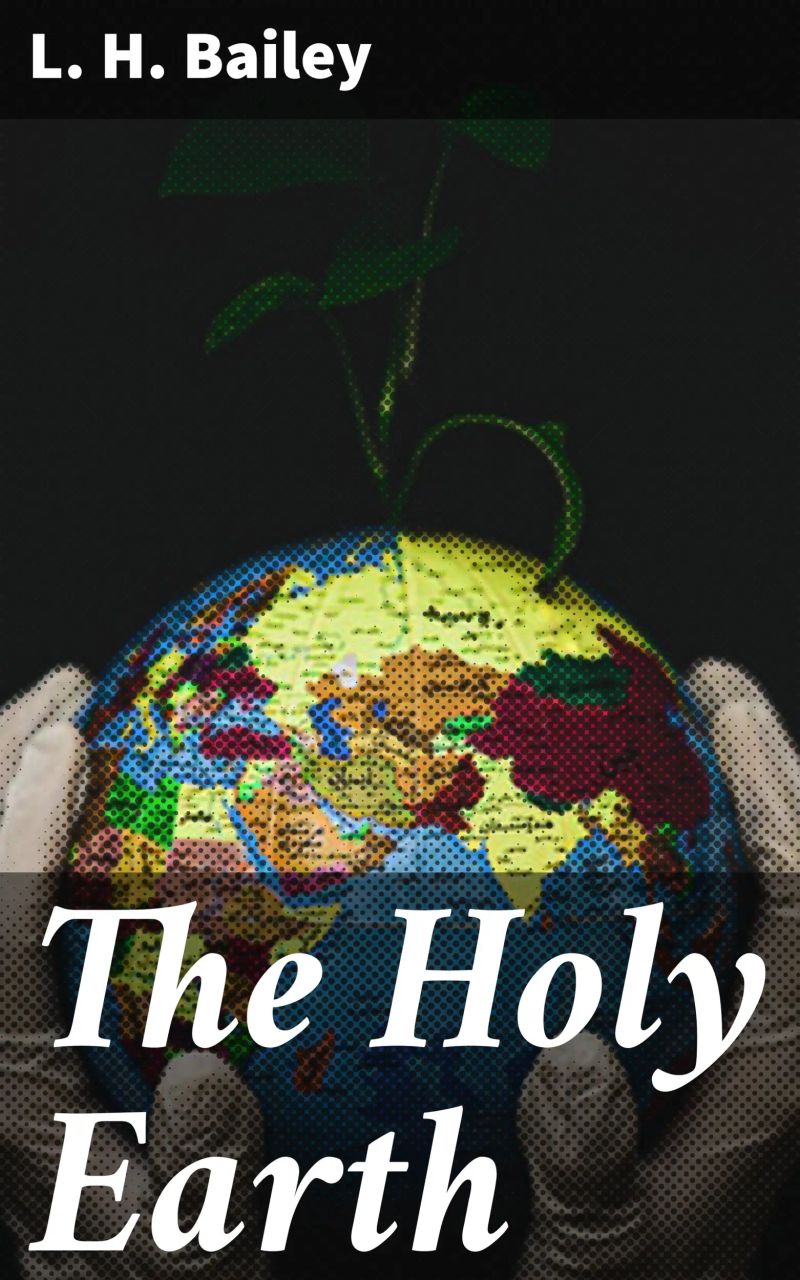
The Holy Earth
Rediscovering the Sacred Connection: A Journey into Environmental Ethics and Sustainable LivingBy L. H. Bailey


Length2h 50m
About this audiobook
In "The Holy Earth," L. H. Bailey presents a profound exploration of humanity's relationship with nature, weaving together elements of philosophy, ecology, and spirituality. This seminal work is characterized by its lyrical prose and a reflective tone that invites readers to reconsider their role within the natural world. Written during a time when industrialization and urbanization were beginning to overshadow the rural landscape, Bailey contextualizes his arguments against the backdrop of early 20th-century environmentalism, drawing on both scientific observations and poetic sensibility to advocate for a holistic understanding of the earth as sacred. L. H. Bailey, a prominent horticulturist and influential educator, dedicated his life to the study and promotion of agriculture and horticulture. His experiences in farming and the cultivation of land profoundly influenced his perspectives, leading him to view the earth not merely as a resource but as a living entity deserving reverence. Bailey's unique position as a scholar engaged with both science and literature enables him to articulate a vision for sustainability and ethical stewardship that resonates across disciplines. "The Holy Earth" is a must-read for anyone interested in environmental philosophy, ecology, and the interconnectedness of life. Bailey's evocative prose and thoughtful insights encourage readers to cultivate a deeper appreciation for the world around them, making this book a timeless call to honor and protect our fragile planet.
Audiobook details
Rating★★★★ 3.8 (63)
Includes Goodreads
GenreScience and Nature
Length2 hrs 50 mins
Narrated byListen with 1,000+ voices
FormateBook with Audio
Publish dateDec 17, 2019
LanguageEnglish
Table of contents
1The underlying training of a people
2The neighbor's access to the earth
3The subdividing of the land
4A new map
5The public program
Show all chaptersShow less
6The honest day's work
7The group reaction
8The spiritual contact with nature
9The struggle for existence: war
10The daily fare
11The admiration of good materials
12The keeping of the beautiful earth
13The tones of industry
14The threatened literature
15The separate soul
16The element of separateness in society
17The democratic basis in agriculture
18The background spaces.—The forest
19A forest background for a reformatory
20The background spaces.—The open fields
21The background spaces.—The ancestral sea
More from L. H. Bailey


A Brief History of IntelligenceMax S. Bennett12h 18m4.6 (6.6K)$29 · $0.00
The Story of BirdsSteve Brusatte11h 49m4.6 (401)$29 · $0.00
Black Earth WisdomLeah Penniman11h 54m4.6 (577)$8 · $0.00

Total Cat MojoJackson Galaxy10h 13m4.5 (8.4K)$23 · $0.00

My Life Among the UnderdogsTia Torres5h 51m4.5 (4K)$24 · $0.00

What It Takes to Save a LifeKwane Stewart6h4.6 (556)$24 · $0.00

Pastoral SongJames Rebanks8h 35m4.5 (12K)$26 · $0.00
How Stella Learned to TalkChristina Hunger7h4.5 (10.9K)$24 · $0.00

Craig & FredCraig Grossi8h 6m4.5 (9.6K)$26 · $0.00
Celebrating BirdsNatalia Rojas, Ana Maria Martinez6h 47m4.6 (330)$24 · $0.00

Saving JemimaJulie Zickefoose4h 59m4.5 (749)$20 · $0.00

Will's Red CoatTom Ryan8h 23m4.5 (2.3K)$26 · $0.00
Of Time and TurtlesSy Montgomery10h 34m4.5 (5K)$29 · $0.00
THE WOLF TRILOGY: Call of the Wild, White Fang & The Son of the WolfJack London17h 31m4.5 (2.4K)$1.99 · $0.00
Zen and the Art of Saving the PlanetThich Nhat Hanh9h 20m4.5 (3.9K)$29 · $0.00
BLACK BEAUTY (With Original Illustrations)Anna Sewell7h 31m4.5 (1.3K)$1.99 · $0.00

Bottle of LiesKatherine Eban14h 25m4.4 (12K)$33 · $0.00
IngrainedCallum Robinson8h 10m4.5 (1.1K)$26 · $0.00

The Lion Tracker's Guide To LifeBoyd Varty3h 1m4.4 (4.8K)$18 · $0.00

Born for LoveBruce D. Perry, Maia Szalavitz11h 42m4.4 (4K)$29 · $0.00
You may also like

Go GentlyBonnie Wright5h 35m4.2 (1.7K)$24 · $0.00

Rise UpAl Sharpton9h 47m4.4 (2.1K)$29 · $0.00

Beyond the PillJolene Brighten8h 46m4.3 (6.9K)$29 · $0.00

A Bigger PictureVanessa Nakate8h 24m4.4 (1.2K)$26 · $0.00
Silent Spring RevolutionDouglas Brinkley29h 25m4.4 (752)$53 · $0.00
Zen and the Art of Saving the PlanetThich Nhat Hanh9h 20m4.5 (3.9K)$29 · $0.00

Fix Your PeriodNicole Jardim10h 41m4.3 (1.2K)$29 · $0.00
Birding to Change the WorldTrish O'Kane13h 55m4.4 (2.3K)$33 · $0.00
Not Too Latevarious authors6h 38m4.1 (1.4K)$17
Silent Spring (Annotated)Rachel Carson13h 32m4.2 (222K)$2 · $0.00

The Rebel’s ApothecaryJenny Sansouci7h 47m4.5 (546)$17

Small WonderBarbara Kingsolver10h 2m4.2 (21.1K)$29 · $0.00

Doctor YourselfAndrew Saul PhD9h 57m4.4 (2.7K)$20
An Appeal to the WorldDalai Lama, Franz Alt1h 24m4.3 (1.4K)$9 · $0.00

This One Wild and Precious LifeSarah Wilson13h 46m3.9 (6.3K)$33 · $0.00

Natural RivalsJohn Clayton9h 45m4.1 (476)$20
Healthy Eating, Healthy WorldJ. Morris Hicks, Ken Kurson7h 39m4.1 (672)$17

Brazil and its Perspectives on The Climate, Digital-Technological and Biological AgesFrancisco Gaetani, Izabella Teixeira, Marcello Brito, Roberto S. Waack4h 2m$3

Save Money & Skip the Meal Subscription ServicesDevon Knott1h 5m3.2 (21)$15

Taiwan Art & CivilisationHsiu-Huei Wang2h 7m$18 · $0.00