
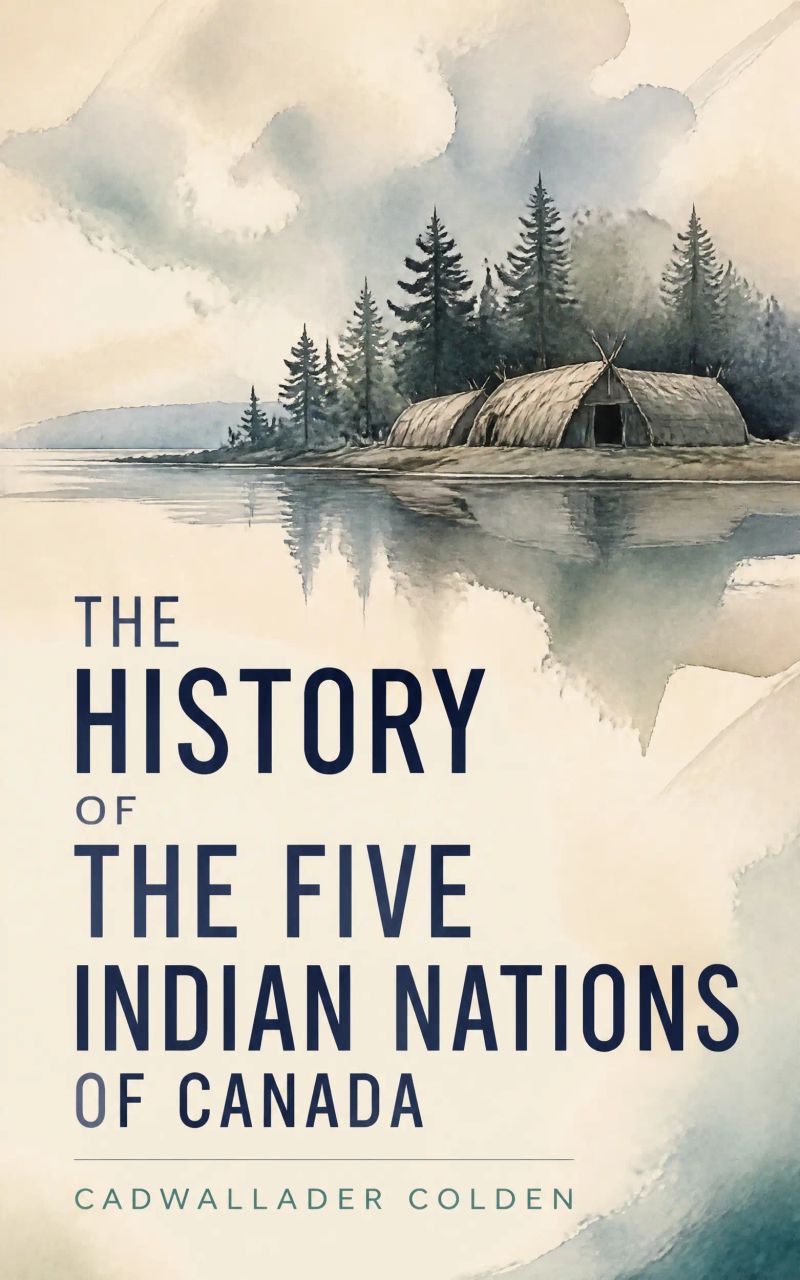
The History of the Five Indian Nations of Canada
Indigenous Statecraft, Diplomacy, and Imperial Rivalry in Eighteenth-Century North AmericaBy Cadwallader Colden


Length7h 16m
About this audiobook
Cadwallader Colden's *The History of the Five Indian Nations of Canada* is an ambitious early eighteenth-century account of the Haudenosaunee—Mohawk, Oneida, Onondaga, Cayuga, and Seneca—and their political, military, and diplomatic relations with neighboring peoples and European colonies. Drawing upon reports, correspondence, and colonial experience, Colden describes Indigenous systems of alliance, warfare, governance, and negotiation in a prose that combines chronicle, ethnography, and political history. Its orderly narrative and emphasis on sovereignty reflect Enlightenment habits of classification, while its subject matter places Indigenous power at the center of British North American affairs. The book is therefore both a historical source and a revealing example of colonial-era writing about Native nations. Born in Scotland and trained as a physician, Colden became a prominent naturalist, surveyor, and colonial administrator in New York, eventually serving as lieutenant governor. His scientific interests and close involvement in imperial diplomacy gave him unusual access to information about Haudenosaunee affairs. He wrote amid intense Anglo-French rivalry, when understanding Indigenous alliances was essential to colonial strategy, yet his work also expresses genuine respect for the political intelligence and military strength of the nations he discusses. Its perspective remains shaped by eighteenth-century imperial assumptions and should be read critically alongside Indigenous histories and oral traditions. This book is recommended to readers interested in Indigenous North American history, colonial diplomacy, early ethnography, and the intellectual culture of the Enlightenment. It offers indispensable insight into the Haudenosaunee Confederacy's regional influence while illustrating how European observers interpreted—and sometimes distorted—Native political life. Students and scholars will find it especially valuable when approached simultaneously as documentation, argument, and artifact: a text that preserves important historical testimony even as it exposes the limitations of colonial knowledge.
Audiobook details
Rating★★★★ 4.1 (65)
Includes Goodreads, Amazon, LibraryThing
GenreHistory
Length7 hrs 16 mins
Narrated byListen with 1,000+ voices
FormateBook with Audio
Publish dateAug 21, 2021
LanguageEnglish
Table of contents
1Canada Under British Rule 1760-1900
2The History of the Five Indian Nations of Canada
3Part I. The History of The Five Nations, From the Time the Christians First Knew Any Thing of Them, to That of the Revolution In Great-Britain
4The Preface to the First Part
5Vocabulary
Show all chaptersShow less
6Introduction
7Chapter I. Of the Wars of The Five Nations With The Adirondacks And Quatoghies
8Chapter II. The Wars and Treaties of Peace of The Indians Of The Five Nations With The French, From 1665 To 1683, And Their Affairs With New-York In That Time
9Chapter III. Of the Transactions of The Indians Of The Five Nations With the Neighbouring English Colonies
10Chapter IV. Mr . De La Barre' S Expedition, and Some Remarkable Transactions In 1684
11Chapter V. The English Attempt to Trade in the Lakes, And The French Attack The Senekas
12Chapter VI. Colonel Dongan's Advice to The Indians. Adario's Enterprize, And Montreal Sacked by The Five Nations
13Part II. The History of The Five Indian Nations Of Canada, From the Time of the Revolution to the Peace Of Reswick
14The Preface to the Second Part
15Chapter I. The State of Affairs In New-York And Canada, At the Time of The Revolution In Great-Britain
16Chapter II. A Treaty Between the Agents Of Massachuset's Bay, New-Plymouth, And Connecticut, And The Sachems Of The Five Nations, At Albany, In the Year 1689
17Chapter III. An Account of a General Council of The Five Nations At Onondaga, To Consider the Count De Frontenac' S Message
18Chapter IV. The French Surprise Schenectady. The Mohawks Speech of Condoleance on That Occasion
19Chapter V. The Five Nations Continue the War With The French; The Mohawks Incline to Peace ; Their Conferences With The Governor Of New-York
20Chapter VI. The English Attack Montreal By Land, In Conjunction With The Indians, And Quebeck By Sea
21Chapter VII. The French And The Five Nations Continue the War All Winter With Various Success . The French Burn A Captain Of The Five Nations Alive
22Chapter VIII. The Five Nations Treat With Captain Ingoldsby
23Chapter IX. The French Surprise and Take Three Mohawk Castles
24Chapter X. The Treaties and Negotiations The Five Nations Had With The English And French, In the Years 1693 And 1694
25Chapter XI. The War Renewed . The French Repossess Themselves Of Cadarackui Fort, And Find Means to Break Off the Treaty Between The Five Nations And Dionondadies
26Chapter XII. The Count De Frontenac Attacks Onondaga In Person, With the Whole Force Of Canada. The Five Nations Continue the War With The French, And Make Peace With The Dionondadies
27Chapter XIII. The Conduct Which The English And French Observed, In Regard to The Five Nations, Immediately After the Peace Of Reswick
More from Cadwallader Colden



A Brief History of IntelligenceMax S. Bennett12h 18m4.6 (6.6K)$29 · $0.00

The Happiest Man on EarthEddie Jaku3h 48m4.6 (178K)$7 · $0.00

MotherlandJulia Ioffe17h 52m4.7 (2.5K)$40 · $0.00

Where Cowards Go to DieBenjamin Sledge8h 42m4.7 (351)$20 · $0.00

RevolutionariesSanjeev Sanyal11h 23m4.6 (2.6K)$29 · $0.00

We Crossed a Bridge and It TrembledWendy Pearlman6h4.6 (5.2K)$24 · $0.00

Unbroken Bonds of BattleJohnny Joey Jones8h 31m4.6 (2.6K)$8 · $0.00

The Daughter of AuschwitzTova Friedman, Malcolm Brabant7h 54m4.6 (16.7K)$26 · $0.00

Lily's PromiseLily Ebert, Dov Forman8h 54m4.6 (16.1K)$29 · $0.00

On Democracies and Death CultsDouglas Murray10h 38m4.6 (6.5K)$29 · $0.00

Across the RiverKent Babb11h 40m4.6 (927)$29 · $0.00

Balcony Over Jerusalem: A Middle East Memoir - Israel, Palestine and BeyondJohn Lyons12h 37m4.6 (1.4K)$33 · $0.00

BeyondStephen Walker15h 39m4.6 (3.2K)$33 · $0.00
Kings and PawnsHoward Bryant10h 9m4.6 (678)$29 · $0.00

No EscapeNury Turkel9h 30m4.6 (809)$28 · $0.00

Jubal Stone: U.S. Marshal: Blood Trail To Hell: A Western Adventure NovelCasey Nash3h 42m4.6 (3.2K)$18 · $0.00

Fall and RiseMitchell Zuckoff17h 23m4.6 (9.8K)$40 · $0.00

The SurvivorJosef Lewkowicz, Michael Calvin9h 22m4.6 (2.5K)$29 · $0.00

Always FaithfulThomas Schueman, Zainullah Zaki12h 12m4.6 (977)$29 · $0.00

The State of Society in France Before the Revolution of 1789 (Annotated)Alexis de Tocqueville17h 25m4.6 (1.2K)$2 · $0.00
You may also like
Lincoln's LieutenantsStephen W. Sears31h 36m4.4 (1.1K)$53 · $0.00

Six Days of WarMichael B. Oren17h 54m4.4 (15.5K)$32

O Jerusalem!Larry Collins, Dominique Lapierre23h 42m4.4 (7.7K)$30
Some Principles of Maritime StrategyJulian Stafford Corbett9h 25m4.2 (988)Free

The Tuscarora WarDavid La Vere9h 53m4.1 (335)$20

The Jewish WarsFlavius Josephus28h 18m4.2 (7K)$2 · $0.00

Guerrilla WarfareErnesto Che Guevara6h 6m4.1 (6.5K)$2 · $0.00

Some Principles of Maritime StrategyJulian Stafford Corbett11h 19m4.2 (385)$1 · $0.00

PutinomicsChris Miller8h 4m4.1 (437)$17

The Civil War: A Narrative, Vol. 2Shelby Foote52h 41m4.6 (11.7K)$30

The Slaveholding Indians (Vol.1-3) (Annotated)Annie Heloise Abel37h 9m4.6 (13)$1.99 · $0.00

The Battle of Ezra Church and the Struggle for AtlantaEarl J. Hess8h 29m4.2 (54)$20

The Story of ManhattanCharles Hemstreet3h 20m$1 · $0.00

The Life and Work of Jefferson Davis (Annotated)Jefferson Davis, Frank H. Alfriend105h 1m$1.99 · $0.00

Peloponnesian War, 431 - 404 BcAndré Geraque Kiffer4h 2m$5 · $0.00

Famous Indian ChiefsCharles H. L. Johnston10h 17m3.9 (34)$1.99 · $0.00

History of the War in the Peninsular and the South of France from the Year 1807 to the Year 1814 Vol. 2William Francis Patrick Napier17h 44m4.4 (17)$2.30

The Battle of WaterlooJohn Codman Ropes15h 1m4.1 (56)$1.99 · $0.00

The Count of the Saxon ShoreAlfred J. Church7h 24m3.6 (35)$2 · $0.00

The U.S.-Mexican War (Vol. 1&2) (Annotated)Justin H. Smith55h 51m3.9 (26)$2 · $0.00