
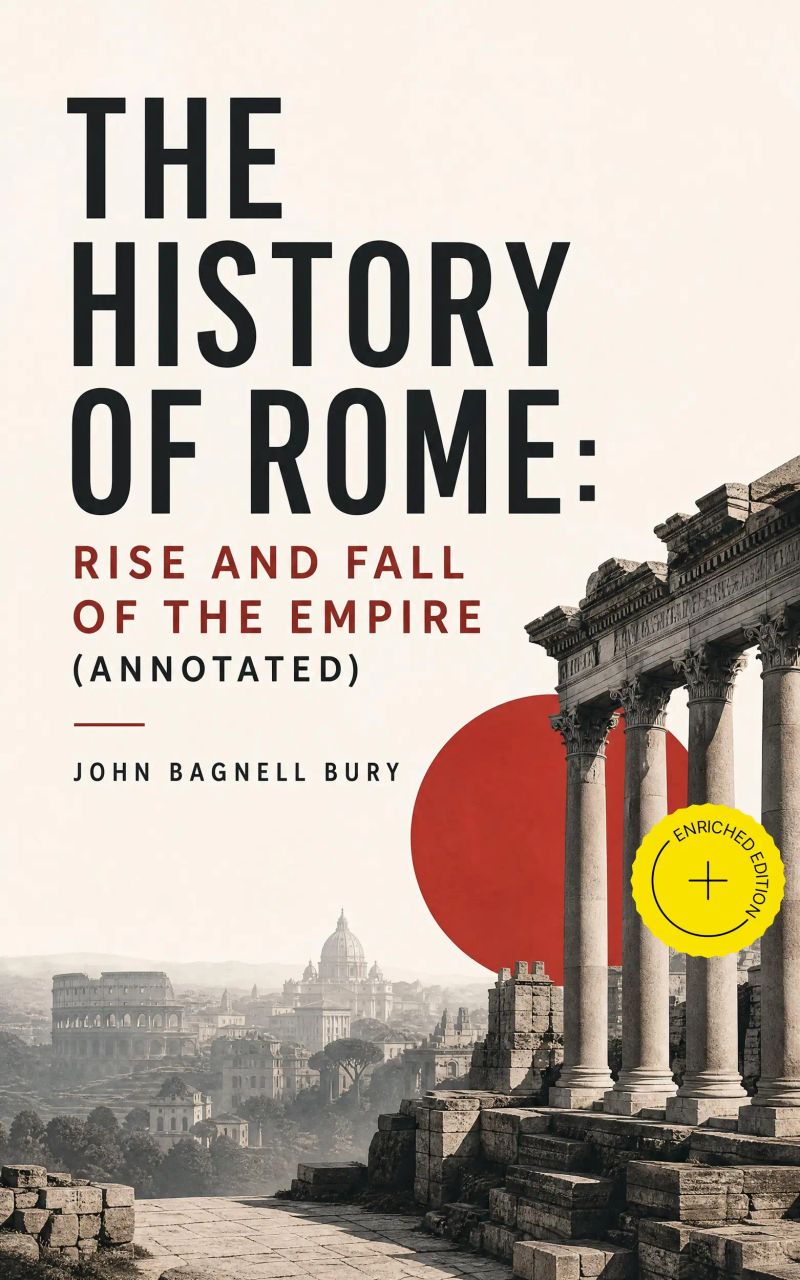
The History of Rome: Rise and Fall of the Empire (Annotated)
Enriched Edition. Republican Expansion, Imperial Rule, and the Transformation of Late AntiquityBy John Bagnell Bury


Length73h 2m
About this audiobook
The History of Rome: Rise and Fall of the Empire presents Roman history as a vast political and cultural drama, tracing the movement from republican expansion to imperial consolidation and eventual dissolution. Written in a lucid, authoritative style, it combines narrative clarity with the analytical habits of nineteenth- and early twentieth-century classical scholarship. Bury situates emperors, armies, institutions, and frontiers within the larger problem of how Rome governed, adapted, and ultimately failed to preserve its imperial order. John Bagnell Bury, an eminent Irish historian and classical scholar, was renowned for his rigorous command of ancient sources and his resistance to overly moralized explanations of historical change. His academic career, including his professorship at Cambridge, was devoted to late antiquity, Byzantium, and the continuity between the classical and medieval worlds. This breadth enabled him to see Rome's fall not as a simple catastrophe, but as a complex transformation shaped by administration, military pressure, religion, and social evolution. This book is highly recommended for readers seeking a disciplined and intellectually serious introduction to Rome's imperial story. Students, general historians, and admirers of classical civilization will value its balance of narrative sweep and scholarly judgment.
This enriched edition has been carefully crafted to add value to your reading experience.
- A succinct Introduction situates the work's timeless appeal and themes.
- The Synopsis outlines the central plot, highlighting key developments without spoiling critical twists.
- A detailed Historical Context immerses you in the era's events and influences that shaped the writing.
- A thorough Analysis dissects symbols, motifs, and character arcs to unearth underlying meanings.
- Reflection questions prompt you to engage personally with the work's messages, connecting them to modern life.
- Hand‐picked Memorable Quotes shine a spotlight on moments of literary brilliance.
- Interactive footnotes clarify unusual references, historical allusions, and archaic phrases for an effortless, more informed read.
Audiobook details
GenreHistory
Length73 hrs 2 mins
Narrated byListen with 1,000+ voices
FormateBook with Audio
Publish dateNov 27, 2023
LanguageEnglish
Table of contents
1Introduction
2Introduction
3Synopsis
4Historical Context
5Foundation and the Golden Age of the Roman Empire
Show all chaptersShow less
6Chapter I. From the Battle of Actium to the Foundation of the Principate
7Chapter II. The Principate
8Chapter III. The Joint Government of the Princeps and Senate
9Chapter IV. The Family of Augustus and His Plans to Found a Dynasty
10Chapter V. Administration of Augustus in Rome and Italy — Organisation of the Army
11Chapter VI. Provincial Administration Under Augustus — The Western Provinces
12Chapter VII. Provincial Administration Under Augustus — The Eastern Provinces and Egypt
13Chapter VIII. Rome and Parthia — Expeditions to Arabia and Ethiopia
14Chapter IX. The Winning and Losing of Germany — Death of Augustus
15Chapter X. Rome Under Augustus — His Buildings
16Chapter XI. Literature of the Augustan Age
17Chapter XII. The Principate of Tiberius (14-37 A.D.)
18Chapter XIII. Principate of Tiberius (Continued)
19Chapter XIV. The Principate of Gaius (Caligula) (37-41 A.D.)
20Chapter XV. The Principate of Claudius (41-54 A.D.)
21Chapter XVI. The Conquest of Britain
22Chapter XVII. The Principate of Nero (54-68 A.D.)
23Chapter XVIII. The Wars for Armenia, Under Claudius and Nero
24Chapter XIX. The Principate of Galba and the Year of the Four Emperors (68-69 A.D.)
25Chapter XX. Rebellions in Germany and Judea
26Chapter XXI. The Flavian Emperors — Vespasian, Titus and Domitian (69-96 A.D.)
27Chapter XXII. Britain and Germany Under the Flavians — Dacian War
28Chapter XXIII. Nerva and Trajan — The Conquest of Dacia
29Chapter XXIV. Trajan's Principate (Continued) — Administration and Eastern Conquests
30Chapter XXV. Literature From the Death of Tiberius to Trajan
31Chapter XXVI. The Principate of Hadrian (117-138 A.D.)
32Chapter XXVII. The Principate of Antoninus Pius (138-161 A.D.)
33Chapter XXVIII. The Principate of Marcus Aurelius (161-180 A.D.)
34Chapter XXIX. Literature Under Hadrian and the Antonines
35Chapter XXX. The Roman World Under the Empire — Politics, Philosophy, Religion and Art
36Chapter XXXI. Roman Life and Manners
37Decline and the Last Years of the Roman Empire
38The Constitution of the Monarchy
39The Administrative Machinery
40Constantinople
41The Neighbours of the Empire at the End of the Fourth Century
42The Supremacy of Stilicho (pt. 1)
43The Supremacy of Stilicho (pt. 2)
44The German Invasions Under Honorius
45Theodosius II and Marcian
46The Dismemberment of the Empire in the West
47The Empire of Attila (pt. 1)
48The Empire of Attila (pt. 2)
49Leo I and Ricimer's Rule in Italy
50Church and State
More from John Bagnell Bury

The Rise and Decline of the Roman Empire (Annotated)John Bagnell Bury72h 59m$3 · $0.00

Roman Empire - The History & the Myth (Annotated)John Bagnell Bury27h 33m$2 · $0.00

ANCIENT GREECE: The History of Classical Greece from Its Earliest Beginnings to the Hellenistic Age (Annotated)John Bagnell Bury41h 58m4.2 (1.3K)$2 · $0.00

The Rise and Decline of the Roman EmpireJohn Bagnell Bury73h 2m$1 · $0.00

ANCIENT GREECE: The History of Classical Greece from Its Earliest Beginnings to the Hellenistic AgeJohn Bagnell Bury41h 52m4.2 (237)$1 · $0.00

The History of Rome: Rise and Fall of the EmpireJohn Bagnell Bury72h 59m4.3 (127)$1.99 · $0.00
The Rise and Fall of Greek Civilization: A 20-Volume AnthologyJohn Bagnell Bury, Edward Bulwer-Lytton, Herodotus, Thucydides, Xenophon, Arrian, Strabo, Plutarch, George Grote, Homer, Andrew Lang, E. Norman Gardiner, James Sir Donaldson, F. A. Wright, Alfred William Benn, H. A. Guerber, Albert Augustus Trever, Basil Edward Hammond, Ernest Arthur Gardner, E. M. Berens631h 21m$1.99
A History of the Roman Empire: From its Foundation to the Death of Marcus Aurelius (27 B.C. – 180 A.D.)John Bagnell Bury26h 43m4.1 (147)$2 · $0.00

A History of the Roman EmpireJohn Bagnell Bury27h 30m4.2 (222)$1 · $0.00
The Rise and Decline of the Roman Empire (Summarized Edition)John Bagnell Bury14h 22m$2
A History of the Roman Empire: From Its Foundation to the Death of Marcus Aurelius (27 B.C. – 180 A.D.) (Summarized Edition)John Bagnell Bury6h 14m$2
The History of Rome: Rise and Fall of the EmpireJohn Bagnell Bury72h 52m4.0 (88)$2 · $0.00
Ancient Greece: The History of Classical Greece from Its Earliest Beginnings to the Hellenistic Age (Summarized Edition)John Bagnell Bury8h 58m$2

A Brief History of IntelligenceMax S. Bennett12h 18m4.6 (6.6K)$29 · $0.00

Black AF HistoryMichael Harriot15h 43m4.7 (14.6K)$33 · $0.00

The Gulag Archipelago Volume 3Aleksandr I. Solzhenitsyn21h 56m4.7 (8.9K)$46 · $0.00

Pearl of Great PriceJoseph Smith3h 8m4.7 (7.2K)$1.20 · $0.00

The Happiest Man on EarthEddie Jaku3h 48m4.6 (178K)$7 · $0.00

MotherlandJulia Ioffe17h 52m4.7 (2.5K)$40 · $0.00

Where Cowards Go to DieBenjamin Sledge8h 42m4.7 (351)$20 · $0.00

RevolutionariesSanjeev Sanyal11h 23m4.6 (2.6K)$29 · $0.00

We Crossed a Bridge and It TrembledWendy Pearlman6h4.6 (5.2K)$24 · $0.00

Unbroken Bonds of BattleJohnny Joey Jones8h 31m4.6 (2.6K)$8 · $0.00

The Daughter of AuschwitzTova Friedman, Malcolm Brabant7h 54m4.6 (16.7K)$26 · $0.00

Lily's PromiseLily Ebert, Dov Forman8h 54m4.6 (16.1K)$29 · $0.00

On Democracies and Death CultsDouglas Murray10h 38m4.6 (6.5K)$29 · $0.00

Across the RiverKent Babb11h 40m4.6 (927)$29 · $0.00

Balcony Over Jerusalem: A Middle East Memoir - Israel, Palestine and BeyondJohn Lyons12h 37m4.6 (1.4K)$33 · $0.00

BeyondStephen Walker15h 39m4.6 (3.2K)$33 · $0.00

Kings and PawnsHoward Bryant10h 9m4.6 (678)$29 · $0.00

No EscapeNury Turkel9h 30m4.6 (809)$28 · $0.00

Jubal Stone: U.S. Marshal: Blood Trail To Hell: A Western Adventure NovelCasey Nash3h 42m4.6 (3.2K)$18 · $0.00

Fall and RiseMitchell Zuckoff17h 23m4.6 (9.8K)$40 · $0.00
You may also like

My Kingdom for a HorseEd West6h 23m4.2 (307)$17

Peter the GreatJacob Abbott6h 53m4.1 (888)$6 · $0.00

TudorsPeter Ackroyd19h 6m4.3 (5.8K)$25

The Brothers YorkThomas Penn23h 14m4.3 (1.8K)$30

The History of England (Complete 6 Volumes) (Annotated)David Hume132h 22m4.3 (261)$2 · $0.00

The Last Plantagenets (Annotated)Thomas Bertram Costain19h 19m4.3 (2.7K)$1.99 · $0.00

THE 12 CAESARSSuetonius16h 7m4.2 (32.6K)$2.99 · $0.00

The BorgiasAlexandre Dumas8h 56m3.7 (2.7K)$1.20 · $0.00

The Black TulipAlexandre Dumas8h 38m4.0 (57.1K)$1.20 · $0.00

Queen of ScotsJohn Guy5h 41m4.1 (9.7K)$24 · $0.00

History of The Decline and Fall of The Roman Empire Vol IIIEdward Gibbon28h 19m4.2 (1.6K)$2.30

King JohnWilliam Shakespeare2h 44m3.7 (10.5K)$1.20 · $0.00

Richard IIJacob Abbott5h 18m3.2 (69)$6 · $0.00

History of Florence and of the Affairs of ItalyNiccolò Machiavelli18h 49m4.0 (738)$2 · $0.00

Battlefield Church, Salop: an historical and descriptive sketchW. G. D. Fletcher53m$2 · $0.00

The History of England (Summarized Edition)David Hume25h 41m$2

Turkey / Peeps at Many LandsJulius R. Van Millingen2h 31m$2.30

Cardinal de RichelieuEleanor C. Price11h 19m$2.40

William the ThirdH. D. Traill5h 18m3.3 (36)$2 · $0.00

Charles IJacob Abbott5h 12m3.5 (115)$6 · $0.00