
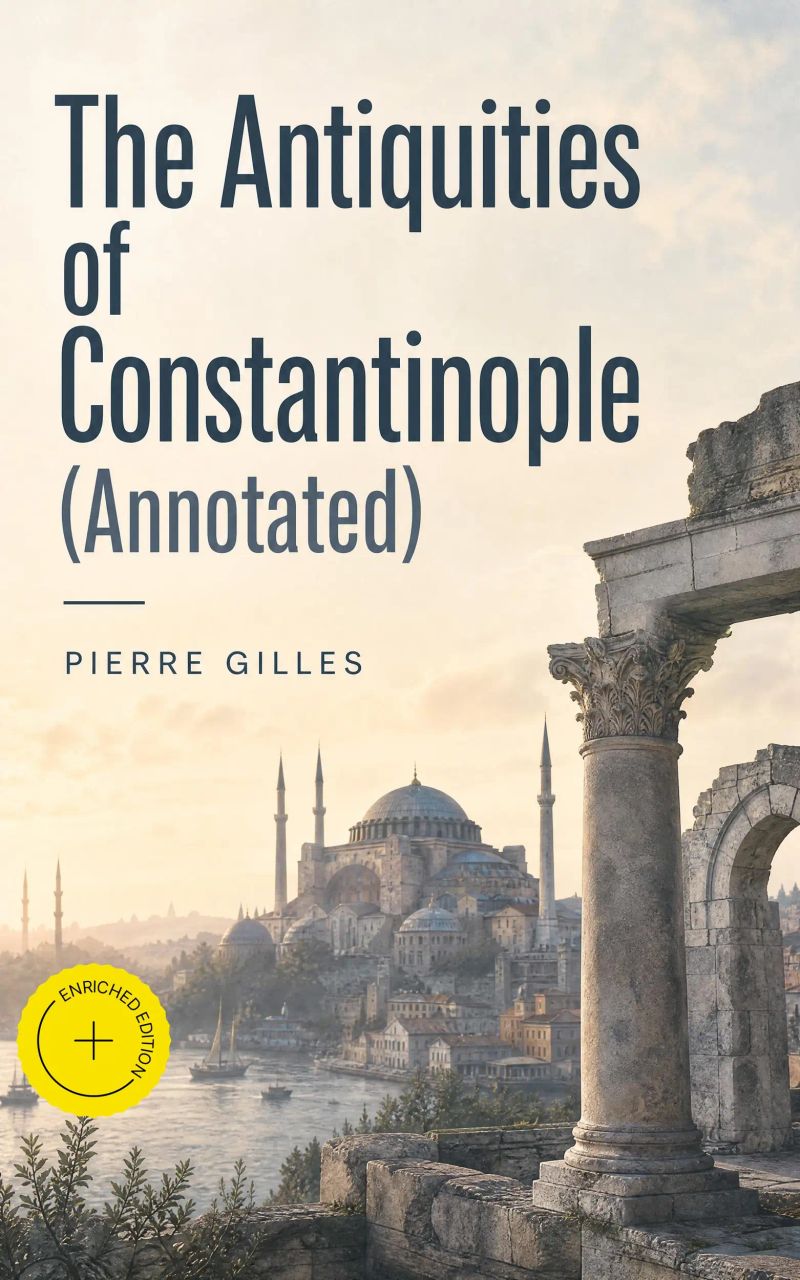
The Antiquities of Constantinople (Annotated)
Enriched Edition. A Renaissance Survey of Byzantine Monuments, Ottoman Istanbul Topography, and Classical RuinsBy Pierre Gilles


Length10h 9m
About this audiobook
The Antiquities of Constantinople is a foundational humanist survey of the city's ancient topography, monuments, inscriptions, churches, cisterns, columns, and imperial ruins. Written in a learned yet observant prose, it combines classical erudition with eyewitness description, attempting to reconcile Byzantine remains with Greek and Roman textual authorities. In the literary context of Renaissance antiquarianism, the book stands beside the great topographical studies of Rome, but turns that method toward a city newly transformed under Ottoman rule. Pierre Gilles, or Petrus Gyllius, was a sixteenth-century French scholar, naturalist, and traveler whose command of Greek and Latin equipped him to read Constantinople as both a physical site and a historical text. Sent eastward in the orbit of French royal and diplomatic interests, he encountered a city whose visible fabric preserved fragments of empire, theology, and conquest. His antiquarian curiosity, sharpened by direct exploration, gave the work its enduring authority. This book is recommended to readers of Byzantine history, classical reception, urban archaeology, and Renaissance scholarship. It rewards anyone interested in how cities survive through ruins, memory, and interpretation.
This enriched edition has been carefully crafted to add value to your reading experience.
- Hand‐picked Memorable Quotes shine a spotlight on moments of literary brilliance.
- Interactive footnotes clarify unusual references, historical allusions, and archaic phrases for an effortless, more informed read.
Audiobook details
GenreHistory
Length10 hrs 9 mins
Narrated byListen with 1,000+ voices
FormateBook with Audio
Publish dateDec 12, 2023
LanguageEnglish
Table of contents
1Introduction
2THE PREFACE OF THE AUTHOR, Describing the Situation of Constantinople , the Conveniences of its Port, and the Commodities in which it abounds.
3THE ANTIQUITIES OF Constantinople . BOOK I.
4Chap. I. Of the Founders of Byzantium, and the different Successes and Revolutions of that City .
5Chap. II. Of the Extent of Old Byzantium.
Show all chaptersShow less
6Chap. III. Of the Rebuilding of Byzantium by Constantine the Great, and the Largeness of it in his Time .
7Chap. IV. Of the present Figure, Compass, Length and Breadth of Constantinople.
8Chap. V. A general Description of Constantinople.
9Chap. VI. Of the Situation of all the Parts of the City describ’d.
10Chap. VII. Of the first Hill, of the Palace of the Grand Seignor, of the Church of St. Sophia, and the Hippodrom.
11Chap. VIII. Of the first Valley.
12Chap. IX. Of the second Hill.
13Chap. X. Of the second Valley, which divides the second from the third Hill.
14Chap. XI. Of the third Hill.
15Chap. XII. Of the third Valley.
16Chap. XIII. Of the fourth Hill.
17Chap. XIV. Of the Fifth Hill.
18Chap. XV. Of the Fifth Valley.
19Chap. XVI.
20Chap. XVII. Of the Valley which divides the Promontory from the seventh Hill .
21Chap. XVIII. Of the seventh Hill.
22Chap. XIX. Of the Walls of the City.
23Chap. XX. Of the Gates of Constantinople, and the seven Towers of Old Byzantium.
24Chap. XXI. Of the long Walls.
25THE ANTIQUITIES OF Constantinople . BOOK II.
26Chap. I. Of the Buildings and Monuments of Old Byzantium and Constantinople, called New Rome.
27Chap. II. Of the Ancient Monuments of the first Hill, and of the first Ward of the City .
28Chap. III. Of the Church of St. Sophia.
29Chap. IV. A Description of the Church of St. Sophia, as it now appears .
30Chap. V. Of the Statues discover’d on one Side of the Church of St. Sophia.
31Chap. VI. Of the Pharo on the Promontory Ceras, and the Mangana.
32Chap. VII. Of the Bagnio’s of Zeuxippus and its Statues .
33Chap. VIII. Of the Hospitals of Sampson and Eubulus.
34Chap. IX. Of the Statue of Eudoxia Augusta, for which St. Chrysostom was sent into Banishment .
35Chap. X. Of those Parts of the City which are contain’d in the third Ward.
36Chap. XI. Of the Hippodrom, its Obelisk, its Statues, and Columns.
37Chap. XII. Of the Colossus.
38Chap. XIII. Of some other Columns in the Hippodrom.
39Chap. XIV. Of the Church of Bacchus, the Court of Hormisda, and the House of Justinian.
40Chap. XV. Of the Port of Julian, and Sophia; of the Portico nam’d Sigma, and the Palace of Sophia.
41Chap. XVI. Of the Fourth Ward.
42Chap. XVII. Of the Forum called the Augustæum, of the Pillar of Theodosius, and Justinian, and the Senate-House.
43Chap. XVIII. Of the Imperial Palace, the Basilica; of the Palace of Constantine, and the House of Entrance nam’d Chalca.
44Chap. XIX. Of the Basilica, and the Imperial Walks .
45Chap. XX. Of the Imperial Library, and Portico; as also of the Imperial Cistern.
46Chap. XXI. Of the Chalcopratia.
47Chap. XXII. Of the Portico’s situate between the Palace, and the Forum of Constantine.
48Chap. XXIII. Of the Miliarium Aureum and its Statues, and of the Fortune of the City, and her Statue .
49Chap. XXIV. Of the Temple of Neptune, of the Church of St. Mina, (or Menna) of the Stadia, and the Stairs of Timasius.
50Chap. XXV. Of the Lausus, and its Statues; namely, a Venus of Cnidos, a Juno of Samos, a Minerva of Lindia, a winged Cupid, a Jupiter Olympius, a Saturn, Unicorns, Tygers, Vultures, Beasts that are half Camels, and half Panthers; of the Cistern of the Hospital called Philoxenos, and the Chrysotriclinium.
More from Pierre Gilles


A Brief History of IntelligenceMax S. Bennett12h 18m4.6 (6.6K)$29 · $0.00

The Daughter of AuschwitzTova Friedman, Malcolm Brabant7h 54m4.6 (16.7K)$26 · $0.00

Lily's PromiseLily Ebert, Dov Forman8h 54m4.6 (16.1K)$29 · $0.00

On Democracies and Death CultsDouglas Murray10h 38m4.6 (6.5K)$29 · $0.00

Across the RiverKent Babb11h 40m4.6 (927)$29 · $0.00
Balcony Over Jerusalem: A Middle East Memoir - Israel, Palestine and BeyondJohn Lyons12h 37m4.6 (1.4K)$33 · $0.00

BeyondStephen Walker15h 39m4.6 (3.2K)$33 · $0.00

Kings and PawnsHoward Bryant10h 9m4.6 (678)$29 · $0.00

No EscapeNury Turkel9h 30m4.6 (809)$28 · $0.00

Jubal Stone: U.S. Marshal: Blood Trail To Hell: A Western Adventure NovelCasey Nash3h 42m4.6 (3.2K)$18 · $0.00

Fall and RiseMitchell Zuckoff17h 23m4.6 (9.8K)$40 · $0.00

The SurvivorJosef Lewkowicz, Michael Calvin9h 22m4.6 (2.5K)$29 · $0.00

Always FaithfulThomas Schueman, Zainullah Zaki12h 12m4.6 (977)$29 · $0.00

The State of Society in France Before the Revolution of 1789 (Annotated)Alexis de Tocqueville17h 25m4.6 (1.2K)$2 · $0.00

All the Gallant MenDonald Stratton, Ken Gire5h 55m4.6 (11.8K)$24 · $0.00
Saint Joan (Annotated)George Bernard Shaw6h 20m4.6 (1.2K)$1.20 · $0.00

Medgar and MyrlieJoy-Ann Reid10h 52m4.5 (27.8K)$29 · $0.00
The History of the Peloponnesian War (Annotated)Thucydides24h 3m4.6 (1.1K)$2 · $0.00

Where the Birds Never SingJack Sacco10h 31m4.6 (3.8K)$29 · $0.00

Serviceman J: The Untold Story of an NZSAS SoldierJamie Pennell5h 51m4.6 (452)$24 · $0.00
You may also like

The Story of EgyptJoann Fletcher17h 26m4.0 (2K)$25

History of the World (Updated)J. M. Roberts54h 42m4.2 (4.8K)$30
The Histories (Annotated)Herodotus33h 18m4.2 (68.1K)$2 · $0.00
ThebesPaul Cartledge11h 28m4.1 (1.7K)$20

A Short History of the World H. G. Wells12h 5m4.0 (4.3K)Free
ANCIENT GREECE: The History of Classical Greece from Its Earliest Beginnings to the Hellenistic Age (Annotated)John Bagnell Bury41h 58m4.2 (1.3K)$2 · $0.00
ANCIENT GREECE: The History of Classical Greece from Its Earliest Beginnings to the Hellenistic AgeJohn Bagnell Bury41h 52m4.2 (237)$1 · $0.00
The Greatest Empires & Civilizations of the Ancient EastGeorge Rawlinson145h 7m$2 · $0.00

African ArtMaurice Delafosse7h 36m3.6 (16)$15.50 · $0.00
ANCIENT EGYPT: History, Archaeology, Literature, Mythology & Ancient Egyptian TextsGeorge Rawlinson, Arthur Gilman, Gaston Maspero, Agnes Sophia Griffith Johns, E. A. Wallis Budge47h 14m4.2 (25)$1.99 · $0.00
Ancient Egypt: History, Mythology & LiteratureLewis Spence, Arthur Gilman, George Rawlinson, E. A. Wallis Budge, Gaston Maspero, Agnes Sophia Griffith Johns47h 11m4.2 (18)$1 · $0.00
The Mythology of Celts (Illustrated)J. A. MacCulloch, T. W. Rolleston, W. Y. Evans-Wentz60h 12m$1 · $0.00
Egyptian History (Annotated)Arthur Gilman, George Rawlinson10h 40m4.3 (11)$2 · $0.00
The Inca Empire: Mythology and Religion of the Inca (A Guide to Inca History, Myths, Deities, and the Rise and Decline of the Ancient Civilization)Daniel Pemberton1h 16m$3.50 · $0.00

Native Americans: 22 Books on History, Mythology, Culture & Linguistic StudiesCharles C. Royce, Clay MacCauley, Franz Boas, William John McGee, James Mooney, Garrick Mallery, John Wesley Powell, Lewis Spence, Erminnie A. Smith, James Owen Dorsey, Frank Hamilton Cushing, Cyrus Thomas, John G. Bourke, Elias Johnson, John Heckewelder, William C. Reichel, Joseph Kossuth Dixon, Alexander Scott Withers, John Stevens Cabot Abbott, Edward S. Curtis, Washington Matthews, Black Hawk, Charles M. Scanlan229h 10m4.4 (23)$1.99 · $0.00
CHALDEA (Illustrated Edition)George Rawlinson6h 18m4.4 (12)$1.99 · $0.00

Use of Tobacco among North American IndiansRalph Linton56m$2.30
The Collected Works of George Rawlinson (Illustrated Edition)George Rawlinson145h 41m4.6 (11)$2 · $0.00
ASSYRIA (Illustrated)George Rawlinson19h 8m4.0 (26)$1.99 · $0.00

The collected stories of Elisabeth Sanxay HoldingElisabeth Sanxay Holding11h 52m$2 · $0.00