
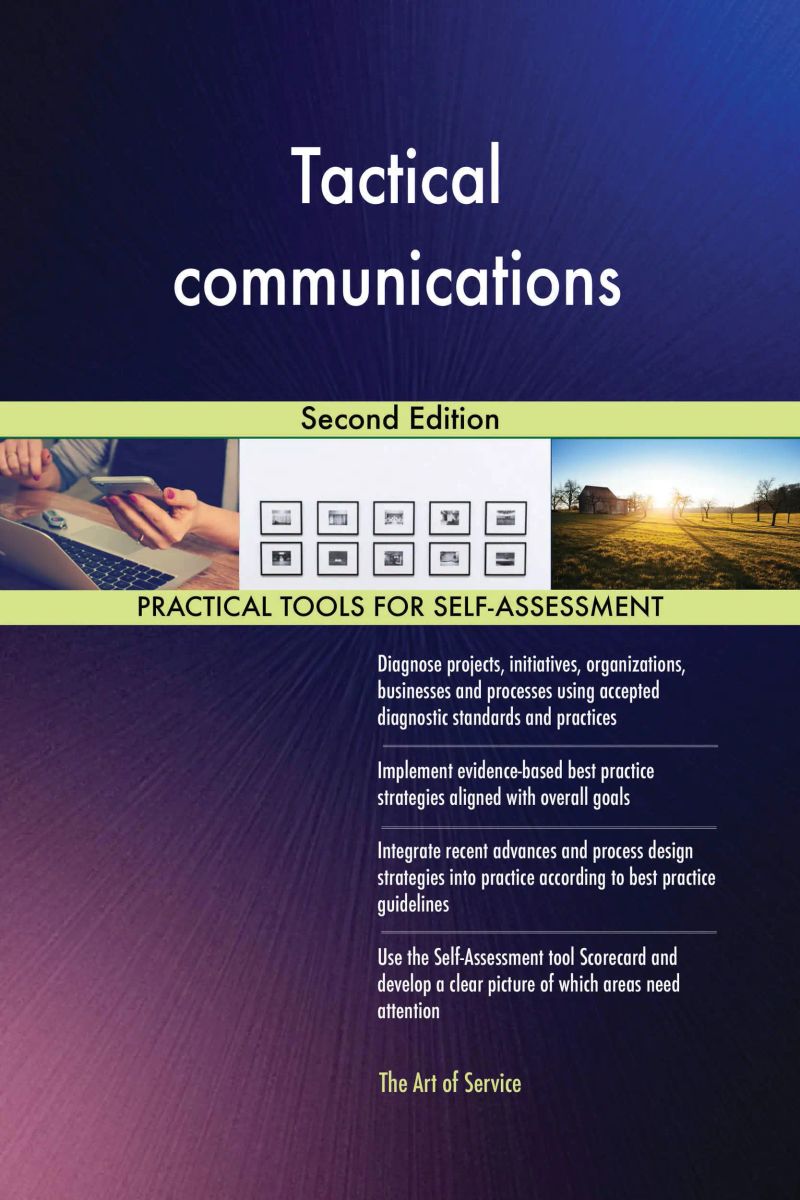
Tactical communications Second Edition
By Gerardus Blokdyk


Length3h 53m
About this audiobook
Who will be responsible for documenting the Tactical communications requirements in detail? How much are sponsors, customers, partners, stakeholders involved in Tactical communications? In other words, what are the risks, if Tactical communications does not deliver successfully? What sources do you use to gather information for a Tactical communications study? Why is it important to have senior management support for a Tactical communications project? What are the rough order estimates on cost savings/opportunities that Tactical communications brings?
Defining, designing, creating, and implementing a process to solve a challenge or meet an objective is the most valuable role… In EVERY group, company, organization and department.
Unless you are talking a one-time, single-use project, there should be a process. Whether that process is managed and implemented by humans, AI, or a combination of the two, it needs to be designed by someone with a complex enough perspective to ask the right questions. Someone capable of asking the right questions and step back and say, 'What are we really trying to accomplish here? And is there a different way to look at it?'
This Self-Assessment empowers people to do just that - whether their title is entrepreneur, manager, consultant, (Vice-)President, CxO etc... - they are the people who rule the future. They are the person who asks the right questions to make Tactical communications investments work better.
This Tactical communications All-Inclusive Self-Assessment enables You to be that person.
All the tools you need to an in-depth Tactical communications Self-Assessment. Featuring 682 new and updated case-based questions, organized into seven core areas of process design, this Self-Assessment will help you identify areas in which Tactical communications improvements can be made.
In using the questions you will be better able to:
- diagnose Tactical communications projects, initiatives, organizations, businesses and processes using accepted diagnostic standards and practices
- implement evidence-based best practice strategies aligned with overall goals
- integrate recent advances in Tactical communications and process design strategies into practice according to best practice guidelines
Using a Self-Assessment tool known as the Tactical communications Scorecard, you will develop a clear picture of which Tactical communications areas need attention.
Your purchase includes access details to the Tactical communications self-assessment dashboard download which gives you your dynamically prioritized projects-ready tool and shows your organization exactly what to do next. You will receive the following contents with New and Updated specific criteria:
- The latest quick edition of the book in PDF
- The latest complete edition of the book in PDF, which criteria correspond to the criteria in...
- The Self-Assessment Excel Dashboard, and...
- Example pre-filled Self-Assessment Excel Dashboard to get familiar with results generation
…plus an extra, special, resource that helps you with project managing.
INCLUDES LIFETIME SELF ASSESSMENT UPDATES
Every self assessment comes with Lifetime Updates and Lifetime Free Updated Books. Lifetime Updates is an industry-first feature which allows you to receive verified self assessment updates, ensuring you always have the most accurate information at your fingertips.
Audiobook details
GenreBusiness and Economics
Length3 hrs 53 mins
Narrated byListen with 1,000+ voices
FormateBook with Audio
Publish dateJul 18, 2018
LanguageEnglish
Table of contents
1About The Art of Service
2Acknowledgments
3Included Resources - how to access
4Your feedback is invaluable to us
5Purpose of this Self-Assessment
Show all chaptersShow less
6How to use the Self-Assessment
7Tactical communicationsScorecard Example
8Tactical communicationsScorecard
9BEGINNING OF THE SELF-ASSESSMENT:
10CRITERION #1: RECOGNIZE
11CRITERION #2: DEFINE:
12CRITERION #3: MEASURE:
13CRITERION #4: ANALYZE:
14CRITERION #5: IMPROVE:
15CRITERION #6: CONTROL:
16CRITERION #7: SUSTAIN:
17Tactical communications and Managing Tactical communications Projects, Criteria for Tactical communications Project Managers:
18Tactical communications: Stakeholder Management Plan
19Tactical communications: Tactical communications Project Schedule
20Tactical communications: Scope Management Plan
21Tactical communications: Roles and Responsibilities
22Tactical communications: Activity Duration Estimates
23Tactical communications: Planning Process Group
24Tactical communications: Executing Process Group
25Tactical communications: Source Selection Criteria
26Tactical communications: Activity Cost Estimates
27Tactical communications: Contract Close-Out
28Tactical communications: Milestone List
29Tactical communications: Activity Resource Requirements
30Tactical communications: Cost Baseline
31Tactical communications: Work Breakdown Structure
32Tactical communications: Change Request
33Tactical communications: Tactical communications Project Charter
34Tactical communications: Assumption and Constraint Log
35Tactical communications: Change Log
36Tactical communications: Quality Audit
37Tactical communications: Risk Management Plan
38Tactical communications: Schedule Management Plan
39Tactical communications: Activity Attributes
40Tactical communications: Contractor Status Report
41Tactical communications: Formal Acceptance
42Tactical communications: Team Operating Agreement
43Tactical communications: Risk Audit
44Tactical communications: Team Member Performance Assessment
45Tactical communications: Closing Process Group
46Tactical communications: Stakeholder Register
47Tactical communications: Variance Analysis
48Tactical communications: Tactical communications Project Performance Report
49Tactical communications: Stakeholder Analysis Matrix
50Tactical communications: Network Diagram

Partner Management A Complete Guide - 2019 EditionGerardus Blokdyk4h 31m$71
Convergence Strategy A Complete Guide - 2020 EditionGerardus Blokdyk4h 32m$71
Internal Auditors A Complete Guide - 2024 EditionGerardus Blokdyk4h 43m$78
Risk Process A Complete Guide - 2020 EditionGerardus Blokdyk4h 25m$78

Security Segregation A Complete Guide - 2020 EditionGerardus Blokdyk4h 36m$78

Employee Benefits Security Administration A Complete Guide - 2020 EditionGerardus Blokdyk4h 54m$78
Ethical banking Complete Self-Assessment GuideGerardus Blokdyk4h 8m$71
Entrepreneurial Leadership A Complete Guide - 2020 EditionGerardus Blokdyk4h 38m$78
Performance Optimization A Complete Guide - 2019 EditionGerardus Blokdyk4h 31m$71
IEC 61850 A Complete Guide - 2019 EditionGerardus Blokdyk4h 58m$71
Secure Network Communications A Complete Guide - 2020 EditionGerardus Blokdyk4h 41m$78
Enhancing the Customer Experience Standard RequirementsGerardus Blokdyk4h 19m$71
Media Engagement A Complete Guide - 2019 EditionGerardus Blokdyk4h 26m$71
Process Simulation A Complete Guide - 2020 EditionGerardus Blokdyk4h 30m$78
NProf Second EditionGerardus Blokdyk4h 1m$42
Rackspace Cloud A Complete Guide - 2020 EditionGerardus Blokdyk4h 30m$78
Email privacy Complete Self-Assessment GuideGerardus Blokdyk1h 57m$42
Energy Management Systems Complete Self-Assessment GuideGerardus Blokdyk1h 48m$42

Strategic Initiatives A Complete Guide - 2024 EditionGerardus Blokdyk4h 46m$78

Never Split the DifferenceChris Voss, Tahl Raz8h 7m4.4 (277.7K)$26 · $0.00

The Intelligent Investor Rev Ed.Benjamin Graham17h 48m4.3 (191.5K)$40 · $0.00

The Hard Thing About Hard ThingsBen Horowitz7h 57m4.2 (134.3K)$26 · $0.00
Boundaries for LeadersHenry Cloud7h 36m4.3 (3.6K)$26 · $0.00

Good to GreatJim Collins9h 59m4.1 (325.2K)$29 · $0.00
The Way of ExcellenceBrad Stulberg6h 46m4.2 (1.1K)$24 · $0.00

Trillion Dollar CoachEric Schmidt, Jonathan Rosenberg, Alan Eagle5h 40m4.1 (22.2K)$24 · $0.00
Be ExceptionalJoe Navarro, Toni Sciarra Poynter9h 11m4.0 (1.3K)$29 · $0.00

The Power of the OtherHenry Cloud5h 52m4.2 (3.5K)$24 · $0.00
Level UpRob Dial7h 42m4.6 (3.3K)$26 · $0.00

Eat It!Jordan Syatt, Michael Vacanti4h 40m4.6 (1.5K)$20 · $0.00

Progress and Poverty, Volumes I and II (Annotated)Henry George19h 21m4.6 (574)$1.99 · $0.00

Not Everything Counts but Everything Matters: The powerful and inspirational new book about leadership and achieving success from the visionary multi-premiership winning Panthers coachIvan Cleary6h 1m4.6 (680)$24 · $0.00
BuildTony Fadell11h 5m4.5 (14.3K)$8 · $0.00

The Joys Of CompoundingGautam Baid17h 34m4.5 (2.5K)$18 · $0.00
Basic EconomicsThomas Sowell18h 32m4.5 (29.3K)$28 · $0.00

The Ambuja StoryNarotam Sekhsaria13h 59m4.5 (830)$33 · $0.00

The Secret Door to SuccessFlorence Scovel Shinn2h 25m4.5 (2.1K)$1.20 · $0.00

This Is Going to HurtAdam Kay5h 47m4.4 (444.7K)$24 · $0.00

Big TrustShadé Zahrai, Fayçal Sekkouah8h 36m4.6 (406)$26 · $0.00
You may also like
critical ratio Standard RequirementsGerardus Blokdyk1h 43m$42
direct channel Second EditionGerardus Blokdyk1h 42m$42
Web content management system Experience Complete Self-Assessment GuideGerardus Blokdyk4h 22m$71
Consumer Security Third EditionGerardus Blokdyk4h 9m$71

Facilities engineering A Complete GuideGerardus Blokdyk1h 56m$42

Wireless Healthcare Asset Management Second EditionGerardus Blokdyk1h 50m$42
Industrial processes Third EditionGerardus Blokdyk1h 56m$42
VMware NSX A Complete Guide - 2020 EditionGerardus Blokdyk4h 38m$78
Water Taxi Service A Complete Guide - 2020 EditionGerardus Blokdyk4h 31m$71

Marketer Transparency In Personalization A Complete Guide - 2019 EditionGerardus Blokdyk4h 49m$71
Wide and narrow data Third EditionGerardus Blokdyk1h 56m$42
Customer Engagement Center Standard RequirementsGerardus Blokdyk4h 27m$71
ISO 55000 A Complete Guide - 2019 EditionGerardus Blokdyk4h 42m$71
Workflow Reinvention A Complete Guide - 2019 EditionGerardus Blokdyk4h 33m$71
Customer Service Experience A Complete Guide - 2021 EditionGerardus Blokdyk4h 45m$78
Integration Efforts A Complete Guide - 2019 EditionGerardus Blokdyk4h 25m$71
iTunes Connect A Complete Guide - 2019 EditionGerardus Blokdyk4h 39m$71
Architecture and Integration Complete Self-Assessment GuideGerardus Blokdyk4h 12m$71
Network Rail A Complete GuideGerardus Blokdyk1h 54m$42
ISO 12006 A Complete Guide - 2020 EditionGerardus Blokdyk4h 24m$78