
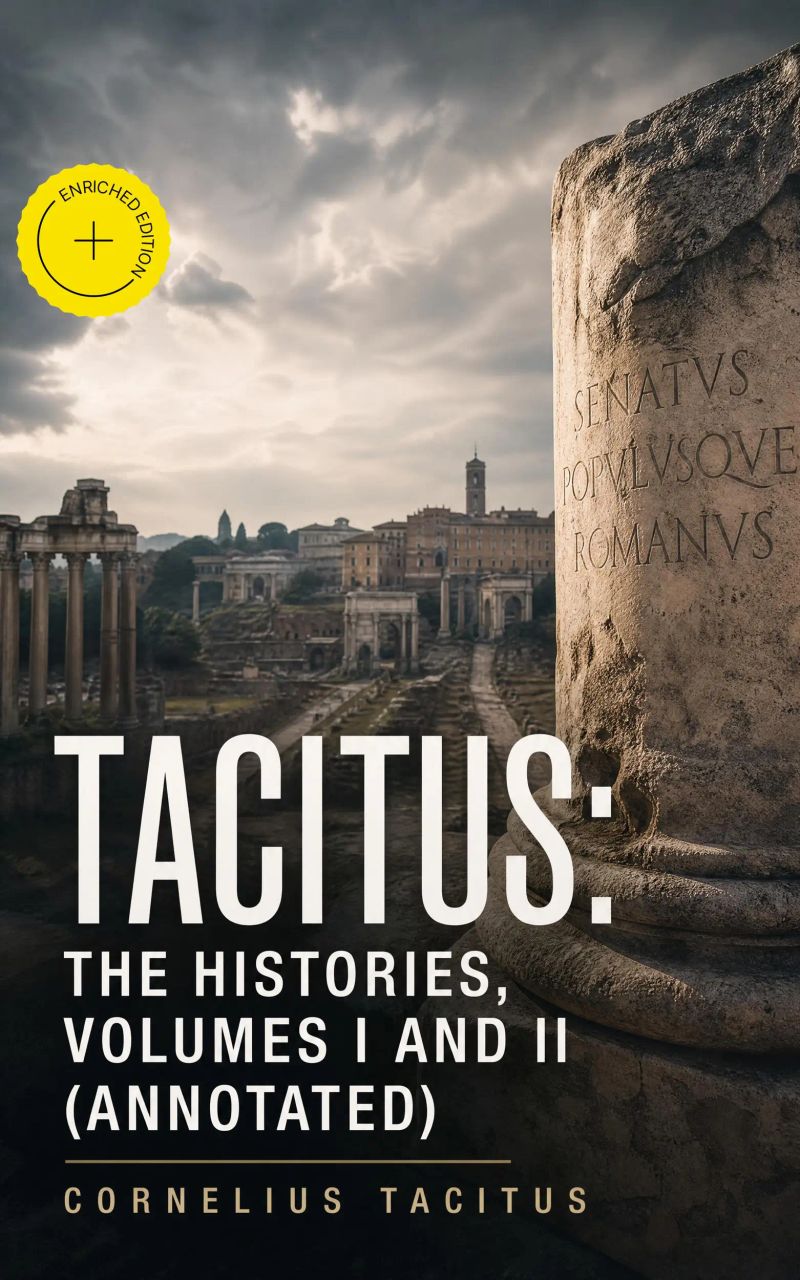
Tacitus: The Histories, Volumes I and II (Annotated)
Enriched Edition. Imperial Crisis, Civil War, and the Rise of Flavian Rome in a Classic Ancient HistoryBy Cornelius Tacitus


Length14h 7m
About this audiobook
Tacitus: The Histories, Volumes I and II presents one of antiquity's most penetrating accounts of imperial Rome in crisis, beginning with the chaotic Year of the Four Emperors in 69 CE and moving through the struggles that established Flavian rule. Written in Tacitus's famously compressed, ironic, and morally charged Latin prose, the work combines political narrative, psychological portraiture, military history, and senatorial critique. It stands within the classical historiographical tradition of Thucydides and Sallust, yet its bleak vision of power, corruption, and civic decline is unmistakably Tacitean. Cornelius Tacitus, senator, advocate, and former provincial governor, wrote with intimate knowledge of Roman public life and the dangers of autocratic rule. His career under the Flavians, Nerva, and Trajan gave him both proximity to power and retrospective distance from the tyranny of Domitian. These experiences shaped his suspicion of imperial rhetoric, his fascination with compromised virtue, and his enduring concern with how freedom survives under monarchy. This edition is recommended to readers seeking a rigorous entry into Roman political thought and historical prose. It rewards classicists, historians, and general readers alike with a drama of ambition, fear, loyalty, and institutional collapse whose insights remain unsettlingly modern.
This enriched edition has been carefully crafted to add value to your reading experience.
- A succinct Introduction situates the work's timeless appeal and themes.
- The Synopsis outlines the central plot, highlighting key developments without spoiling critical twists.
- A detailed Historical Context immerses you in the era's events and influences that shaped the writing.
- An Author Biography reveals milestones in the author's life, illuminating the personal insights behind the text.
- A thorough Analysis dissects symbols, motifs, and character arcs to unearth underlying meanings.
- Reflection questions prompt you to engage personally with the work's messages, connecting them to modern life.
- Hand‐picked Memorable Quotes shine a spotlight on moments of literary brilliance.
- Interactive footnotes clarify unusual references, historical allusions, and archaic phrases for an effortless, more informed read.
Audiobook details
GenreHistory
Length14 hrs 7 mins
Narrated byListen with 1,000+ voices
FormateBook with Audio
Publish dateNov 21, 2023
LanguageEnglish
Table of contents
1Introduction
2Introduction
3Synopsis
4Historical Context
5Author Biography
Show all chaptersShow less
6SUMMARY OF CHIEF EVENTS
7TACITUS THE HISTORIES
8INTRODUCTION
9SUMMARY OF CHIEF EVENTS
10BOOK I
11Preface
12The State of the Empire
13Galba's Position
14The Distribution of Forces
15The German Revolt and the Adoption of Piso
16Galba's Measures of Precaution
17The Rise of Otho
18The Fall of Galba
19Otho on the Throne
20Dramatis Personae
21The Rise of Vitellius
22The March of Valens' Column
23The March of Caecina's Column
24Otho's Government and the Distribution of Forces
25Otho's Plans
26BOOK II
27Vespasian and the East
28The Trial of Annius Faustus
29Otho's Measures of Defence
30The Decisive Struggle
31Vitellius' Principate
32The Revolt of Vespasian
33Vitellius in Rome
34SUMMARY OF CHIEF EVENTS
35BOOK III
36Antonius' Advance
37Dissension in Vitellius' Camp
38The Engagement near Cremona
39The Fate of Cremona
40Vitellius
41The State of the Provinces
42Antonius' Advance from Cremona
43Vitellius' Measures of Defence
44The Passage of the Apennines
45The Abdication of Vitellius and the Burning of the Capitol
46The Taking of Tarracina
47The Sack of Rome and the end of Vitellius
48BOOK IV
49Rome after the Fall of Vitellius
50The Revolt of Civilis and the Batavi
More from Cornelius Tacitus

Arguments of Celsus, Porphyry, and the Emperor Julian, Against the Christians (Annotated)Cornelius Tacitus, Flavius Josephus, Emperor of Rome Julian, Siculus Diodorus, Porphyry, active 180 Celsus3h 47m3.7 (55)$2 · $0.00

Die GermaniaCornelius Tacitus1h 41m4.0 (5.7K)$1 · $0.00

Tacitus on GermanyCornelius Tacitus2h 29m4.1 (4.5K)$2 · $0.00
Moeurs des anciens GermainsCornelius Tacitus1h 26m4.0 (19.2K)$2 · $0.00

The Germany and the Agricola of TacitusCornelius Tacitus6h 38m4.1 (18.2K)$1 · $0.00

Arguments of Celsus, Porphyry, and the Emperor Julian, Against the ChristiansCornelius Tacitus, Flavius Josephus, Emperor of Rome Julian, Siculus Diodorus, Porphyry, Active 180 Celsus3h 42m3.7 (52)$2 · $0.00

Arguments of Celsus, Porphyry, and the Emperor Julian, Against the ChristiansCornelius Tacitus, Flavius Josephus, Emperor of Rome Julian, Siculus Diodorus, Porphyry, active 180 Celsus3h 40m3.7 (52)$2 · $0.00

A Brief History of IntelligenceMax S. Bennett12h 18m4.6 (6.6K)$29 · $0.00

The Daughter of AuschwitzTova Friedman, Malcolm Brabant7h 54m4.6 (16.7K)$26 · $0.00

Lily's PromiseLily Ebert, Dov Forman8h 54m4.6 (16.1K)$29 · $0.00

On Democracies and Death CultsDouglas Murray10h 38m4.6 (6.5K)$29 · $0.00

Across the RiverKent Babb11h 40m4.6 (927)$29 · $0.00

Balcony Over Jerusalem: A Middle East Memoir - Israel, Palestine and BeyondJohn Lyons12h 37m4.6 (1.4K)$33 · $0.00

BeyondStephen Walker15h 39m4.6 (3.2K)$33 · $0.00

Kings and PawnsHoward Bryant10h 9m4.6 (678)$29 · $0.00

No EscapeNury Turkel9h 30m4.6 (809)$28 · $0.00

Jubal Stone: U.S. Marshal: Blood Trail To Hell: A Western Adventure NovelCasey Nash3h 42m4.6 (3.2K)$18 · $0.00

Fall and RiseMitchell Zuckoff17h 23m4.6 (9.8K)$40 · $0.00

The SurvivorJosef Lewkowicz, Michael Calvin9h 22m4.6 (2.5K)$29 · $0.00

Always FaithfulThomas Schueman, Zainullah Zaki12h 12m4.6 (977)$29 · $0.00

The State of Society in France Before the Revolution of 1789 (Annotated)Alexis de Tocqueville17h 25m4.6 (1.2K)$2 · $0.00

All the Gallant MenDonald Stratton, Ken Gire5h 55m4.6 (11.8K)$24 · $0.00

Saint Joan (Annotated)George Bernard Shaw6h 20m4.6 (1.2K)$1.20 · $0.00

Medgar and MyrlieJoy-Ann Reid10h 52m4.5 (27.8K)$29 · $0.00

The History of the Peloponnesian War (Annotated)Thucydides24h 3m4.6 (1.1K)$2 · $0.00

Where the Birds Never SingJack Sacco10h 31m4.6 (3.8K)$29 · $0.00

Serviceman J: The Untold Story of an NZSAS SoldierJamie Pennell5h 51m4.6 (452)$24 · $0.00
You may also like

HistoriesTacitus12h 23m4.1 (5.8K)$1.99 · $0.00

The Histories (Annotated)Tacitus12h 25m4.2 (5.6K)$2 · $0.00

The French RevolutionIan Davidson11h 52m3.9 (2.4K)$23

Rousseau and RevolutionWill Durant, Ariel Durant57h 17m4.4 (4.6K)$30
King JohnWilliam Shakespeare2h 44m3.7 (10.5K)$1.20 · $0.00

The History of England for ChildrenCharles Dickens32h 3m3.8 (2.8K)$2 · $0.00

The Brothers YorkThomas Penn23h 14m4.3 (1.8K)$30

King JohnWilliam Shakespeare2h 28m3.7 (11K)$15

The Complete Historical Plays of William ShakespeareWilliam Shakespeare29h 39m4.4 (613)$1.99 · $0.00

The PrinceNiccolò Machiavelli3h 24m4.0 (451.2K)$3 · $0.00
The PrinceNiccolo Machiavelli3h 10m4.0 (468.6K)$3.50 · $0.00

The History of England (Complete 6 Volumes) (Annotated)David Hume132h 22m4.3 (261)$2 · $0.00
THE 12 CAESARSSuetonius16h 7m4.2 (32.6K)$2.99 · $0.00
History of The Decline and Fall of The Roman Empire Vol IEdward Gibbon30h 34m4.4 (6.2K)$2.30

ChinaDemetrius Charles Boulger17h 18m3.2 (28)$2 · $0.00

The History of England: From Henry VII. to MaryDavid Hume16h 53m4.4 (34)$1 · $0.00

Geoffrey de Mandeville: A study of the AnarchyJohn Horace Round19h 39m$1 · $0.00

Evolution of the English Medieval Monarchy – 3 Classic English History TextsEdward A. Freeman, Alice Stopford Green, Kate Norgate27h 50m$2

The Last TsarŁarysa Jermiłowa3h4.2 (25)$18 · $0.00

History of King Charles the First of EnglandJacob Abbott4h 50m3.5 (115)$1 · $0.00