
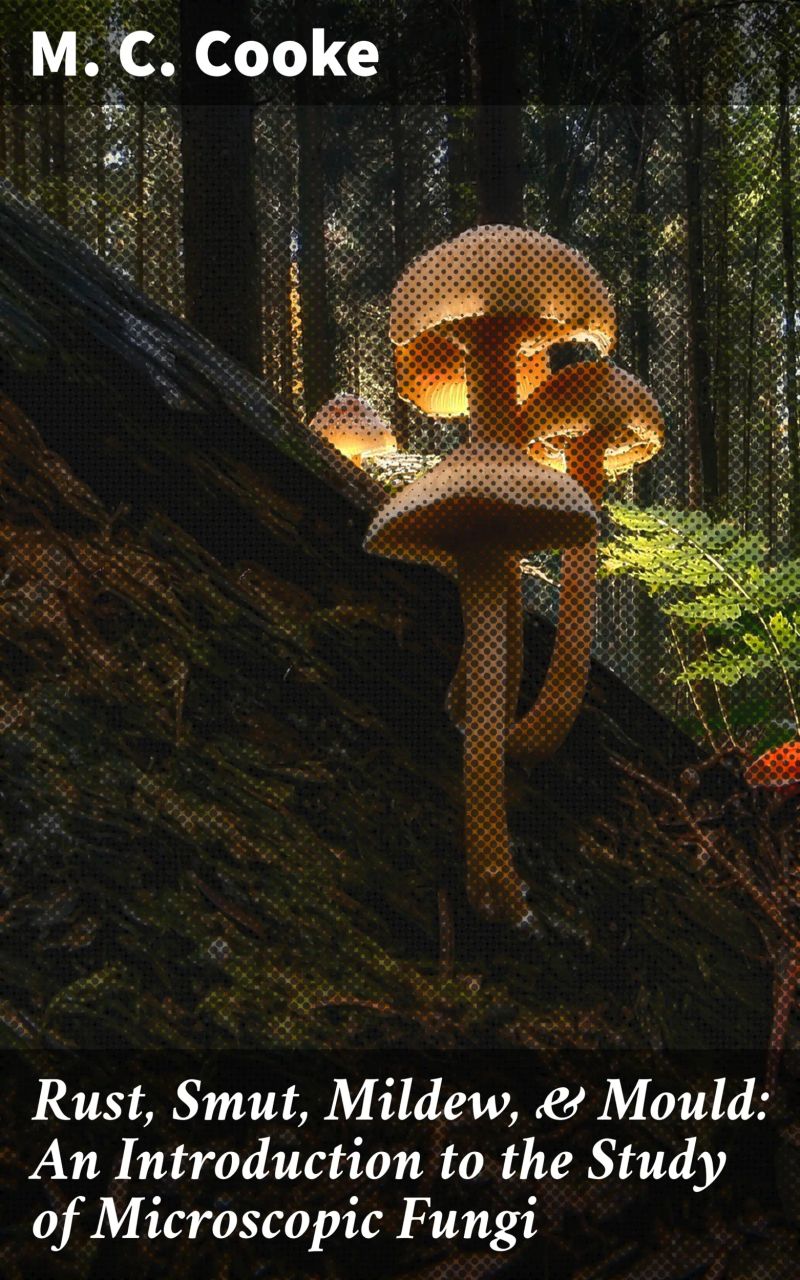
Rust, Smut, Mildew, & Mould: An Introduction to the Study of Microscopic Fungi
Exploring the World of Microscopic FungiBy M. C. Cooke

Length7h 20m
About this audiobook
In "Rust, Smut, Mildew, & Mould: An Introduction to the Study of Microscopic Fungi," M. C. Cooke presents a meticulously crafted exploration of the often-overlooked realm of fungi. This scholarly text combines a rich descriptive narrative with detailed observations of various fungal species, employing a systematic approach that situates microscopic fungi within their ecological context. Cooke's literary style is both accessible and engaging, effectively bridging the gap between scientific rigor and general readability. The book engages with contemporary fungal research while also revisiting classical scientific frameworks, thus highlighting the evolutionary significance and ecological roles of these organisms. M. C. Cooke, a renowned mycologist with extensive fieldwork experience, draws upon a diverse background in microbiology and environmental science. His passion for the microscopic world is reflected in his thorough methodology and keen observational skills. Cooke's prior works have established him as an authority in mycology, and his insights into environmental impacts on fungal life inform the discussions presented in this text, making it a significant addition to the field. This book is highly recommended for both budding mycologists and seasoned researchers alike, as it offers a foundational understanding of microscopic fungi while inspiring curiosity about their ecological roles. Cooke'Äôs passion for fungi encourages readers to appreciate the often-neglected yet vital components of our ecosystems, making it an indispensable resource for anyone interested in the biological sciences.
Audiobook details
Rating★★★★ 4.2 (16)
Includes Amazon, Goodreads
GenreScience and Nature
Length7 hrs 20 mins
Narrated byListen with 1,000+ voices
FormateBook with Audio
Publish dateNov 5, 2021
LanguageEnglish
Table of contents
1Introduction
26Gymnosporangium, DC.
2CHAPTER II. SPERMOGONES.
27PODISOMA, Lk.
3CHAPTER III. DI-MORPHISM.
28CÆOMACEI.
4CHAPTER IV. MILDEW AND BRAND.
29Tilletia, Tul.
5CHAPTER V. COMPLEX BRANDS.
30Ustilago, Link.
Show all chaptersShow less
6CHAPTER VI. SMUTS.
31Uredo, Lév.
7CHAPTER VII. COMPLEX SMUTS.
32Lecythea, Lév.
8CHAPTER VIII. RUSTS.
33Trichobasis, Lév.
9CHAPTER IX. RUSTS.
34Uromyces, Lév.
10CHAPTER X. WHITE RUSTS.
35Polycystis, Lév.
11CHAPTER XI. MOULDS.
36Tuburcinia, Fr.
12CHAPTER XII. WHITE MILDEWS OR BLIGHTS.
37Coleosporium, Lév.
13CHAPTER XIII. SUGGESTIONS.
38Melampsora, Cast.
14APPENDIX A.
39Cystopus.
15ÆCIDIACEI.
40PERONOSPOREI, De By.
16Rœstelia, Reb.
41Erysiphei.
17Peridermium, Chev.
42Sphærotheca, Lév.
18Æcidium, Pers.
43Phyllactinia, Lév.
19Sect. II. Peridia in tufts or clusters.
44Uncinula, Lév.
20Endophyllum, Lév.
45Microsphæria, Lév.
21PUCCINIÆI.
46Erysiphe, Hedw.
22Xenodochus, Schl.
47Chætomium, Kze.
23Aregma, Fr.
48Ascotricha, Berk.
24Triphragmium, Lk.
49Eurotium, Link.
25Puccinia, Pers.
50APPENDIX B.: Podosphæra, Kunze.
More from M. C. Cooke


A Brief History of IntelligenceMax S. Bennett12h 18m4.6 (6.6K)$29 · $0.00
The Story of BirdsSteve Brusatte11h 49m4.6 (401)$29 · $0.00

BeyondStephen Walker15h 39m4.6 (3.2K)$33 · $0.00

LiftoffEric Berger9h 4m4.6 (9.5K)$29 · $0.00
Black Earth WisdomLeah Penniman11h 54m4.6 (577)$8 · $0.00

Total Cat MojoJackson Galaxy10h 13m4.5 (8.4K)$23 · $0.00

My Life Among the UnderdogsTia Torres5h 51m4.5 (4K)$24 · $0.00

What It Takes to Save a LifeKwane Stewart6h4.6 (556)$24 · $0.00

Pastoral SongJames Rebanks8h 35m4.5 (12K)$26 · $0.00

How Stella Learned to TalkChristina Hunger7h4.5 (10.9K)$24 · $0.00

Craig & FredCraig Grossi8h 6m4.5 (9.6K)$26 · $0.00
Celebrating BirdsNatalia Rojas, Ana Maria Martinez6h 47m4.6 (330)$24 · $0.00

Saving JemimaJulie Zickefoose4h 59m4.5 (749)$20 · $0.00

Will's Red CoatTom Ryan8h 23m4.5 (2.3K)$26 · $0.00
Of Time and TurtlesSy Montgomery10h 34m4.5 (5K)$29 · $0.00

THE WOLF TRILOGY: Call of the Wild, White Fang & The Son of the WolfJack London17h 31m4.5 (2.4K)$1.99 · $0.00

Zen and the Art of Saving the PlanetThich Nhat Hanh9h 20m4.5 (3.9K)$29 · $0.00

BLACK BEAUTY (With Original Illustrations)Anna Sewell7h 31m4.5 (1.3K)$1.99 · $0.00

Bottle of LiesKatherine Eban14h 25m4.4 (12K)$33 · $0.00
IngrainedCallum Robinson8h 10m4.5 (1.1K)$26 · $0.00
You may also like

EarthElijah V. Reynolds5h 22m$4.10 · $0.00
The Moths of the British Isles. Comprising the Families Sphingidæ to NoctuidæRichard South13h 27m$2 · $0.00
Quadrupeds, What They Are and Where Found: A Book of Zoology for BoysMayne Reid5h 46m$1 · $0.00

Alden's Handy Atlas of the WorldJohn B. Alden5h 40m$1 · $0.00
Learn Beekeeping for Beginners - From Beekeeping to Honey: How to Easily Learn the Basics of Beekeeping, Keep Bees and Produce Your Own Honey in No Time at AllSabine Graß3h 45m$18 · $0.00

The Mining Handbook: 5 Classic Books on Mining Operations and ManagementArthur J. Hoskin, William H. Storms, Harold W. Fairbanks, Charles A. Bramble, Herbert Hoover31h 43m4.4 (11)$1.99 · $0.00
Underground Treasures: How and Where to Find ThemJames Orton2h 14m4.1 (11)$1 · $0.00

The Diatomaceæ of Philadelphia and VicinityCharles S. Boyer9h 11m$1 · $0.00
How We Are Fed: A Geographical ReaderJames Franklin Chamberlain2h 27m$2 · $0.00

The Story Of The Universe Volume 2 (of 4) : The Earth, Land and SeaEsther Singleton12h 49m$2.40
The Botanist's Repository for New and Rare Plants Vol 1& 2Henry Cranke Andrews8h 4m$2.30

The Geographical Distribution of AnimalsAlfred Russel Wallace42h 20m4.2 (132)$1.99 · $0.00
Noteworthy Mammals from Sinaloa, MexicoTicul Alvarez, J. Knox Jones, M. Raymond Lee38m$2 · $0.00

The Geologic Story of Glacier National ParkJames L. Dyson56m$1 · $0.00
Mammals of the San Gabriel Mountains of CaliforniaTerry A. Vaughan3h 9m$1 · $0.00

The Manual of the Botany of the Northern United StatesAsa Gray48h 1m4.5 (44)$2 · $0.00
Manures and the principles of manuringCharles Morton Aikman16h 3m$2 · $0.00
Handwork in WoodWilliam Noyes6h 46m3.3 (90)$1 · $0.00

Pearse's Commercial Directory to Swansea and the Neighbourhood, for 1854Ebenezer Pearse3h 44m$1 · $0.00

British Museum (Natural History) General GuideBritish Museum3h 21m$1 · $0.00