
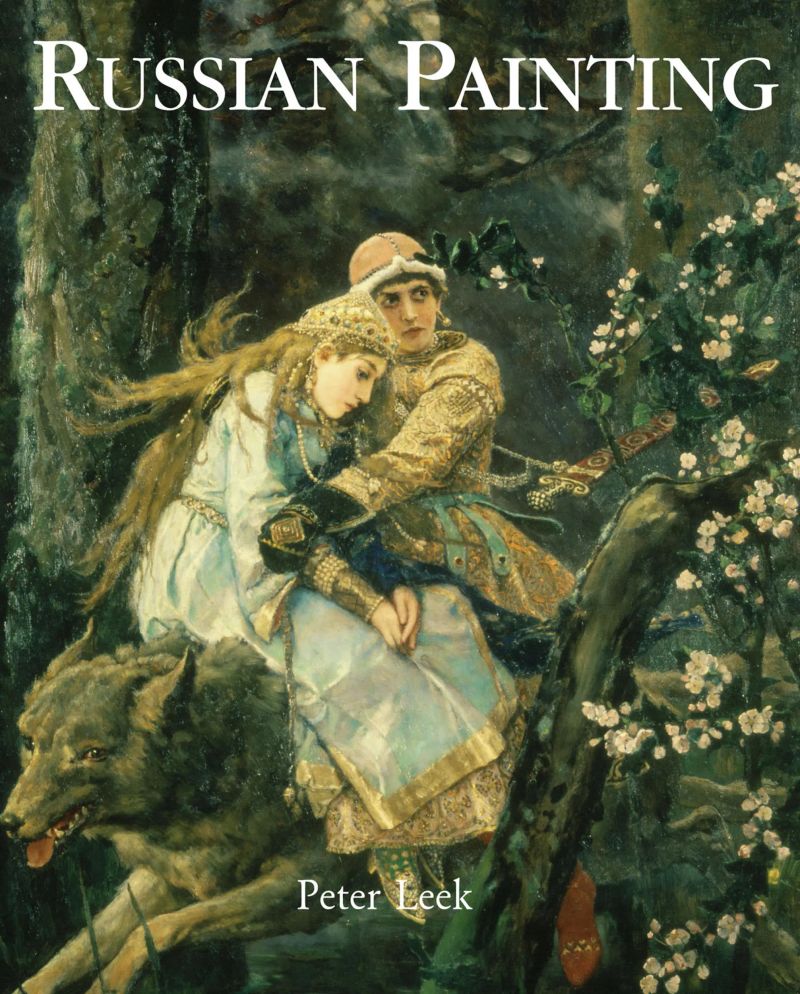
Russian Painting
Icons, landscapes, and the soul of a nationBy Peter Leek


Length5h 59m
About this audiobook
From the 18th century to the 20th, this book gives a panorama of Russian painting not equalled anywhere else. Russian culture developed in contact with the wider European influence, but retained strong native intonations. It is a culture between East and West, and both influences in together. The book begins with Icons, and it is precisely Icon-painting which gave Russian artist their peculiar preoccupation with ethical questions and a certain kind of palette. It goes on the expound the duality of their art, and point out the originality of their contribution to world art. The illustrations cover all genres and styles of painting in astonishing variety. Such figures as Borovokovsky, Rokotov, Levitsky, Brullov, Fedatov, Repin, Shishkin and Levitan and many more are in these pages.
Audiobook details
GenreOther
Length5 hrs 59 mins
Narrated byListen with 1,000+ voices
FormateBook with Audio
Publish dateMay 8, 2012
LanguageEnglish
Table of contents
1RUSSIAN PAINTING
2Author: Peter Leek
3Icon painting
4Parsunas
5scarcely less than Nikon’s.
Show all chaptersShow less
6The Academy
7Hermitage, St. Petersburg.
8Cross-currents in art
9The Itinerants
10Architecture in Moscow from 1871 to 1883; Grigory Miasoyedov, portrait, historical and
11to another.
12The emergence of Russian Avant-garde
13twentieth century.
14of eighteenth-century portrait painting at the Tauride Palace in Saint Petersburg in
15Cathedral in Saint Petersburg.
16of his artistic career.
17Russian Museum, St. Petersburg.
18Academy, Nikolaï Gay’s powerful painting The Last Supper was exhibited in Saint
19banal concerns.” Through techniques and pictorial means such as contrast between light
20King Salomon (1854) and Achilles Mourning Patrocles (1855).
21Religious Painting
22Russian Museum, St. Petersburg.
23friends: Tolstoy, Gay…
24Religious Painting
25Russian Museum, St. Petersburg.
26stature in Russia and outside of its national frontiers.
27the fifteenth itinerant exhibition.
28Tretyakov Gallery, Moscow.
29until his death from tuberculosis in 1836.
30permanent collection.
31Zakomelskaya and her Daughter in a Boat.
32From the 1860s to the 1890s
33on character observation for their lively satire or humour.
34the eve of destruction”.
35From the 1890s to the Post-Revolutionary Period
36with an Injured Arm.
37towards the end of his life.
38Museum of Russian Art, Kiev.
39Saryan, Surikov, Vrubel, Petrov-Vodkin, Robert Falk and Mikhaïl Nesterov who all
40Historical Painting
41From the Eigteenth Century to the 1860s
42Historical Painting
43Tretyakov Gallery, Moscow.
44From the 1860s to the 1890s
45opponents.
46Historical Painting
47Tretyakov Gallery, Moscow.
48From the 1890s to the Revolutionary Period
49Historical Painting
5043.5 x 62 cm, Tretyakov Gallery, Moscow.
More from Peter Leek

Russian PaintingPeter Leek5h 32m4.1 (54)$18 · $0.00

La Peinture RussePeter Leek5h 52m4.1 (43)$18 · $0.00

Russische MalereiPeter Leek5h 55m4.2 (29)$18 · $0.00

Russische MalereiPeter Leek5h 52m4.0 (38)$18 · $0.00

La Peinture RussePeter Leek5h 42m4.0 (33)$18 · $0.00
Mere ChristianityC. S. Lewis7h 7m4.4 (519.7K)$24 · $0.00

Her Daily BreadKate Wood12h 57m4.6 (153)$33 · $0.00
The Holy Bible - 1 SamuelKing James2h 13m4.8 (1.6K)$3 · $0.00

The American Standard Bible — The Gospel of MatthewMatthew3h 56m4.7 (3K)$2 · $0.00

Bad Fat Black GirlSesali Bowen6h 32m4.7 (2.8K)$24 · $0.00
The King James Audio Bible New Testament CompleteChristopher Glyn20h 2m4.7 (2.6K)$12 · $0.00

Faiths CheckbookCharles Spurgeon12h 44m4.7 (3.2K)$11 · $0.00
Ten Things I Wish You Knew About Your Child's Mental HealthDr. Billy Garvey4h 53m4.7 (2.4K)$20 · $0.00
Designing Terry Pratchett’s DiscworldPaul Kidby3h 52m4.7 (343)$20 · $0.00
The Chosen Book OneAmanda Jenkins, Kristen Hendricks, Dallas Jenkins3h 8m4.6 (4.9K)$10 · $0.00
The Lives of BrianBrian Johnson9h 45m4.6 (3.5K)$29 · $0.00
Expository Thoughts on the Gospel of LukeJ.C. Ryle27h 13m4.7 (536)$18 · $0.00

CrossroadsKaleb Dahlgren7h 56m4.6 (4.9K)$26 · $0.00

Across the RiverKent Babb11h 40m4.6 (927)$29 · $0.00

Brain Training for RidersAndrea Monsarrat Waldo5h 56m4.7 (550)$19 · $0.00

My Effin' LifeGeddy Lee17h 11m4.6 (13.1K)$40 · $0.00

Kings and PawnsHoward Bryant10h 9m4.6 (678)$29 · $0.00

The Elementia Chronicles #2: The New OrderSean Fay Wolfe11h 17m4.6 (841)$29 · $0.00

The ActsLuke2h 55m4.6 (19.7K)$12 · $0.00

New Testament - Easy NavigationWorld English Bible19h 35m4.6 (1.3K)$1.30 · $0.00
You may also like

Pete the Cat: The Wheels on the BusJames Dean4m4.2 (18.5K)$4 · $0.00

Pete the Cat: Old MacDonald Had a FarmJames Dean6m3.8 (5.3K)$4 · $0.00
House of the Rising Sun - DainesBill Brown Jr.1h 7m$10

Piano by Ear: Hymns and Worship Box Set 1Bill Brown Jr.16h 5m$25

Whiskey Before BreakfastBill Brown Jr.18m4.4 (16)$2

Dixie HoedownBill Brown Jr.23m$2

Wabash CannonballBill Brown Jr.20m$2

When the Saints Go Marching InBill Brown Jr.17m$2

Barney's HorseSyd Hoff5m3.5 (106)$4 · $0.00

The Ballad of Jed ClampettBill Brown Jr.21m$2
Oh, Susanna!Bill Brown Jr.20m$2

The Fox and the Cat: a Ukrainian Folk TaleRobert Nisbet Bain6m$2

Solamente Una Vez – classical soloBill Brown Jr.29m$2

The Remarkable Adventures of an Old Woman and Her PigAnonymous10m$2 · $0.00

Rope Skipping for Beginners - The practice book: How to learn rope jumping quickly, acquire jumping techniques in no time and continuously improve your new skillsKatja Eden1h$10 · $0.00
Art in Needlework: A Book about EmbroideryMary Buckle, Lewis F. Day4h 55m4.0 (82)$2 · $0.00

Star Spangled BannerBill Brown Jr.20m$2

Old Tavern SignsFritz August Gottfried Endell5h 40m$2 · $0.00

O Holy NightBill Brown Jr.2h 17m4.8 (11)$10

When Johnny Comes Marching HomeBill Brown Jr.14m4.6 (11)$1