
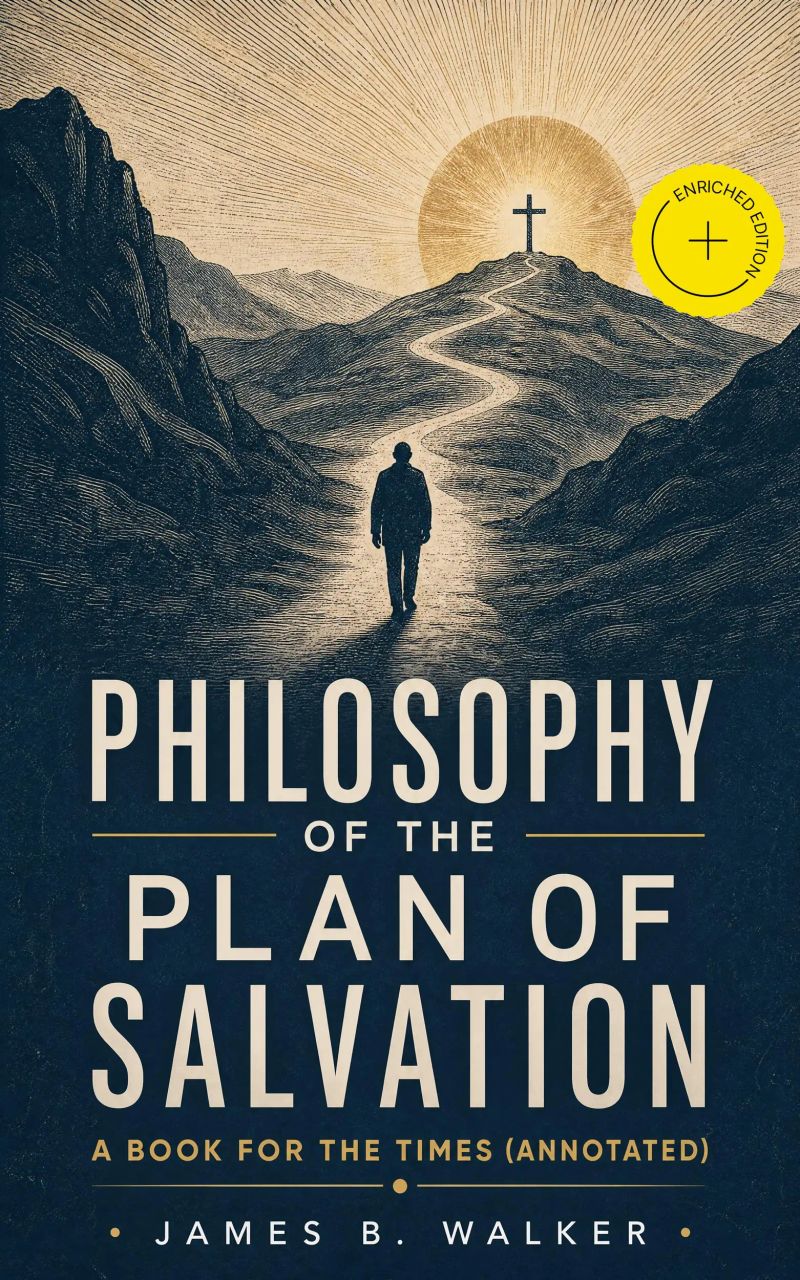
Philosophy of the Plan of Salvation: A Book for the Times (Annotated)
Enriched Edition. A Nineteenth-Century Apologetic on Revelation, Atonement, and SalvationBy James B. Walker


Length5h 13m
About this audiobook
Philosophy of the Plan of Salvation: A Book for the Times is a nineteenth-century work of Christian apologetics that seeks to demonstrate the rational coherence and moral necessity of the biblical scheme of redemption. Moving from human conscience and religious history to revelation, atonement, and spiritual renewal, Walker writes in a didactic, orderly prose shaped by Protestant moral philosophy. Its style belongs to an age when theology, common-sense reasoning, and public instruction were closely allied. James B. Walker, an American clergyman and religious writer, addressed readers unsettled by skepticism, sectarian controversy, and rapid social change. His concern was not merely to defend doctrine but to show that Christianity answers the deepest conditions of human nature: guilt, moral weakness, and the longing for reconciliation with God. The book reflects a pastoral intellect intent on making evangelical faith intellectually persuasive. This volume is recommended to readers interested in historical theology, apologetics, and the religious imagination of the nineteenth century. Though its arguments bear the marks of its era, its central ambition remains compelling: to present salvation as a divinely ordered remedy for the human predicament.
This enriched edition has been carefully crafted to add value to your reading experience.
- Hand‐picked Memorable Quotes shine a spotlight on moments of literary brilliance.
- Interactive footnotes clarify unusual references, historical allusions, and archaic phrases for an effortless, more informed read.
Audiobook details
Rating★★★★ 4.1 (15)
Includes Goodreads
GenreSpirituality and Religion
Length5 hrs 13 mins
Narrated byListen with 1,000+ voices
FormateBook with Audio
Publish dateDec 12, 2023
LanguageEnglish
Table of contents
1Introduction
2PREFACE.
3I. OCCASION OF THE WORK.
4II. REASONS FOR PRESENTING THE WORK TO THE PUBLIC.
5CHAPTER I. INTRODUCTORY. MAN WILL WORSHIP—HE WILL BECOME ASSIMILATED TO THE CHARACTER OF THE OBJECT THAT HE WORSHIPS—CHARACTER OF HEATHEN DEITIES DEFECTIVE AND UNHOLY—FROM THIS CORRUPTING WORSHIP MAN HAS NO POWER TO EXTRICATE HIMSELF.
Show all chaptersShow less
6THE FIRST FACT STATED.
7THE SECOND FACT STATED.
8THE THIRD FACT IS STATED.
9CHAPTER II. THE DESIGN AND NECESSITY OF THE BONDAGE IN EGYPT.
10CHAPTER III. CONCERNING MIRACLES—PARTICULARLY THE MIRACLES WHICH ACCOMPANIED THE DELIVERANCE OF THE ISRAELITES FROM BONDAGE IN EGYPT.
11CHAPTER IV. WHAT WAS NECESSARY AS THE FIRST STEP IN THE PROCESS OF REVELATION.
12CHAPTER V. THE NECESSITY OF AFFECTIONATE OBEDIENCE TO GOD; AND THE MANNER OF PRODUCING THAT OBEDIENCE IN THE HEARTS OF THE ISRAELITES.
13CHAPTER VI. THE DESIGN AND NECESSITY OF THE MORAL LAW.
14CHAPTER VII. THE DEVELOPMENT OF THE IDEA OF HOLINESS AND ITS TRANSFER TO JEHOVAH AS AN ATTRIBUTE.
15CHAPTER VIII. THE ORIGIN OF THE IDEAS OF JUSTICE AND MERCY, AND THEIR TRANSFER TO THE CHARACTER OF JEHOVAH.
16CHAPTER IX. THE TRANSITION FROM THE MATERIAL SYSTEM, BY WHICH RELIGIOUS IDEAS WERE CONVEYED THROUGH THE SENSES, TO THE SPIRITUAL SYSTEM, IN WHICH ABSTRACT IDEAS WERE CONVEYED BY WORDS AND PARABLES.
17CHAPTER X. THE MEDIUM OF CONVEYING TO MEN PERFECT INSTRUCTION IN DOCTRINE AND DUTY.
18CHAPTER XI. SOME OF THE PECULIAR PROOFS OF THE MESSIAHSHIP OF CHRIST.
19CHAPTER XII. THE CONDITION IN LIFE WHICH IT WAS NECESSARY THE MESSIAH SHOULD ASSUME IN ORDER TO BENEFIT THE HUMAN FAMILY IN THE GREATEST DEGREE, BY HIS EXAMPLE AND INSTRUCTIONS.
20CHAPTER XIII. THE ESSENTIAL PRINCIPLES WHICH MUST, ACCORDING TO THE NATURE OF THINGS, LIE AT THE FOUNDATION OF THE INSTRUCTION OF CHRIST.
21CHAPTER XIV. FAITH, THE EXERCISE THROUGH WHICH TRUTH REACHES AND AFFECTS THE SOUL.
22CHAPTER XV. THE MANIFESTATIONS OF GOD WHICH WOULD BE NECESSARY, UNDER THE NEW AND SPIRITUAL DISPENSATION, TO PRODUCE IN THE SOUL OF MAN AFFECTIONATE OBEDIENCE.
231. The testimony of Jesus that it was necessary man should feel the want, in order to exercise the love.
242. The testimony of the Scriptures that God did thus manifest himself as suffering and making self-denials for the spiritual good of men.
253. The atonement of Christ produces the necessary effect upon the human soul, in restoring it to affectionate obedience, which neither philosophy, law, nor perceptive truth could accomplish.
264. Analogy between the moral and physical laws of the universe.
275. Illustrations from nature and the Scriptures.
286. The preceding views established by reductio ad absurdum.
29CHAPTER XVI. THE INFLUENCE OF FAITH IN CHRIST UPON THE MORAL DISPOSITION AND MORAL POWERS OF THE SOUL.
30CHAPTER XVII. THE DESIGN AND THE IMPORTANCE OF THE MEANS OF GRACE.
311.—PRAYER.
322.—PRAISE.
333.—PREACHING.
34CHAPTER XVIII. THE AGENCY OF GOD IN CARRYING ON THE WORK OF REDEMPTION, AND THE MANNER IN WHICH THAT AGENCY IS EXERTED.
35CHAPTER XIX. CONCERNING THE PRACTICAL EFFECTS OF THE SYSTEM.
36CONCLUSION.
37Memorable Quotes

The Secret of the RosaryLouis de Montfort6h 1m4.7 (16K)$2 · $0.00

The Holy Qur-an: Text, Translation and CommentaryAbdullah Yusuf Ali22h 16m4.7 (133K)$1 · $0.00

All of Grace (Annotated)Charles Spurgeon5h 1m4.7 (1.3K)$1.99 · $0.00

Steps to ChristEllen G. White3h 12m4.7 (13.8K)$2 · $0.00

The Doctrine and Covenants of the Church of Jesus Christ of Latter Day Saints (Annotated)Joseph Smith13h 57m4.7 (575)$2 · $0.00

Sinners in the Hands of an Angry God & Other Sermons (Annotated)Jonathan Edwards7h 51m4.7 (1.5K)$2 · $0.00

Swayam Ki AwaazPrem Rawat8h 34m4.7 (1.1K)$26 · $0.00

Behind the BadgeAdam Davis10h 18m4.7 (2.7K)$10 · $0.00

The New Human Revolution, vol. 1Daisaku Ikeda7h 46m4.7 (669)$12 · $0.00

You Are Worth ItKyle Carpenter, Don Yaeger8h 53m4.7 (4.8K)$29 · $0.00
Praying GraceDavid A. Holland3h 2m4.7 (658)$10 · $0.00

Evidence Not SeenDarlene Deibler Rose11h 11m4.6 (11.9K)$29 · $0.00

The Christ KeyChad Bird, Chad Bird7h 33m4.7 (592)$17.40 · $0.00

He and IGabrielle Bossis10h 12m4.7 (554)$17 · $0.00

Your Body Already KnowsNidhi Pandya Bhanshali9h 7m4.7 (360)$16 · $0.00

The Complete WorksFlorence Scovel Shinn7h 59m4.6 (6.6K)$2 · $0.00
Driven by EternityJohn Bevere3h 50m4.6 (3.2K)$10 · $0.00
Spiritual AnatomyDaaji Kamlesh D. Patel9h 47m4.7 (319)$29 · $0.00

The Mahabharata of Krishna-Dwaipayana Vyasa Translated into English ProseAnonymous8h 1m4.7 (1.9K)$2 · $0.00
The Chosen Book OneAmanda Jenkins, Kristen Hendricks, Dallas Jenkins3h 8m4.6 (4.9K)$10 · $0.00
You may also like

On the Incarnation (Annotated)Athanasius of Alexandria4h 47m4.4 (20.4K)$2 · $0.00

The Doctrine of ElectionArthur W. Pink9h 20m4.6 (321)$17
Old PathsJ. C. Ryle21h 5m4.7 (413)$25
The Chosen Book OneAmanda Jenkins, Kristen Hendricks, Dallas Jenkins3h 8m4.6 (4.9K)$10 · $0.00

The Bruised ReedRichard Sibbes4h 28m4.6 (6.6K)$10

All of GraceCharles H. Spurgeon3h 30m4.6 (8.1K)$10 · $0.00

Book of I PeterUnknown Author19m4.6 (3.9K)$8
The Practice of the Presence of GodBrother of the Resurrection Lawrence1h 6m4.4 (78.1K)Free
Jesus in RedRay Comfort10h 2m4.6 (3.2K)$10 · $0.00

The Life of St. Teresa of Jesus, of the Order of Our Lady of CarmelOf Avila Saint Teresa18h 23m4.3 (5.4K)$2 · $0.00
The Person and Work of The Holy Spirit (Annotated)R. A. Torrey8h 10m4.5 (2.6K)$2 · $0.00
Humility: The Beauty of HolinessAndrew Murray2h 8m4.5 (14.3K)$2 · $0.00
The Twelve Powers of ManCharles Fillmore4h 41m4.4 (1.1K)$1 · $0.00

The Crook in the LotThomas Boston4h 38m4.6 (1.8K)$14
The Story of JesusBrian Simmons3h 10m4.8 (295)$3 · $0.00

The Cloud of UnknowingAnonymous3h 39m4.3 (5.6K)$21 · $0.00
RomansJohn Warwick Montgomery13h 4m$33 · $0.00
The Message and the ManJ. Dodd Jackson5h 54m$2 · $0.00
Operating in the Power of God’s GraceRobert Henderson6h 32m4.4 (186)$17 · $0.00
The Mind of Apostle PaulDavid T. Reuben3h 31m$8