
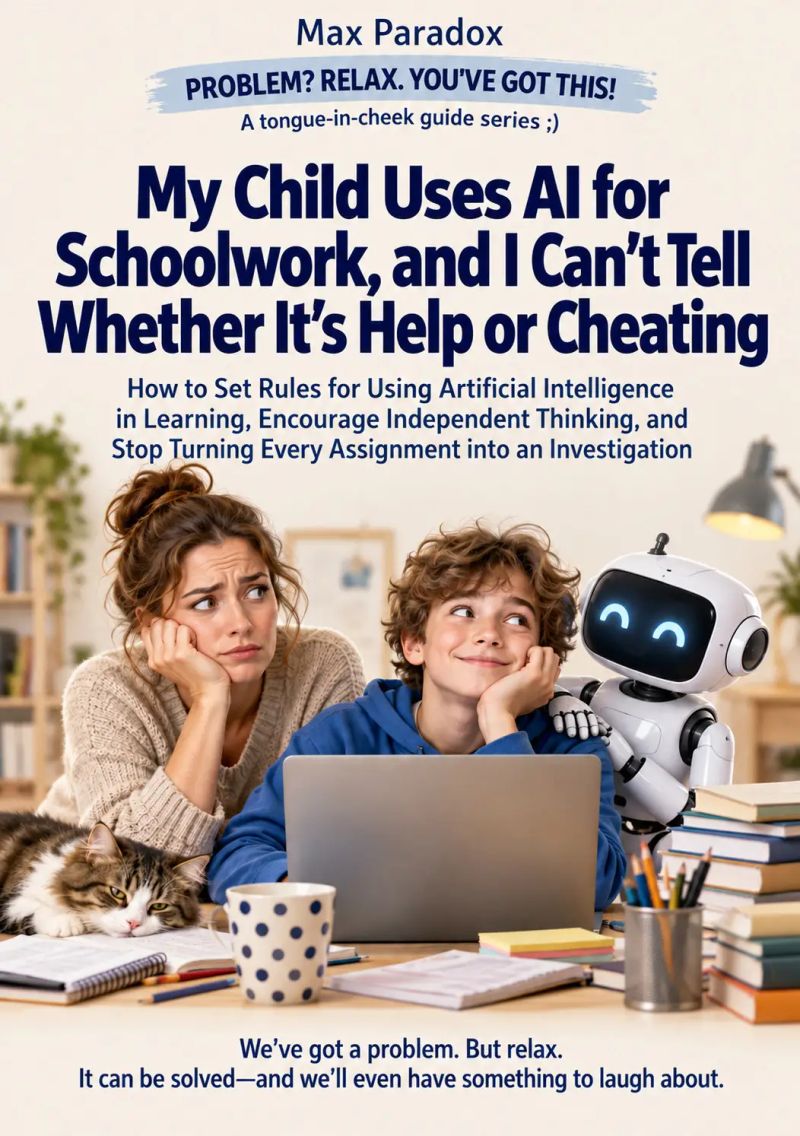
My Child Uses AI for Schoolwork, and I Can't Tell Whether It's Help or Cheating - How to Set Rules for Using Artificial Intelligence in Learning, Encourage Independent Thinking, and Stop Turning Every Assignment into an Investigation
By Max Paradox


Length6h 13m
About this audiobook
Your child has homework. Your child has artificial intelligence. And suddenly, you have a new unpaid job: investigating whether a suspiciously impressive essay was written by a student, a chatbot, or some mysterious combination of the two.
Yesterday, your biggest homework problem was explaining fractions without losing your patience. Today, you're wondering whether asking AI for an explanation counts as studying, whether improving a paragraph counts as cheating, and whether your child has secretly hired a digital academic department.
Welcome to modern parenting.
In My Child Uses AI for Schoolwork, and I Can't Tell Whether It's Help or Cheating, Max Paradox explores one of the most confusing questions facing families: How can children benefit from artificial intelligence without letting it do their learning for them?
The answer isn't to ban every chatbot, grant unlimited access, or inspect every conversation like a detective examining evidence at a crime scene.
Instead, this practical, humorous guide helps parents understand what actually matters.
You'll discover how to distinguish useful explanations from completed assignments, recognize when AI is replacing independent thinking, and teach children to question answers that sound convincing but may be completely wrong. You'll also learn why excessive editing can erase a student's individual voice and why parents sometimes interfere with learning just as effectively as technology does.
The book goes beyond warnings and offers realistic ways to use AI responsibly. Learn how to establish clear family expectations, ask teachers about ambiguous school rules, protect personal information, and use AI for practice questions, constructive feedback, and thoughtful challenges rather than effortless answers.
What happens when several students use AI on a group project and nobody knows who contributed what? How should you respond when your child admits submitting generated work dishonestly? What if they become convinced they can't complete an assignment without a chatbot?
These situations deserve something better than another lecture about how difficult school was before the internet.
Max Paradox examines the pressure children face from deadlines, classmates, grades, and their own expectations. He explains how to address mistakes without permanently destroying trust, support different learning needs without confusing fairness with identical treatment, and gradually give children greater responsibility for their own decisions.
Written for parents of school-age children and teenagers, this guide combines relatable situations, useful conversations, clear distinctions, and intelligent humor. It doesn't assume that you understand every new AI feature or have unlimited time to supervise homework. It also doesn't expect your child to become a model of technological responsibility after one inspiring family meeting.
The goal is practical: help your child use powerful tools while continuing to develop knowledge, judgment, honesty, and independence.
Because a beautifully written assignment isn't necessarily evidence of a beautifully educated mind.
And because your evenings deserve something better than an interrogation about the suspiciously sophisticated vocabulary in paragraph three.
You don't need to become an AI expert or the household's Chief Inspector of Homework. You need clear principles, workable boundaries, and a child who increasingly knows when to ask for help, when to question an answer, and when to think independently.
Let AI assist with learning. Don't let it replace the learner.
This publication was prepared using tools that support the creative process, including artificial intelligence solutions. The final concept, structure and editing are the responsibility of the author.
Audiobook details
GenreSelf-Help
Length6 hrs 13 mins
Narrated byListen with 1,000+ voices
FormateBook with Audio
Publish dateOct 24, 2026
LanguageEnglish
Table of contents
1INTRO
2Chapter 1 - When AI Helps Your Child Learn and When It Quietly Does the Homework
3Chapter 2 - Why Your Child Opens AI Before Even Trying to Think
4Chapter 3 - AI Sounds Like an Expert Even When It's Making Things Up
5Chapter 4 - Ban It, Allow Everything, or Monitor Every Click? Three Excellent Ways to Start an Argument
Show all chaptersShow less
6Chapter 5 - When AI Keeps Improving the Assignment Until Your Child Disappears
7Chapter 6 - Parents Can Do Their Children's Homework Too, and They Don't Even Need AI
8Chapter 7 - Your Child's Homework Doesn't Need Everyone's Names, Addresses, and Family Secrets
9Chapter 8 - Four Students, One Chatbot, and Nobody Knows Who Actually Did the Project
10Chapter 9 - The Family AI Agreement That Doesn't Require a Lawyer
11Chapter 10 - The Hint Ladder: How to Let AI Help Without Letting It Take Over the Thinking
12Chapter 11 - The Teacher Says "Do It Independently." Your Child Asks, "How Independently?"
13Chapter 12 - AI as a Study Coach, Not a Machine That Keeps Saying "You're Amazing!"
14Chapter 13 - Don't Let AI Agree With You: Teaching Children to Argue Instead of Collecting Approval
15Chapter 14 - AI Can Design the Experiment, but It Can't Watch the Ice Melt
16Chapter 15 - Caught Cheating with AI: How to Put Things Right Without Destroying Trust
17Chapter 16 - "I Can't Do It Without AI": Rebuilding Independence Without Pulling the Plug
18Chapter 17 - When One Child Needs AI and Another Should Put It Away: Fair Doesn't Always Mean Identical
19Chapter 18 - Keeping the Rules Useful Without Becoming the Family's Digital Surveillance Department
20Chapter 19 - "Everyone Uses AI Anyway": Making Good Decisions When Shortcuts Become Tempting
21Chapter 20 - Hand Over the Controls: The Best AI Rule Is the One Your Child No Longer Needs You to Enforce

The Food Label Has More Information Than My Résumé - How to Read Food Labels, Separate What Matters from Marketing Noise, and Shop Normally Without Taking a Biochemistry Exam in the Grocery AisleMax Paradox6h 22m$7.70 · $0.00

Czytam Książki i Po Tygodniu Pamiętam Tylko Okładkę - Jak czytać aktywniej, zapamiętywać to, co naprawdę ważne, i używać książek bez robienia notatek dłuższych od samego rozdziałuMax Paradox6h 19m$7.70 · $0.00

I Got Promoted, but My Paycheck Didn't Get the Memo - How to Talk About Money After Taking On More Responsibility, Set Expectations, and Avoid Accepting a New Role Just for a More Impressive Email SignatureMax Paradox6h 48m$7.70 · $0.00

I Read Books and a Week Later All I Remember Is the Cover - How to Read More Actively, Remember What Really Matters, and Put Books to Use Without Taking Notes Longer Than the Chapter ItselfMax Paradox6h 14m$7.70 · $0.00

I Feel Too Old for the Job Market and Too Young for Retirement - How to Plan Your Next Career Chapter, Update Your Skills, and Find Work in Your Forties or Fifties Without Pretending to Be TwentyMax Paradox6h 36m$7.70 · $0.00

Dziecko Ma AI do Lekcji i Nie Wiem, Czy To Pomoc, Czy Ściąga - Jak ustalić zasady korzystania ze sztucznej inteligencji w nauce, wspierać samodzielne myślenie i nie zamieniać każdego zadania w śledztwoMax Paradox6h 5m$7.70 · $0.00

Dostałem Awans, Ale Pensja Zapomniała - Jak rozmawiać o pieniądzach po zwiększeniu odpowiedzialności, ustalać oczekiwania i nie przyjmować nowej roli wyłącznie za bardziej imponujący podpis w mailuMax Paradox6h 18m$7.70 · $0.00

Etykieta Jedzenia Ma Więcej Informacji Niż Moje CV - Jak czytać etykiety, odróżniać ważne informacje od marketingowego hałasu i robić normalne zakupy bez egzaminu z biochemii przy półceMax Paradox6h 7m$7.70 · $0.00

Czuję Się Za Stary na Rynek Pracy i Za Młody na Emeryturę - Jak planować kolejny zawodowy rozdział, aktualizować kompetencje i szukać pracy po czterdziestce lub pięćdziesiątce bez udawania dwudziestolatkaMax Paradox6h 12m$7.70 · $0.00

Chcę Pomóc Dorosłemu Dziecku i Nie Zostać Bankomatem - Jak wspierać finansowo dorosłe dzieci, stawiać granice i rozmawiać o samodzielności bez prowadzenia rodzinnej infolinii kredytowejMax Paradox6h 23m$7.80 · $0.00

Chcę Zmienić Branżę, Ale Moje CV Utknęło w Poprzedniej - Jak przełożyć doświadczenie na nowe kompetencje, zbudować wiarygodną historię zmiany i wejść do innej branży bez zaczynania życia od zeraMax Paradox6h 57m$7.80 · $0.00

Chcę Się Starzeć, Ale Najchętniej Wolniej - Jak budować proste nawyki wspierające zdrowie, sprawność i samodzielność bez biohackingu, lodowej beczki i obsesji na punkcie wieku biologicznegoMax Paradox6h 41m$7.80 · $0.00

Without GPS, I Can't Even Find Places I've Been Before - How to Regain Your Sense of Direction, Plan Routes, and Use Maps as a Tool Instead of the Only Way to Get to the Bakery Two Streets AwayMax Paradox6h 8m$7.80 · $0.00

Bez GPS-u Nie Trafię Nawet Tam, Gdzie Już Byłem - Jak odzyskać orientację, planować trasę i korzystać z map jako narzędzia zamiast jedynego sposobu dotarcia do piekarni dwie ulice dalejMax Paradox5h 38m$7.80 · $0.00

I Want to Switch Industries, but My Résumé Is Stuck in the Old One - How to Translate Your Experience into Skills for a New Field, Build a Credible Career-Change Story, and Enter a Different Industry Without Starting Your Life from ScratchMax Paradox6h 59m$7.80 · $0.00

I Want to Get Older, Just Preferably More Slowly - How to Build Simple Habits That Support Health, Physical Ability, and Independence Without Biohacking, Ice Baths, or Obsessing Over Biological AgeMax Paradox6h 35m$7.80 · $0.00

Other People's Moods Control My Day - How to Stop Absorbing Other People's Tension, Tell Empathy Apart from Emotional Contagion, and Keep Your Own MoodMax Paradox5h 29m$7.80 · $0.00

I Want to Help My Adult Child Without Becoming an ATM - How to Support Adult Children Financially, Set Boundaries, and Talk About Independence Without Running a Family Loan HotlineMax Paradox6h 21m$7.80 · $0.00

Cudzy Humor Steruje Moim Dniem - Jak nie przejmować napięcia innych ludzi, odróżniać empatię od emocjonalnego zarażania się i zachować własny nastrójMax Paradox5h 34m$7.80 · $0.00
Learning to PrayJames Martin13h 24m4.5 (3.4K)$33 · $0.00

The Happiest Man on EarthEddie Jaku3h 48m4.6 (178K)$7 · $0.00

Finding MeViola Davis9h 15m4.6 (256.4K)$29 · $0.00

Spiritual AnatomyDaaji Kamlesh D. Patel9h 47m4.7 (319)$29 · $0.00

The Dangerous Truth about Today’s MarijuanaLaura Stack CSP, MBA9h 57m4.7 (385)$20 · $0.00

The Gospel according to Spiritualism (Translated)Allan Kardec14h 39m4.6 (3.9K)$5.70 · $0.00

Birdie & HarlowTaylor Wolfe7h 50m4.6 (6.5K)$26 · $0.00

CrossroadsKaleb Dahlgren7h 56m4.6 (4.9K)$26 · $0.00

Life on the BridgeKaelynn Partlow5h 40m4.6 (1.1K)$24 · $0.00

Keep Your Love OnDanny Silk9h 4m4.6 (8.1K)$10 · $0.00

The Tao of Joy Every DayDerek Lin10h 24m4.6 (762)$20 · $0.00

UndividedVicky Beeching9h 2m4.6 (1.3K)$29 · $0.00

HE CAN WHO THINKS HE CAN & OTHER BOOKS ON SUCCESSOrison Swett Marden5h 54m4.6 (1.2K)$1.99 · $0.00
Level UpRob Dial7h 42m4.6 (3.3K)$26 · $0.00

Burn the HaystackJennie Young, PhD9h 30m4.6 (543)$29 · $0.00

ACRES OF DIAMONDS: Our Every-day Opportunities (Wisdom & Empowerment Series) (Annotated)Russell Conwell2h 26m4.6 (1K)$2 · $0.00

Good InsideBecky Kennedy9h 55m4.5 (59.3K)$29 · $0.00

The Lost VoiceGreta Morgan8h 30m4.7 (285)$26 · $0.00

Stripped DownBunnie Xo8h 25m4.5 (32.9K)$26 · $0.00

UnthinkableJamie Raskin15h 8m4.5 (9.3K)$8 · $0.00
You may also like
To Siri with LoveJudith Newman5h 49m3.7 (3K)$24 · $0.00

#AskGaryVeeGary Vaynerchuk11h 38m4.2 (5K)$29 · $0.00

Baby, UnpluggedSophie Brickman9h 59m4.0 (818)$29 · $0.00

Dad is cool 2Marcos Piangers1h 49m4.4 (2K)$3 · $0.00

Dog Is LoveClive D. L. Wynne8h 26m4.1 (1.8K)$26 · $0.00

Real Life OrganizingCassandra Aarssen4h 7m4.1 (4.9K)$20

Well EndowedVivian Tu8h 11m3.9 (1.7K)$12 · $0.00
Raised, Not ProgrammedKieran Solis9h 41m$18
To Siri with LoveJudith Newman5h 49m3.4 (2.7K)$24 · $0.00

The Senior’s Guide To ChatgptDaniel Mercer3h 57m$6

My Parents Believe Everything They See on Facebook - How to Talk About Fakes, AI, and “A Friend Sent It” Without Starting a Family WarMax Paradox7h 49m$7.80 · $0.00

How to Protect Your Child's Image and Privacy in the Age of AIMax Paradox9h 24m$7.80 · $0.00

plan-bSara Mamdouh Alrassan4h$26 · $0.00

AI Brain Games For SeniorsJasper Livingstone3h 35m$9

Overcoming Information ChaosUnknown Author11h 12m$15

The Guide to Gymnastics for childrenAnna Salaris1h 35m$15 · $0.00

RAISING STREET-SMART CHRISTIAN KIDS IN A DIGITAL WORLDNATION J. IBE2h 47m$5

In the Cards - A Conversation with Fred GitelmanHoward Burton1h 28m$3 · $0.00

The Collected Letters of Anne Gilchrist and Walt WhitmanAnne Gilchrist7h 35m3.7 (20)$1 · $0.00
I Want to Help My Adult Child Without Becoming an ATM - How to Support Adult Children Financially, Set Boundaries, and Talk About Independence Without Running a Family Loan HotlineMax Paradox6h 21m$7.80 · $0.00