
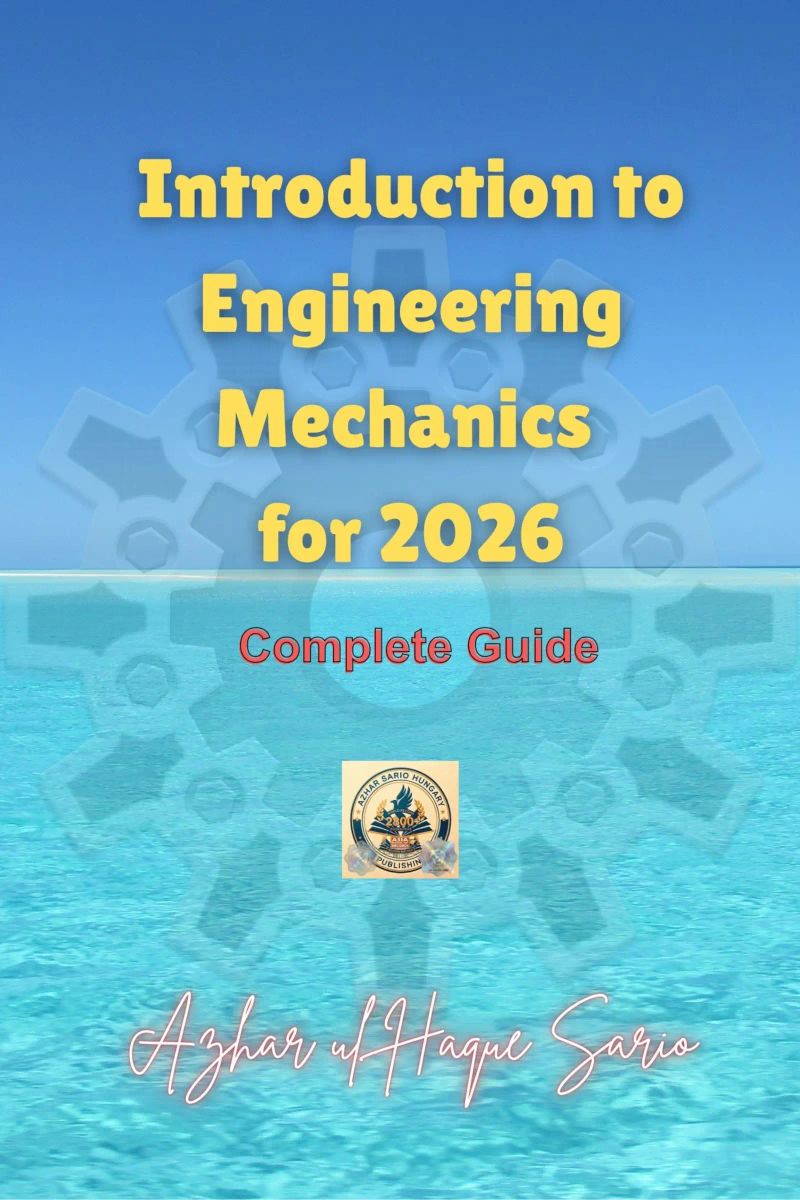
Introduction to Engineering Mechanics for 2026
Complete GuideBy Azhar ul Haque Sario


Length5h 41m
About this audiobook
Discover the profound shift from classical isolated component design to the breathtaking reality of sentient, cyber-physical engineering in the year 2026.
Have you ever wondered how a modern skyscraper breathes under the crushing weight of the world? Or how a digital twin predicts the exact moment a critical structure might fail? This book invites you to explore the invisible forces shaping our modern built environment. We leave behind the simple, flat diagrams of the past. Instead, we dive straight into the chaotic, living heart of modern mechanics. You will uncover the deep secrets of programmable matter and bio-inspired structures. What happens when synthetic materials are designed to heal themselves? How do we build autonomous robots that move with artificial grace? From massive subterranean storm vaults to the freezing vacuum of space, every chapter holds a new revelation. The ancient rules of mechanical survival have permanently changed. Are you ready to learn the new language of the physical universe?
Unlike traditional texts that focus entirely on outdated, isolated calculations, this complete guide delivers a radically holistic approach tailored specifically for the year 2026. It gracefully bridges the gap between majestic classical heritage and modern computational realities. Here, you gain cutting-edge insights into multiscale material science, circular economy paradigms, and state-of-the-art robotic kinematics. You will not just blindly memorize formulas; you will learn the algorithmic logic driving today's automated design software. By mastering these advanced 2026 applications, you gain an unparalleled competitive advantage in the field. This book fully equips you to design the hyper-efficient, sustainable infrastructure that our rapidly changing planet demands.
Azhar ul Haque Sario is a bestselling author, data scientist, and Cambridge alumnus with a profound background in business and analytics. He proudly holds the Asia Books of Records title for publishing an astounding 2,810 books in a single year. His vast expertise seamlessly connects rigorous academic theory with cutting-edge, real-world applications.
Copyright & Legal Disclaimer
This book is an independent educational publication produced under nominative fair use for educational and entertainment purposes only. The author and publisher assume no responsibility for contrary interpretations of the subject matter herein. All content is originally crafted to provide an independent study guide, ensuring no unauthorized use of artificial intelligence models for training or trademarked terms.
"Introduction to Engineering Mechanics" is a general term and it is not meant to be registered trademark of the respective engineering and academic boards. This publication is an independent study tool and is not affiliated with or endorsed by any academic board or institution.
Audiobook details
GenreScience and Nature, Technology
Length5 hrs 41 mins
Narrated byListen with 1,000+ voices
FormateBook with Audio
Publish dateApr 15, 2026
LanguageEnglish
Table of contents
1Part I: Theoretical Fundamentals and Algorithmic Statics
2Axioms of Static Equilibrium and Spatial Force Analysis
3Kinematics of Motion & Continuous Trajectories
4Algorithmic Structural Analysis and Topological Optimization
5Distributed Mass Systems and Inertial Tensors in Complex Geometries
Show all chaptersShow less
6Part II: Deformable Body Mechanics and Material Responses
7Stress, Strain, and Programmable Material Behavior
8Torsional Mechanics and Flexural Yielding
9Multiaxial Stress States and Predictive Failure Theories
10Particle Kinetics and High-Velocity Dynamics
11Part III: Advanced Dynamics, Variational Methods, and Computation
12Rigid Body Kinetics and Spatial Manipulation
13Variational Principles and Analytical Mechanics
14High-Fidelity Finite Element Methodologies
15Multiscale Modeling and Optical Strain Measurement
16Part IV: 2026 Engineering Applications and Circular Paradigms
17Circular Economy Mechanics and Eco-Design Integration
18Biomechanical Systems and Cellular Mechanics
19Digital Twin Mechanics and Cyber-Physical Infrastructure
20About Author & Publisher
Architecting ProficiencyAzhar ul Haque Sario3h 26m$7
Architecting the Digital FortressAzhar ul Haque Sario3h 27m$7
Forging Silicon LogicAzhar ul Haque Sario3h 22m$7

Artificial Intelligence Implications for Business Strategy for 2026Azhar ul Haque Sario4h 57m5.0 (1)$7

Teenage Psychology for 2026Azhar ul Haque Sario3h 17m$7
Introduction to Computer Science 2026Azhar ul Haque Sario3h 27m$7
Machine Learning Specialization 2026Azhar ul Haque Sario2h 56m$7
Thermodynamics and Propulsion 2026Azhar ul Haque Sario3h 32m$7

How Thinking Machines Build FutureAzhar ul Haque Sario5h 20m$8

Constitutional AI and Principle Aligned ArchitecturesAzhar ul Haque Sario5h 30m$8

Advanced Compute Architectures and Deep Learning AccelerationAzhar ul Haque Sario5h 31m$8
Grow Your Wealth MindsetAzhar ul Haque Sario5h 33m$7

Your Freedom the Invisible WealthAzhar ul Haque Sario5h 28m$7

Dental Anesthesia and Behavioral Pain Management in 2026Azhar ul Haque Sario5h 3m$7

Making Agreements Fair and AgileAzhar ul Haque Sario5h 29m$7

Think Beyond FearAzhar ul Haque Sario5h 45m$7

The Complete LawyerAzhar ul Haque Sario5h 41m$7
Evolution Directs TomorrowAzhar ul Haque Sario5h 41m$7

Master Your Mind in 2026Azhar ul Haque Sario5h 58m$7

A Brief History of IntelligenceMax S. Bennett12h 18m4.6 (6.6K)$29 · $0.00
The Story of BirdsSteve Brusatte11h 49m4.6 (401)$29 · $0.00

Life On Earth 40th Anniversary EditionSir David Attenborough12h 27m4.6 (6.5K)$29 · $0.00

BeyondStephen Walker15h 39m4.6 (3.2K)$33 · $0.00

LiftoffEric Berger9h 4m4.6 (9.5K)$29 · $0.00

Black Earth WisdomLeah Penniman11h 54m4.6 (577)$8 · $0.00

Total Cat MojoJackson Galaxy10h 13m4.5 (8.4K)$23 · $0.00

My Life Among the UnderdogsTia Torres5h 51m4.5 (4K)$24 · $0.00

What It Takes to Save a LifeKwane Stewart6h4.6 (556)$24 · $0.00

Pastoral SongJames Rebanks8h 35m4.5 (12K)$26 · $0.00

How Stella Learned to TalkChristina Hunger7h4.5 (10.9K)$24 · $0.00

Craig & FredCraig Grossi8h 6m4.5 (9.6K)$26 · $0.00

Celebrating BirdsNatalia Rojas, Ana Maria Martinez6h 47m4.6 (330)$24 · $0.00

Saving JemimaJulie Zickefoose4h 59m4.5 (749)$20 · $0.00

Will's Red CoatTom Ryan8h 23m4.5 (2.3K)$26 · $0.00

Of Time and TurtlesSy Montgomery10h 34m4.5 (5K)$29 · $0.00

Zen and the Art of Saving the PlanetThich Nhat Hanh9h 20m4.5 (3.9K)$29 · $0.00

BLACK BEAUTY (With Original Illustrations)Anna Sewell7h 31m4.5 (1.3K)$1.99 · $0.00

Bottle of LiesKatherine Eban14h 25m4.4 (12K)$33 · $0.00

IngrainedCallum Robinson8h 10m4.5 (1.1K)$26 · $0.00
LiftoffEric Berger9h 4m4.6 (9.5K)$29 · $0.00

The Honey BusMeredith May9h 31m4.4 (16.6K)$25 · $0.00

Collected Writings of Nikola TeslaThomas Commerford Martin, Nikola Tesla19h 42m4.4 (2.8K)$1.99 · $0.00

Operation PedestalMax Hastings12h 29m4.4 (5.2K)$29 · $0.00

When the Heavens Went on SaleAshlee Vance18h 20m4.4 (3K)$40 · $0.00

Everybody Has a Podcast (Except You)Justin McElroy, Travis McElroy, Griffin McElroy5h 9m4.3 (2.3K)$24 · $0.00

Hands of TimeRebecca Struthers8h 8m4.4 (1.3K)$26 · $0.00
Never Lost AgainBill Kilday10h 1m4.4 (805)$29 · $0.00

How the Internet HappenedBrian McCullough13h 28m4.3 (2.7K)$23 · $0.00

Collected Writings of Nikola TeslaNikola Tesla, Thomas Commerford Martin21h 50m4.3 (1.7K)$1 · $0.00
Just AspireAjai Chowdhry9h 13m4.4 (260)$29 · $0.00

The Little Book of AliensAdam Frank8h 20m4.3 (1.3K)$26 · $0.00

The inventions, researches and writings of Nikola Tesla (Annotated)Thomas Commerford Martin16h 59m4.3 (1.3K)$2 · $0.00

KargilV.P. Malik15h 18m4.3 (2K)$24 · $0.00
Experiments with Alternating CurrentsNikola Tesla9h 16m4.3 (874)$1.99 · $0.00

Fire on the HorizonTom Shroder, John Konrad8h 23m4.3 (858)$26 · $0.00

The Smell of Kerosene (Annotated)National Aeronautics and Space Administration, Donald L. Mallick, Peter W. Merlin11h 32m4.3 (523)$2 · $0.00

The Boy Who Harnessed the WindWilliam Kamkwamba, Bryan Mealer10h 5m4.2 (78.9K)$29 · $0.00

Across the Airless WildsEarl Swift10h 8m4.3 (1.3K)$29 · $0.00

Console WarsBlake J. Harris20h 41m4.2 (13.7K)$46 · $0.00