
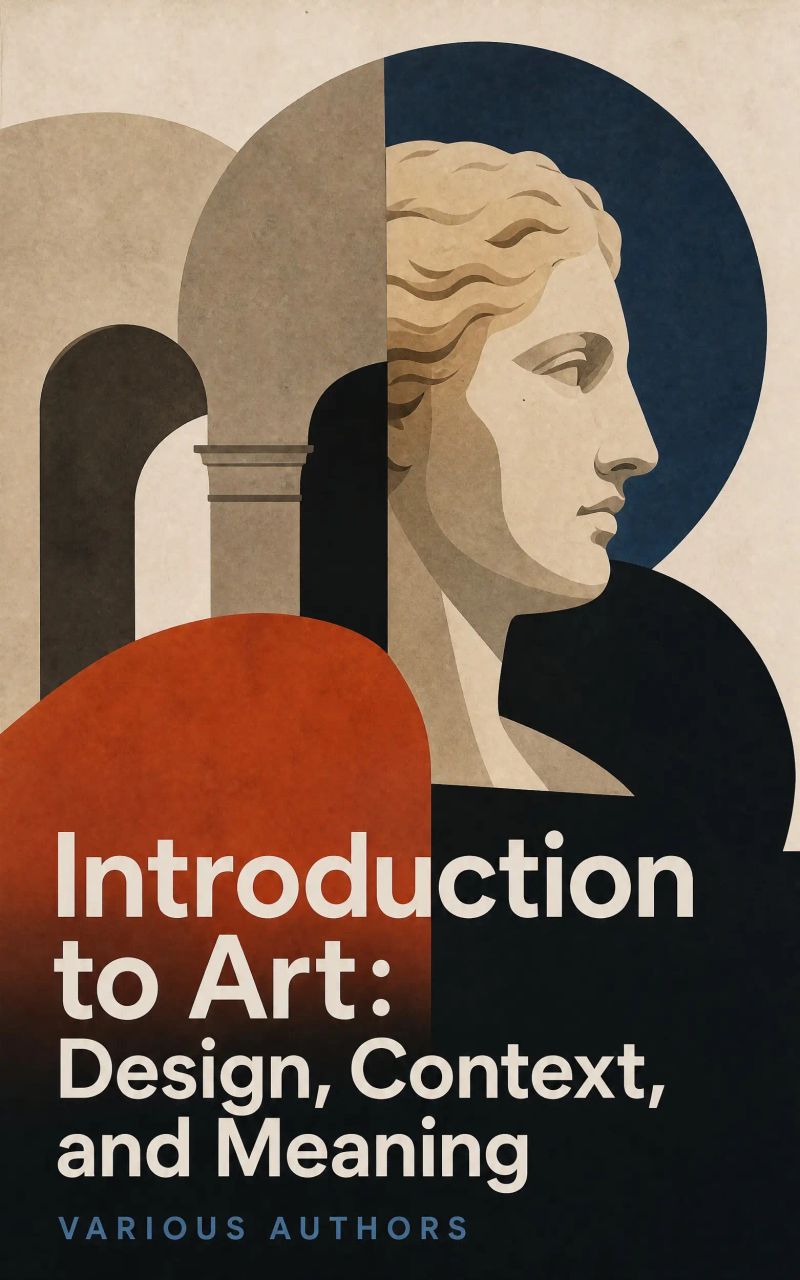
Introduction to Art: Design, Context, and Meaning
A Global Guide to Visual Culture, Design Principles, and Art in Cultural ContextBy Pamela Sachant, Peggy Blood, Jeffery LeMieux, Rita Tekippe


Length12h 37m
About this audiobook
Introduction to Art: Design, Context, and Meaning offers a capacious, visually attentive approach to the study of art, joining formal analysis with historical inquiry and cultural interpretation. Across discussions of line, color, space, media, and visual organization, the volume moves beyond the isolated masterpiece to consider how artworks acquire significance through makers, audiences, institutions, and social contexts. Its accessible critical vocabulary and broad range of examples make it a valuable entry point into the many styles, periods, and purposes of artistic production. Developed by Pamela Sachant, Peggy Blood, Jeffery LeMieux, and Rita Tekippe, the book reflects a collaborative pedagogical commitment to art history as both a discipline and a practice of looking. Their combined approach situates design principles alongside questions of patronage, identity, belief, technology, and cultural exchange. In doing so, the volume aligns with contemporary interdisciplinary art-historical teaching, which treats visual culture as a dynamic record of human experience rather than a fixed canon of objects. This is an especially rewarding resource for students and general readers seeking multiple ways to encounter art within one volume. It encourages close observation while furnishing the historical and conceptual tools needed to interpret what one sees. Readers will find in its breadth an education in visual literacy and a sustained dialogue between form, context, and meaning.
Audiobook details
Rating★★★★ 3.8 (25)
Includes Goodreads
GenreOther
Length12 hrs 37 mins
Narrated byListen with 1,000+ voices
FormateBook with Audio
Publish dateDec 18, 2023
LanguageEnglish
Table of contents
1The History of Painting in Italy (Annotated)
21.1 LEARNING OUTCOMES
31.2 INTRODUCTION
41.3 WHAT IS VISUAL ART?
51.4 WHO IS CONSIDERED AN ARTIST? WHAT DOES IT MEAN TO BE AN ARTIST?
Show all chaptersShow less
61.5 THE ROLE OF THE VIEWER
71.6 WHY DO WE MAKE ART?
81.7 CONCEPTS EXPLORED IN LATER CHAPTERS
91.9 KEY TERMS
102.1 LEARNING OUTCOMES
112.2 INTRODUCTION
122.3 ART SPECIFIC VOCABULARY
132.4 ART FORMS
142.5 FORM AND COMPOSITION
152.6 BEFORE YOU MOVE ON
162.7 KEY TERMS
173.1 LEARNING OUTCOMES
183.2 INTRODUCTION
193.3 UTILITY AND VALUE OF MATERIALS
203.4 PRECIOUS MATERIALS, SPOLIA, AND BORROWED GLORY
213.5 LIQUIDATION OF TREASURES
223.6 WOOD, INLAY, AND LACQUER
233.7 INTRINSIC VALUES AND ENHANCED WORTH OF METALS
243.8 RARE MATERIALS AND PROHIBITED USES
253.9 MATERIAL CONNOTATIONS OF CLASS OR STATION
263.10 BEFORE YOU MOVE ON
273.11 KEY TERMS
284.1 LEARNING OUTCOMES
294.2 INTRODUCTION
304.3 FORMAL OR CRITICAL ANALYSIS
314.4 TYPES OF ART
324.5 STYLES OF ART
334.6 BEFORE YOU MOVE ON
344.7 KEY TERMS
355.1 LEARNING OUTCOMES
365.2 INTRODUCTION
375.3 SOCIO-CULTURAL CONTEXTS
385.4 SYMBOLISM AND ICONOGRAPHY
395.5 BEFORE YOU MOVE ON
405.6 KEY TERMS
416.1 LEARNING OUTCOMES
426.2 INTRODUCTION
436.3 AESTHETICS
446.4 EXPRESSION (PHILOSOPHICAL, POLITICAL, RELIGIOUS, PERSONAL)
456.6 COMMUNICATION
466.7 PROTEST AND SHOCK
476.8 CELEBRATION AND COMMEMORATION
486.9 WORSHIP
496.10 INFORMATION, EDUCATION, AND INSPIRATION
506.11 BEFORE YOU MOVE ON
More from Pamela Sachant, Peggy Blood, Jeffery LeMieux, Rita Tekippe
Mere ChristianityC. S. Lewis7h 7m4.4 (519.7K)$24 · $0.00

Her Daily BreadKate Wood12h 57m4.6 (153)$33 · $0.00
The Holy Bible - 1 SamuelKing James2h 13m4.8 (1.6K)$3 · $0.00

The American Standard Bible — The Gospel of MatthewMatthew3h 56m4.7 (3K)$2 · $0.00

Bad Fat Black GirlSesali Bowen6h 32m4.7 (2.8K)$24 · $0.00
The King James Audio Bible New Testament CompleteChristopher Glyn20h 2m4.7 (2.6K)$12 · $0.00

Faiths CheckbookCharles Spurgeon12h 44m4.7 (3.2K)$11 · $0.00

Ten Things I Wish You Knew About Your Child's Mental HealthDr. Billy Garvey4h 53m4.7 (2.4K)$20 · $0.00

Designing Terry Pratchett’s DiscworldPaul Kidby3h 52m4.7 (343)$20 · $0.00
The Chosen Book OneAmanda Jenkins, Kristen Hendricks, Dallas Jenkins3h 8m4.6 (4.9K)$10 · $0.00
The Lives of BrianBrian Johnson9h 45m4.6 (3.5K)$29 · $0.00
Expository Thoughts on the Gospel of LukeJ.C. Ryle27h 13m4.7 (536)$18 · $0.00

CrossroadsKaleb Dahlgren7h 56m4.6 (4.9K)$26 · $0.00

Across the RiverKent Babb11h 40m4.6 (927)$29 · $0.00

Brain Training for RidersAndrea Monsarrat Waldo5h 56m4.7 (550)$19 · $0.00

My Effin' LifeGeddy Lee17h 11m4.6 (13.1K)$40 · $0.00

Kings and PawnsHoward Bryant10h 9m4.6 (678)$29 · $0.00

The Elementia Chronicles #2: The New OrderSean Fay Wolfe11h 17m4.6 (841)$29 · $0.00
The ActsLuke2h 55m4.6 (19.7K)$12 · $0.00

New Testament - Easy NavigationWorld English Bible19h 35m4.6 (1.3K)$1.30 · $0.00
You may also like

The World as Will and Idea (Vol. 1-3)Arthur Schopenhauer56h 21m4.3 (2K)$2 · $0.00

English TraitsRalph Waldo Emerson7h 2m3.8 (1K)$21 · $0.00
Beyond Good and EvilFriedrich Nietzsche8h 10m4.2 (136.2K)$17

After BuddhismStephen Batchelor17h 39m4.3 (1.5K)$23
The Joys Of CompoundingGautam Baid17h 34m4.5 (2.5K)$18 · $0.00

Groundwork of the Metaphysics of MoralsImmanuel Kant4h 28m4.0 (28.5K)$1 · $0.00
The Critique of Practical ReasonImmanuel Kant8h 28m4.1 (13.8K)$1.99 · $0.00
The Critique of Practical ReasonImmanuel Kant6h 52m4.2 (14.9K)$3.50 · $0.00

Kant's Three CritiquesImmanuel Kant47h 6m4.3 (1.3K)$2 · $0.00

Fundamental Principles of the Metaphysic of MoralsImmanuel Kant3h 21m4.0 (24.5K)$0.60 · $0.00

EXPERIENCE AND EDUCATION – Premium Edition (Including Democracy & Education) (Annotated)John Dewey19h 17m4.6 (1K)$2 · $0.00

SiddharthaHermann Hesse4h 12m4.2 (1M)$1.20 · $0.00

The Genealogy of MoralsFriedrich Nietzsche5h 43m4.3 (84.3K)$12

Several Short Sentences about WritingVerlyn Klinkenborg4h 26m4.0 (6.6K)$15

Styles of Radical WillSusan Sontag10h4.1 (4.8K)$20 · $0.00

Fascinate, Revised and UpdatedSally Hogshead7h 40m4.1 (1.1K)$26 · $0.00

Rules for the Direction of the MindRené Descartes1h 15m3.9 (904)$1 · $0.00

Children Want to WriteThomas Newkirk, Penny Kittle8h 14m4.5 (141)$23

Duality of VoiceEmil Sutro6h 2m$2 · $0.00
LSDRichard Alpert, PhD, a.k.a. Ram Dass, Sidney Cohen MD, Lawrence Schiller5h 22m4.1 (165)$17 · $0.00