
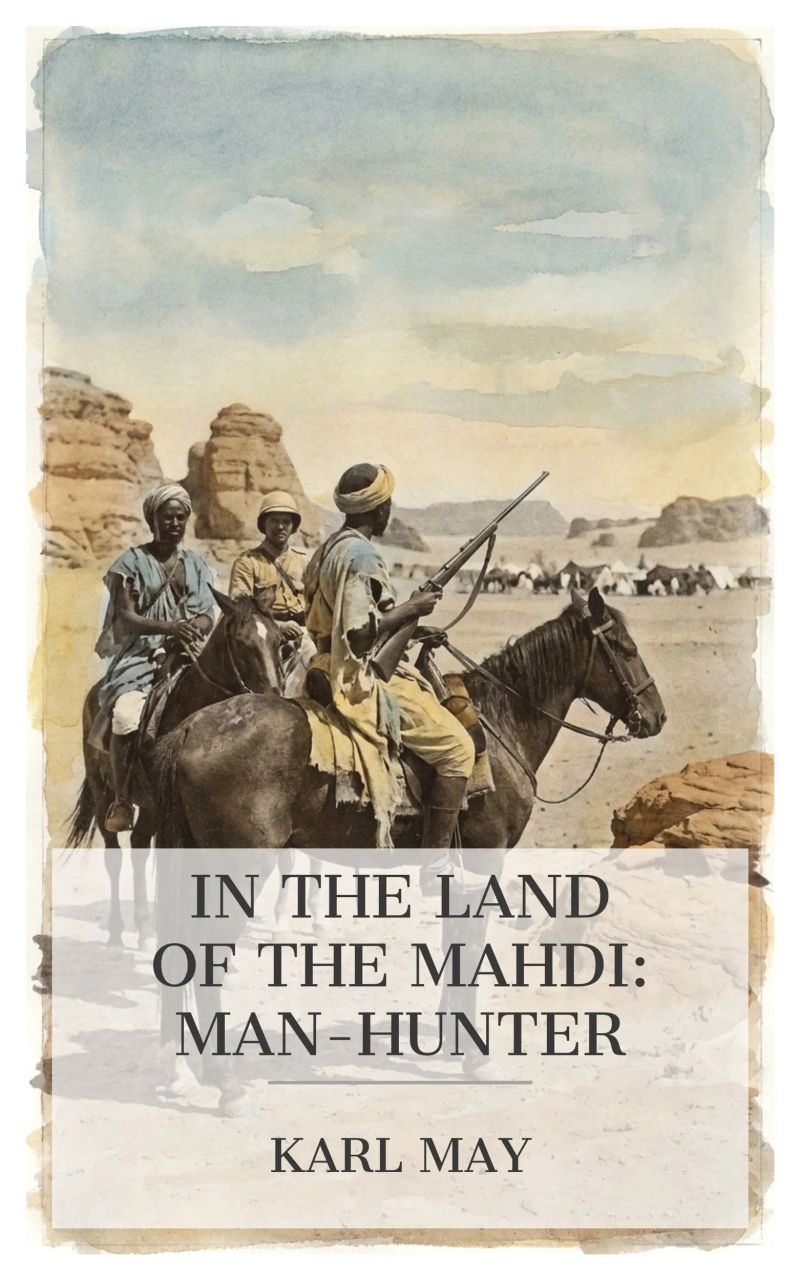
In the Land of the Mahdi: Man-Hunter
Adventure Classic of Frontier Pursuit, Conflict, and ExplorationBy Karl May

Length18h 20m
About this audiobook
In the Land of the Mahdi: Man-Hunter is Karl May's adventure novel set against the upheavals of the Mahdist Sudan, where pursuit, captivity, and imperial conflict shape a narrative of danger and moral testing. Written in May's characteristic mode of exotic travel fiction, the book combines brisk action, picturesque geography, and ethnographic detail—often filtered through the imaginative conventions of late nineteenth-century German popular literature. As part of the larger Mahdi cycle, it reflects European fascination with North Africa and the Islamic world while dramatizing themes of endurance, loyalty, and the contest between civilization and violence. Karl May (1842–1912) was one of the most widely read German-language adventure writers of his age, celebrated for tales of distant lands he often described before visiting them himself. His difficult early life, including poverty, imprisonment, and social marginality, helped shape his attraction to reinvention, heroism, and redemption. These impulses animate Man-Hunter, where perilous landscapes become stages for ethical struggle and imaginative escape. This book is especially recommended for readers interested in colonial-era adventure fiction, German literary popular culture, and the afterlife of nineteenth-century Orientalism. Though it invites critical historical reading, it remains an engrossing example of May's narrative energy and mythmaking power.
Audiobook details
Rating★★★★ 3.7 (231)
Includes Goodreads, LibraryThing
GenreAction and Adventure, Historical Fiction
Length18 hrs 20 mins
Narrated byListen with 1,000+ voices
FormateBook with Audio
Publish dateMay 20, 2026
LanguageEnglish
Table of contents
1Introduction
10Underground (pt. 1)
2ChapterOne
11Underground (pt. 2)
3AChajjal (pt. 1)
12ChapterFive
4AChajjal (pt. 2)
13IntheDesert (pt. 1)
5ChapterTwo
14IntheDesert (pt. 2)
Show all chaptersShow less
6TheReïsEffendina
15ChapterSix
7ChapterThree
16TheSlaves (pt. 1)
8InSiut
17TheSlaves (pt. 2)
9ChapterFour

Winnetou IKarl May17h 56m4.3 (17.5K)$18 · $0.00

Orangen und DattelnKarl May20h 40m4.1 (273)$1 · $0.00

Am Stillen Ocean: AbenteuerromanKarl May18h 43m4.2 (886)$1 · $0.00

Winnetou (4 Bücher in einem Band)Karl May81h 30m4.4 (4.3K)$1 · $0.00

Die besten Western-Romane aller ZeitenKarl May, James Fenimore Cooper, Jack London, Charles Sealsfield, Franz Treller, Walther Kabel, Friedrich Gerstäcker, Balduin Möllhausen, Max Brand, Bret Harte, Ann Stephens924h 37m4.3 (12)$1 · $0.00

JugenderzählungenKarl May61h 11m4.2 (25)$1 · $0.00

Im Lande des MahdiKarl May57h 24m4.0 (362)$1 · $0.00

In den Schluchten des BalkanKarl May21h 19m4.1 (637)$1 · $0.00

HimmelsgedankenKarl May3h 52m4.0 (122)$1 · $0.00

Weihnacht! (Abenteuerroman zur schönsten Zeit des Jahres)Karl May21h 50m3.9 (710)$1 · $0.00

Deutsche Herzen - Deutsche HeldenKarl May133h 49m4.1 (781)$1 · $0.00

Satan und IschariotKarl May57h 4m4.3 (496)$2 · $0.00

Der Schatz im SilberseeKarl May24h 20m4.2 (5.5K)$1 · $0.00

Von Bagdad nach StambulKarl May15h 54m4.2 (982)$12 · $0.00

Durchs wilde KurdistanKarl May14h 59m4.0 (2.7K)$12 · $0.00

Durch die WüsteKarl May14h 48m4.1 (2.4K)$12 · $0.00

Der Schatz im SilberseeKarl May27h 9m4.2 (5.2K)$15 · $0.00

Deutsche Herzen - Deutsche Helden (Kommentiert)Karl May138h 24m$1 · $0.00

Weihnachten im Wilden Westen - SammelbandKarl May, Max Brand, James Fenimore Cooper, Charles Sealsfield, Jack London, Franz Treller, Walther Kabel, Friedrich Gerstäcker, Balduin Möllhausen, Bret Harte, Charly Kraft, Friedrich Strubberg972h 59m4.1 (16)$1 · $0.00

50 WESTERNS (Vol. 1)Karl May, James Fenimore Cooper, Max Brand, James Oliver Curwood, B. M. Bower, Zane Grey, Jackson Gregory, Jack London, Edgar Rice Burroughs, Emerson Hough, Andy Adams, Bret Harte, Owen Wister, O. Henry, Grace Livingston Hill, Charles Alden Seltzer, Dane Coolidge, Frederic Homer Balch, Frederic Remington, Robert W. Chambers, Frank H. Spearman, J. Allan Dunn, Robert E. Howard, Ernest Haycox, Charles Siringo468h 46m4.3 (11)$2.99 · $0.00

Scaramouche (Annotated)Rafael Sabatini15h 24m4.6 (1.8K)$2 · $0.00

Jubal Stone: U.S. Marshal: Blood Trail To Hell: A Western Adventure NovelCasey Nash3h 42m4.6 (3.2K)$18 · $0.00

The Labyrinth of the SpiritsCarlos Ruiz Zafon27h 55m4.5 (77.2K)$53 · $0.00

Ship of the Line (Annotated)Cecil Louis Troughton Smith11h 13m4.6 (1K)$2 · $0.00
The Road to Gundagai (The Matilda Saga, #3)Jackie French12h 31m4.6 (1.2K)$33 · $0.00
TimelessR. A. Salvatore12h 30m4.5 (8K)$33 · $0.00

An Inside JobDaniel Silva9h 28m4.4 (26.3K)$29 · $0.00

The CommodoreP. T. Deutermann11h 53m4.5 (2.4K)$20 · $0.00

A Closed and Common OrbitBecky Chambers11h 30m4.4 (140.7K)$29 · $0.00

Thud!Terry Pratchett10h 31m4.4 (112.6K)$8 · $0.00

All Quiet on the Western Front (Annotated)Erich Maria Remarque8h 34m4.4 (12.9K)$1.99 · $0.00

Crime and punishmentFyodor Dostoevsky22h 34m4.4 (1.3M)$3 · $0.00

Exit FeeBrad Taylor3h 16m4.5 (1.9K)$18 · $0.00

The Alice NetworkKate Quinn15h 7m4.4 (887.1K)$33 · $0.00

The Ohio River Trilogy: Betty Zane, The Spirit of the Border & The Last TrailZane Grey29h 8m4.4 (1.8K)$1 · $0.00

A Darkness ReturnsRaymond E. Feist19h 29m4.4 (1.9K)$40 · $0.00

THE VALLEY OF SILENT MEN (Annotated)James Oliver Curwood8h 25m4.5 (420)$2 · $0.00

West of the TularosaLouis L’Amour5h 53m4.4 (3.6K)$20 · $0.00

The Emperor's FistJay Allan8h 37m4.5 (272)$26 · $0.00

The Amazing Interlude (Annotated)Mary Roberts Rinehart8h 42m4.5 (365)$1.99 · $0.00
The Labyrinth of the SpiritsCarlos Ruiz Zafon27h 55m4.5 (77.2K)$53 · $0.00

The Things We Cannot SayKelly Rimmer13h 48m4.5 (359.1K)$33 · $0.00

Lieutenant Hornblower (Annotated)C. S. Forester11h 41m4.5 (2.9K)$2 · $0.00

Rilla of InglesideLucy Maud Montgomery11h 44m4.5 (48.2K)$2 · $0.00

The Viennese DressmakerKathryn Gauci11h 46m4.5 (2.1K)$23 · $0.00

The Man in the Brown Suit & They Came to BaghdadAgatha Christie15h 43m4.6 (495)$33 · $0.00

Under the Light of the Italian MoonJennifer Anton12h 28m4.5 (5.3K)$23 · $0.00

Jubilee, 50th Anniversary EditionMargaret Walker15h 43m4.5 (9.5K)$25 · $0.00

Pride and PrejudiceJane Austen14h 44m4.4 (4.7M)$2 · $0.00

Flying Colours (Annotated)Cecil Louis Troughton Smith9h 26m4.4 (10.1K)$2 · $0.00

With Love from HarlemReShonda Tate13h 48m4.5 (2K)$6 · $0.00

Sweet Home Highland ChristmasMay McGoldrick, Jan Coffey2h 54m4.5 (1.4K)$7 · $0.00

Rilla of InglesideL. M. Montgomery12h 25m4.4 (67.5K)$2 · $0.00

Death Comes for the Archbishop (Annotated)Willa Cather9h 13m4.4 (4.7K)$2 · $0.00
The Alice NetworkKate Quinn15h 7m4.4 (887.1K)$33 · $0.00

The Goddess of WarsawLisa Barr13h 4m4.4 (36.4K)$33 · $0.00
The Ohio River Trilogy: Betty Zane, The Spirit of the Border & The Last TrailZane Grey29h 8m4.4 (1.8K)$1 · $0.00

The Attic ChildLola Jaye14h 46m4.4 (21K)$33 · $0.00

Martyr of the CatacombsJames De Mille3h 41m4.5 (744)$1 · $0.00

Quo VadisHenryk Sienkiewicz22h 52m4.4 (62K)$21 · $0.00
You may also like

The Treasure of Silver LakeKarl May22h 2m4.3 (3.6K)$1 · $0.00

A Man Called TrentLouis L’Amour9h 48m4.3 (2.4K)$20

My Six Years with the Texas RangersJames B. Gillett7h 35m4.2 (1.7K)$1 · $0.00

My Six Years with the Texas RangersJames B. Gillett7h 35m4.2 (1.6K)$2 · $0.00

Six Years With the Texas Rangers: 1875 to 1881James B. Gillett7h 39m4.4 (1.3K)$1 · $0.00

Six Years With the Texas RangersJames B. Gillett7h 34m4.2 (2.3K)$2 · $0.00

By Force of ArmsJames L. Nelson10h 15m4.2 (1.2K)$20

Across the Río BravoR. W. Stone5h 20m4.1 (26)$17

Gypsies of the AirBess Moyer2h 27m$1 · $0.00

THE THIRD OFFICER (Annotated)Percy F. Westerman9h 59m$1.99 · $0.00

The Bible in SpainGeorge Borrow22h 21m3.9 (787)$1 · $0.00

Adventures of Big-Foot Wallace (Illustrated Edition) (Annotated)John Crittenden Duval8h 56m3.9 (915)$2 · $0.00

Kid Wolf of TexasPaul S. Powers7h3.7 (216)$2.30

The Cruise of the Midge (Annotated)Michael Scott24h 25m$2 · $0.00
The Coming of CassidyClarence E. Mulford8h 26m4.1 (104)$1 · $0.00

The Coral Island & The Gorilla Hunters (Annotated)R. M. Ballantyne21h 19m$2 · $0.00

THE BAR-20 TRILOGY - Complete Western Series: Bar-20 + Bar-20 Days + The Bar-20 ThreeClarence Mulford25h 20m4.1 (127)$2 · $0.00

The Hero of Panama: A Tale of the Great CanalF. S. Brereton9h 46m$2 · $0.00

In the Land of the Mahdi: The MahdiKarl May16h 57m4.0 (307)$2 · $0.00

Motor Matt's Make-and-Break; or, Advancing the Spark of FriendshipStanley R. Matthews2h 43m$2 · $0.00