
Greek art
The Birthplace of Beauty and Classical IdealsBy Elie Faure, Klaus H. Carl


Length1h 44m
About this audiobook
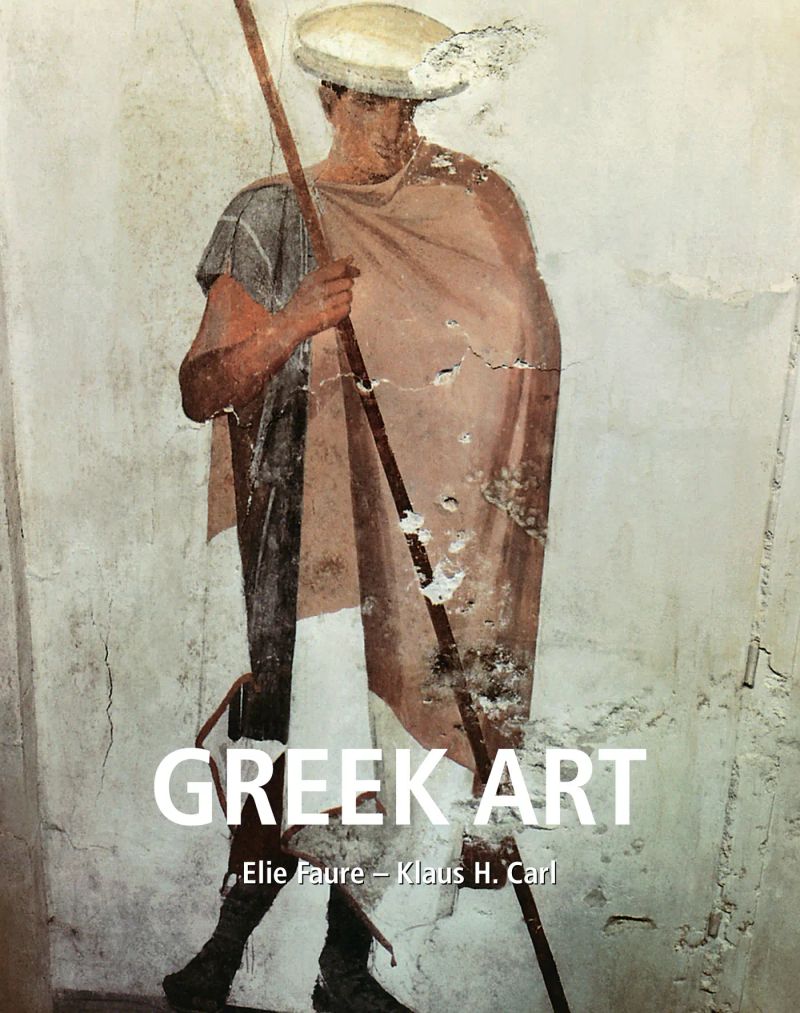
Greek art, at the very moment that it was breaking up in depth, was scattering over the whole material surface of Hellenic antiquity. After the movement of concentration that had brought to Athens all the forces of Hellenism, a movement of dispersal began, which was to carry from Athens to southern Italy, to Sicily, to Cyrenaica, Egypt, the Islands, and Asia Minor the passion and, unfortunately, the mania, for beautiful things—in default of creative genius. Dilettantism and the diffusion of taste multiply and at the same time weaken talent. It is the Hellenistic period, perhaps the richest in artists and in works of art that history has to show, but possibly, also, one of the poorest in power of emotion.
The ideal of the Greek is wisdom. He also has a strong feeling for what is just, but what is beautiful and what is true is to the same degree the object of his passion. He finds in each of these ideas the echoes of the other two, and completes, tempers, and broadens each one through the others. Phidias is in Pythagoras, and Socrates is in Phidias.
The “Greek miracle” was necessary. The whole ancient world had prepared, had willed its coming. During the fruitful silence when the Dorians were “accumulating within themselves the strength of their soil, Egypt and Assyria kept their lead. But they were discouraged and stricken by the cold of age. They were to become the initiators of the Hellenic Renaissance, as they had been the guides for the childhood of the peoples of the Archipelago. Greek Art, the perfume of the Greek soul, is preserved until our time, through Pompeii.
Audiobook details
GenreOther
Length1 hr 44 mins
Narrated byListen with 1,000+ voices
FormateBook with Audio
LanguageEnglish
Table of contents
1Introduction
8The Apollonian Myth
2Introduction
9The Hellenistic Period
3The Sources of Greek Art
10Phidias (c. 480 – 430 BC)
4The Dorians
11The Parthenon
5Dorian Art and Architecture
12The Dusk of Mankind
Show all chaptersShow less
6The Hera of Samos
13Praxiteles (c. 400 – before 326 B. C.)
7The Ionians
14The Gods Have Deserted the Souls of the Artists
Series
More from Elie Faure, Klaus H. Carl
Explorez la richesse de Histoire de l'art de l'Egypte ancienneElie Faure, Victoria Charles1h 23m$13 · $0.00
L’art grecElie Faure, Klaus H. Carl1h 22m4.0 (16)$13 · $0.00
Memory of Empires: Ancient Egypt - Ancient Greece - Persian Empire - Roman Empire - Byzantine EmpireElie Faure, Victoria Charles7h 6m$19 · $0.00

Paul CézanneElie Faure2h 38m$16 · $0.00
Mere ChristianityC. S. Lewis7h 7m4.4 (519.7K)$24 · $0.00

Her Daily BreadKate Wood12h 57m4.6 (153)$33 · $0.00
The Holy Bible - 1 SamuelKing James2h 13m4.8 (1.6K)$3 · $0.00

The American Standard Bible — The Gospel of MatthewMatthew3h 56m4.7 (3K)$2 · $0.00

Bad Fat Black GirlSesali Bowen6h 32m4.7 (2.8K)$24 · $0.00
The King James Audio Bible New Testament CompleteChristopher Glyn20h 2m4.7 (2.6K)$12 · $0.00

Faiths CheckbookCharles Spurgeon12h 44m4.7 (3.2K)$11 · $0.00

Ten Things I Wish You Knew About Your Child's Mental HealthDr. Billy Garvey4h 53m4.7 (2.4K)$20 · $0.00

Designing Terry Pratchett’s DiscworldPaul Kidby3h 52m4.7 (343)$20 · $0.00
The Chosen Book OneAmanda Jenkins, Kristen Hendricks, Dallas Jenkins3h 8m4.6 (4.9K)$10 · $0.00

The Lives of BrianBrian Johnson9h 45m4.6 (3.5K)$29 · $0.00
Expository Thoughts on the Gospel of LukeJ.C. Ryle27h 13m4.7 (536)$18 · $0.00

CrossroadsKaleb Dahlgren7h 56m4.6 (4.9K)$26 · $0.00

Across the RiverKent Babb11h 40m4.6 (927)$29 · $0.00

Brain Training for RidersAndrea Monsarrat Waldo5h 56m4.7 (550)$19 · $0.00

My Effin' LifeGeddy Lee17h 11m4.6 (13.1K)$40 · $0.00

Kings and PawnsHoward Bryant10h 9m4.6 (678)$29 · $0.00

The Elementia Chronicles #2: The New OrderSean Fay Wolfe11h 17m4.6 (841)$29 · $0.00

The ActsLuke2h 55m4.6 (19.7K)$12 · $0.00

New Testament - Easy NavigationWorld English Bible19h 35m4.6 (1.3K)$1.30 · $0.00
You may also like

The Outline of HistoryH. G. Wells44h 31m4.0 (6.4K)$40
The Life of GreeceWill Durant32h 34m4.4 (5.6K)$30

The Song Celestial or Bhagavad-Gita (Annotated)Edwin Arnold3h 10m4.3 (3.6K)$1.99 · $0.00

A Selection from the Discourses of Epictetus with the EncheiridionEpictetus5h 12m4.2 (599)$2 · $0.00
SymposiumPlato1h 34m4.2 (115.7K)$2.99 · $0.00

The God Who Is ThereD. A. Carson10h 2m4.4 (2.9K)$17
The RepublicPlato13h 29m4.1 (263.7K)$21 · $0.00
SymposiumPlato4h 52m4.2 (110.7K)$1 · $0.00
Sadhana, the Realisation of LifeRabindranath Tagore3h 26m4.4 (6.1K)$16 · $0.00

The Song Celestial or Bhagavad-Gita: Discourse Between Arjuna, Prince of India, and the Supreme Being Under the Form of KrishnaEdwin Arnold3h 4m4.3 (1.9K)$1 · $0.00

Manifest Your DestinyWayne W. Dyer2h 34m4.4 (4.4K)$18 · $0.00
History of the Phoenician CivilizationGeorge Rawlinson16h 50m3.8 (134)$1 · $0.00

Esto perpetua : Algerian studies and impressionsHilaire Belloc3h 10m$1 · $0.00

Raphael - Volume 2Eugène Müntz3h 22m$18 · $0.00

History of the Phoenician CivilizationGeorge Rawlinson17h 29m3.6 (89)$1 · $0.00
Peter Paul RubensMaria Varshavskaya, Xenia Yegorova3h 19m4.0 (28)$16 · $0.00

A Beginner's History of Philosophy, Vol. 1: Ancient and Mediæval PhilosophyHerbert Ernest Cushman12h 29m3.9 (25)$2 · $0.00

Religious Tourism and Sustainability in the MENA RegionAntonio Angelucci, Flavia Cortelezzi, Alessandro Cupri11h 55m$14 · $0.00
Homer and Hesiod: The Foundations of Ancient Greek LiteratureGilbert Murray, Homer, Hesiod32h 7m$1 · $0.00
The Book of Ancient GreeksDorothy Mills11h 13m4.1 (248)$2.30